

How to Read a COA
AT A GLANCE
reading time 6-7 minutes
You’ll Learn
- What a Certificate of Analysis (COA) is
- Why lot and batch numbers matter
- How to confirm a COA corresponds to the material being evaluated
- How to interpret testing and report dates
- How to identify the laboratory that performed the analysis
- The difference between a test method, specification, and result
- How to interpret purity and other reported test results
- What a COA can — and cannot — establish
- Common red flags to watch for when reviewing a COA
- A simple checklist for evaluating a COA
What Is a Certificate of Analysis?
A Certificate of Analysis, often called a COA, is a laboratory document that summarizes the results of analytical testing performed on a specific sample or batch of material.
Think of it as a report card for that batch.
Rather than simply stating that a material meets certain standards, a COA documents what was tested, how it was tested, and what the laboratory found. Depending on the analysis performed, it may report information such as identity, purity, moisture content, sterility, endotoxin levels, or other measured characteristics.
A well-prepared COA also provides important traceability information—including the product or sample identification, lot or batch number, testing dates, analytical methods, and laboratory information—so the reported results can be connected to the material being evaluated.
🔬 RESEARCH NOTE
A COA only provides information about the tests that were actually performed. A result for one characteristic—such as purity—should not be interpreted as evidence for a different characteristic that was not tested.
Why Does Every Batch Have Its Own COA?
Not every batch of a compound is identical.
Even when the same manufacturing process is followed, each production run is assigned its own batch or lot number. Batch-specific testing allows analytical results to be traced back to the particular material that was sampled and tested.
That’s why the lot or batch number shown on a COA should correspond to the lot number printed on the product being evaluated.
If those numbers do not match, the COA may describe a different production run—and its results cannot automatically be assumed to apply to the material in front of you.
📊 READING THE DATA
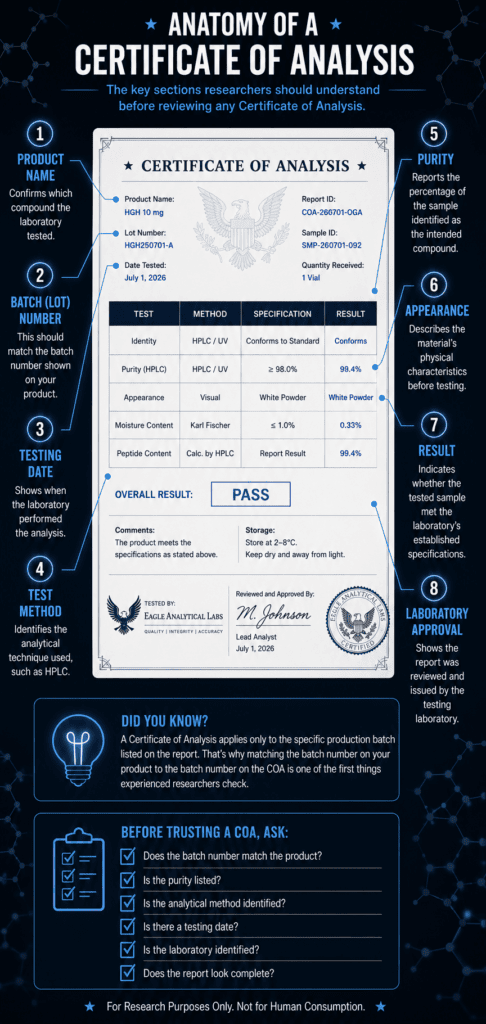
When reviewing a COA, compare the product name, lot or batch number, and any available sample or report identifiers with the material and documentation you received. These identifiers form the basic traceability chain between the laboratory report and the tested batch.
⚠️ IMPORTANT DISTINCTION
A matching lot number connects the COA to a reported production batch, but it does not mean that every individual vial or container from that batch was separately tested. Analytical testing is generally performed on a sample representing the batch, and the COA reports the results obtained from that sample.
The Most Important Sections of a COA
Although Certificates of Analysis vary between laboratories, most well-documented reports contain several core pieces of information. Learning what each section means—and how the sections relate to one another—is the key to reading a COA correctly.
Product Identification
Before looking at purity percentages or test results, first confirm what the laboratory actually tested.
Look for information such as:
- Product or compound name
- Lot or batch number
- Sample identification number
- Report or certificate number
- Quantity or sample description, when provided
These identifiers establish the connection between the laboratory report and the material represented by that report.
A compound name alone isn’t enough. Two COAs may list the same compound while representing completely different production batches.
Dates provide another important piece of the traceability puzzle.
Depending on the laboratory, a COA may include several different dates, such as:
- Sample received date
- Testing or analysis date
- Report or issue date
- Review or approval date
These dates don’t necessarily represent the same event.
The testing date indicates when the analytical work was performed, while the report date generally indicates when the laboratory issued or finalized the results.
🔬 RESEARCH NOTE
Don’t assume that the newest date appearing on a COA is the date the sample was tested. Look at the label attached to each date to understand what event it represents.
Laboratory Identification
A COA should clearly identify the laboratory responsible for the reported analysis.
Depending on the laboratory and report format, this may include the laboratory name, contact information, report number, analyst or reviewer, approval information, or other identifying details.
This information helps establish who performed and reported the testing and provides another point of traceability when reviewing the document.
A COA with impressive numbers but no clear indication of who generated those numbers leaves an important piece of the analytical record missing.
⚠️ IMPORTANT DISTINCTION
Identifying the laboratory does not, by itself, establish the quality or reliability of the testing. Laboratory identity, analytical methods, documentation, and the reported data should be considered together.
Method vs. Specification vs. Result
These terms often appear close together on a COA, but they describe three different things.
Method tells you how the sample was analyzed.
Examples may include HPLC, mass spectrometry, Karl Fischer titration, microbial testing, or other analytical techniques.
Specification tells you the predefined acceptance criterion or target for that particular test.
For example, a purity specification might be listed as ≥98.0%.
Result tells you what the laboratory actually measured or observed when the sample was tested.
For example, the reported purity result might be 99.4%.
So a COA might show:
TEST: Purity
METHOD: HPLC
SPECIFICATION: ≥98.0%
RESULT: 99.4%
In this example, HPLC is the analytical method, ≥98.0% is the acceptance specification, and 99.4% is the measured result.
📊 READING THE DATA
Don’t mistake the specification for the laboratory result. A specification tells you what the material is expected or required to meet; the result tells you what was actually reported from the analysis.
Not Every COA Uses the Same Format
Some COAs clearly separate test, method, specification, and result into individual columns. Others may combine information, use different terminology, or provide analytical methods elsewhere in the report.
You may also encounter terms such as acceptance criteria, limits, reference standards, or requirements in place of “specification.”
The exact layout matters less than understanding what each piece of information represents.
🔬 RESEARCH NOTE
A reported result is only meaningful in the context of the test used to generate it. Different analytical methods answer different scientific questions, which is why a single number cannot provide a complete picture of a material.
Purity
Purity is one of the most commonly reported—and commonly misunderstood—values on a COA.
When purity is measured using HPLC, the reported percentage generally describes the relative chromatographic purity of the analyzed sample: how much of the detected chromatographic signal is associated with the primary compound compared with other detected components under the conditions of that analysis.
For example, an HPLC purity result of 99.2% indicates that the primary peak accounted for approximately 99.2% of the integrated chromatographic signal included in that calculation.
It does not necessarily mean that 99.2% of the total physical material in a vial is the target compound.
Components such as water, residual solvents, counterions, or other substances may not be represented by an HPLC area-purity percentage in the same way and may require different analytical methods to evaluate.
⚠️ IMPORTANT DISTINCTION
Chromatographic purity and total material composition are not the same measurement. A high HPLC purity percentage tells you something important about the chromatographic profile of the tested sample, but it should not automatically be interpreted as the percentage of the vial’s total mass made up by the target compound.
For a deeper explanation of this distinction, see Understanding Purity Percentages.
For more on interpreting those peaks, see How to Read an HPLC Chromatogram.
Understanding the Reported Results
A COA may contain several different analytical results, and each one answers a different scientific question.
Depending on the material and the testing performed, results may include:
- Identity — provides evidence about whether the analyzed compound matches the expected molecular identity.
- Purity — evaluates the relative amount of the primary component compared with other detected components under a particular analytical method.
- Moisture or water content — measures water present in the tested material.
- Sterility testing — evaluates whether viable contaminating microorganisms are detected under the conditions of the test.
- Endotoxin testing — measures bacterial endotoxins, which can remain present even when viable bacteria are not detected.
- Other chemical or physical analyses — may evaluate characteristics such as residual solvents, counterions, pH, appearance, or other properties relevant to the material.
The important thing is not simply how many tests appear on a COA, but what each test actually establishes.
A purity result does not establish identity. An identity result does not establish sterility. And a sterility test does not provide an endotoxin result.
⚠️ IMPORTANT DISTINCTION
There is no single analytical test that answers every question about a material. Multiple testing methods are often used because they provide different—and complementary—pieces of information.
For example, HPLC can provide information about chromatographic purity, while mass spectrometry can provide evidence about molecular identity. Likewise, sterility testing and endotoxin testing evaluate different forms of potential contamination.
For deeper explanations, see HPLC vs. Mass Spectrometry and Sterility Testing vs. Endotoxin Testing.
🔬 RESEARCH NOTE
When reviewing a COA, avoid treating the document as a single “pass or fail” certificate. Read each reported test individually: What was tested? Which method was used? What result was obtained? And what conclusion does that particular test actually support?
Does This COA Correspond to the Material?
Before relying on the results of a COA, make sure the document can actually be connected to the material being evaluated.
Check that:
- The compound or product name matches.
- The lot or batch number matches the material.
- Sample or report identifiers are present where applicable.
- Testing and report dates make sense for that batch.
- The laboratory responsible for the testing is clearly identified.
No single item establishes traceability on its own. Taken together, however, these details help establish a documented connection between the laboratory report and the batch it represents.
📊 READING THE DATA
Don’t start with the purity percentage. Start with traceability. A 99.9% result isn’t particularly useful if you can’t determine which material the result actually belongs to.
What a COA Can — and Cannot — Tell You
A COA provides documented analytical results for the tests performed on a particular sample associated with a batch. It can provide valuable evidence about characteristics such as identity, purity, moisture, sterility, or endotoxin levels—when those tests are actually included.
What it cannot do is answer questions that were never tested.
A high purity result does not establish sterility. An identity test does not establish purity. And the presence of a COA alone does not mean that every possible characteristic of the material has been evaluated.
⚠️ IMPORTANT DISTINCTION
A COA should be read as a record of specific analytical findings, not as a universal guarantee of quality. The strength of the document depends on the testing performed, the methods used, the traceability of the sample, and the information actually reported.
Quick COA-Reading Checklist
Before relying on a COA, ask:
- Does the product or compound name match?
- Does the lot or batch number match?
- Is the testing laboratory clearly identified?
- Are the testing and report dates provided?
- Can you distinguish the test method, specification, and actual result?
- Do you understand what each reported test measures?
- Are you drawing conclusions only from tests that were actually performed?
💡 DID YOU KNOW?
One of the easiest mistakes when reading a COA is jumping straight to the purity percentage. A better approach is to check traceability first, testing second, and results third.
Key Takeaways
- A Certificate of Analysis (COA) documents analytical testing performed on a sample associated with a specific batch or lot.
- Always confirm traceability first by checking the compound name, lot number, dates, laboratory, and other identifying information.
- Method, specification, and result are different: how it was tested, what criterion applies, and what the laboratory actually found.
- Different analytical tests answer different scientific questions—purity, identity, sterility, and endotoxin results are not interchangeable.
- A COA can only provide evidence for what was actually tested. Understanding its limits is just as important as understanding its results.
Continue Your Research...
What is HPLC?
How to Read an HPLC Chromatogram
HPLC vs Mass Spectrometry
Sterility vs Endotoxin Testing
References and Further Reading
U.S. Food and Drug Administration (FDA). Analytical Procedures and Methods Validation for Drugs and Biologics. Guidance for Industry, July 2015.
Covers analytical procedures used to document identity, strength, quality, purity, and potency, and supports our discussion of interpreting analytical methods and results.
FDA — Analytical Procedures and Methods ValidationInternational Council for Harmonisation (ICH). ICH Q2(R2): Validation of Analytical Procedures. 2023.
Establishes current principles and terminology for analytical procedures used for identity, assay, purity, impurities, and other quantitative or qualitative measurements—including the fundamental principle that an analytical procedure must be fit for its intended purpose.
ICH — Q2(R2) Validation of Analytical ProceduresInternational Council for Harmonisation (ICH). ICH Q6A: Specifications: Test Procedures and Acceptance Criteria for New Drug Substances and New Drug Products.
Particularly useful for our distinction between test procedures, specifications/acceptance criteria, and analytical results, as well as the concept that different quality attributes require different tests.
FDA — ICH Q6A Specifications and Acceptance CriteriaU.S. Food and Drug Administration (FDA). Pyrogen and Endotoxins Testing: Questions and Answers. Guidance for Industry, Edition 2, March 2026.
Supports our discussion that endotoxin testing evaluates a specific analytical characteristic and should not be treated as interchangeable with other microbiological testing.
FDA — Pyrogen and Endotoxins TestingU.S. Food and Drug Administration (FDA). Q14 Analytical Procedure Development. Guidance for Industry, March 2024.
Provides additional scientific context for analytical procedure development and reinforces the importance of selecting analytical procedures appropriate to their intended purpose.
FDA — Q14 Analytical Procedure Development
Research Disclaimer
The information provided in this guide is intended solely for educational and research purposes. It is designed to help readers understand common laboratory analytical terminology and should not be interpreted as medical advice or as a statement regarding the safety, efficacy, or intended use of any research material.
How To Read a COA
At a Glance
Reading Time: 6-7 minutes
You’ll Learn
- What a Certificate of Analysis (COA) is
- Why lot and batch numbers matter
- How to confirm a COA corresponds to the material being evaluated
- How to interpret testing and report dates
- How to identify the laboratory that performed the analysis
- The difference between a test method, specification, and result
- How to interpret purity and other reported test results
- What a COA can — and cannot — establish
- Common red flags to watch for when reviewing a COA
- A simple checklist for evaluating a COA
What Is a Certificate of Analysis?
A Certificate of Analysis, often called a COA, is a laboratory document that summarizes the results of analytical testing performed on a specific sample or batch of material.
Think of it as a report card for that batch.
Rather than simply stating that a material meets certain standards, a COA documents what was tested, how it was tested, and what the laboratory found. Depending on the analysis performed, it may report information such as identity, purity, moisture content, sterility, endotoxin levels, or other measured characteristics.
A well-prepared COA also provides important traceability information—including the product or sample identification, lot or batch number, testing dates, analytical methods, and laboratory information—so the reported results can be connected to the material being evaluated.
🔬 RESEARCH NOTE
A COA only provides information about the tests that were actually performed. A result for one characteristic—such as purity—should not be interpreted as evidence for a different characteristic that was not tested.
Why Does Every Batch Have Its Own COA?
Not every batch of a compound is identical.
Even when the same manufacturing process is followed, each production run is assigned its own batch or lot number. Batch-specific testing allows analytical results to be traced back to the particular material that was sampled and tested.
That’s why the lot or batch number shown on a COA should correspond to the lot number printed on the product being evaluated.
If those numbers do not match, the COA may describe a different production run—and its results cannot automatically be assumed to apply to the material in front of you.
📊 READING THE DATA
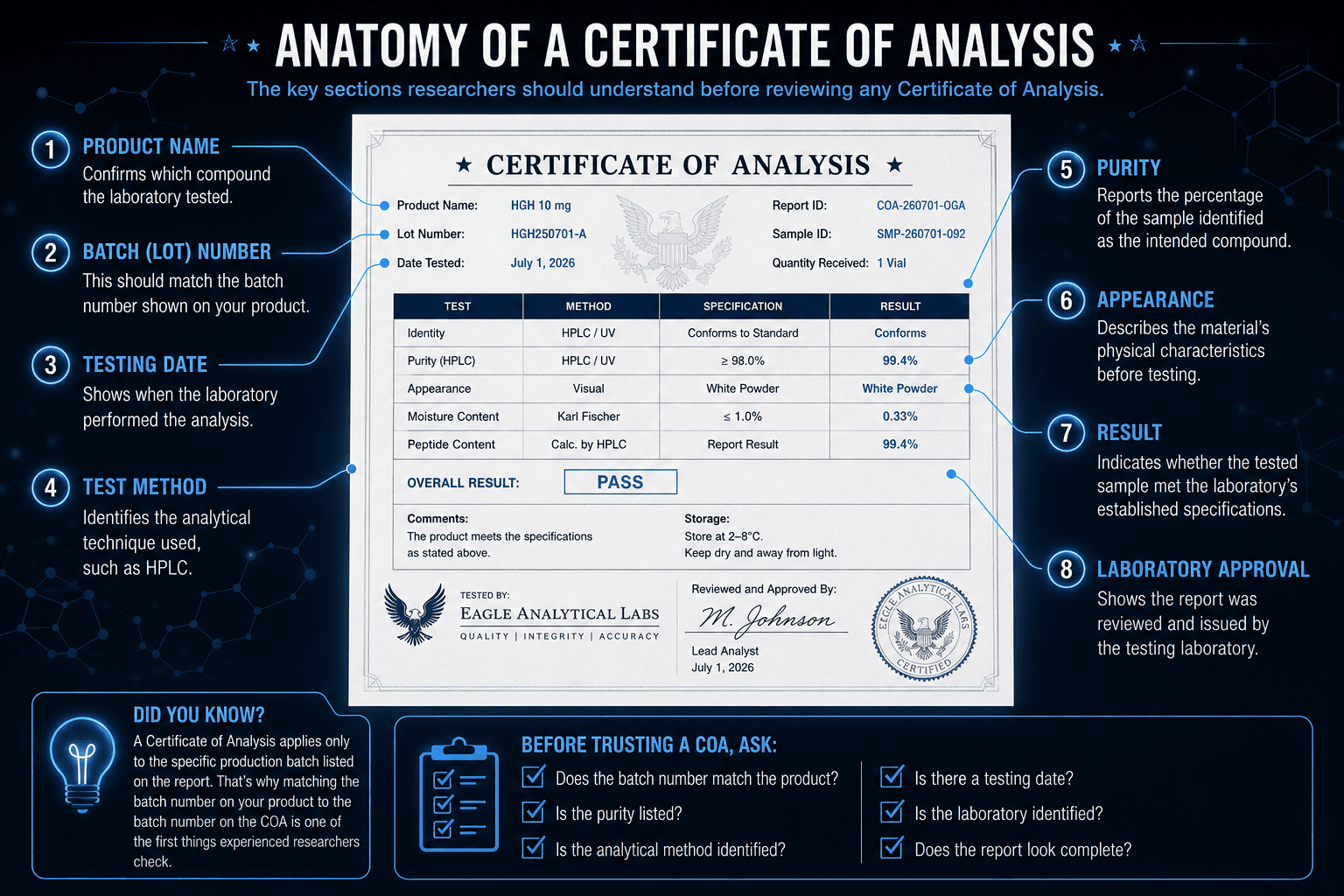
When reviewing a COA, compare the product name, lot or batch number, and any available sample or report identifiers with the material and documentation you received. These identifiers form the basic traceability chain between the laboratory report and the tested batch.
⚠️ IMPORTANT DISTINCTION
A matching lot number connects the COA to a reported production batch, but it does not mean that every individual vial or container from that batch was separately tested. Analytical testing is generally performed on a sample representing the batch, and the COA reports the results obtained from that sample.
The Most Important Sections of a COA
Although Certificates of Analysis vary between laboratories, most well-documented reports contain several core pieces of information. Learning what each section means—and how the sections relate to one another—is the key to reading a COA correctly.
Product Identification
Before looking at purity percentages or test results, first confirm what the laboratory actually tested.
Look for information such as:
- Product or compound name
- Lot or batch number
- Sample identification number
- Report or certificate number
- Quantity or sample description, when provided
These identifiers establish the connection between the laboratory report and the material represented by that report.
A compound name alone isn’t enough. Two COAs may list the same compound while representing completely different production batches.
Dates provide another important piece of the traceability puzzle.
Depending on the laboratory, a COA may include several different dates, such as:
- Sample received date
- Testing or analysis date
- Report or issue date
- Review or approval date
These dates don’t necessarily represent the same event.
The testing date indicates when the analytical work was performed, while the report date generally indicates when the laboratory issued or finalized the results.
🔬 RESEARCH NOTE
Don’t assume that the newest date appearing on a COA is the date the sample was tested. Look at the label attached to each date to understand what event it represents.
Laboratory Identification
A COA should clearly identify the laboratory responsible for the reported analysis.
Depending on the laboratory and report format, this may include the laboratory name, contact information, report number, analyst or reviewer, approval information, or other identifying details.
This information helps establish who performed and reported the testing and provides another point of traceability when reviewing the document.
A COA with impressive numbers but no clear indication of who generated those numbers leaves an important piece of the analytical record missing.
⚠️ IMPORTANT DISTINCTION
Identifying the laboratory does not, by itself, establish the quality or reliability of the testing. Laboratory identity, analytical methods, documentation, and the reported data should be considered together.
Method vs. Specification vs. Result
These terms often appear close together on a COA, but they describe three different things.
Method tells you how the sample was analyzed.
Examples may include HPLC, mass spectrometry, Karl Fischer titration, microbial testing, or other analytical techniques.
Specification tells you the predefined acceptance criterion or target for that particular test.
For example, a purity specification might be listed as ≥98.0%.
Result tells you what the laboratory actually measured or observed when the sample was tested.
For example, the reported purity result might be 99.4%.
So a COA might show:
| Test | Method | Specification | Result |
|---|---|---|---|
| Purity | HPLC | ≥98.0% | 99.4% |
In this example, HPLC is the analytical method, ≥98.0% is the acceptance specification, and 99.4% is the measured result.
📊 READING THE DATA
Don’t mistake the specification for the laboratory result. A specification tells you what the material is expected or required to meet; the result tells you what was actually reported from the analysis.
Not Every COA Uses the Same Format
Some COAs clearly separate test, method, specification, and result into individual columns. Others may combine information, use different terminology, or provide analytical methods elsewhere in the report.
You may also encounter terms such as acceptance criteria, limits, reference standards, or requirements in place of “specification.”
The exact layout matters less than understanding what each piece of information represents.
🔬 RESEARCH NOTE
A reported result is only meaningful in the context of the test used to generate it. Different analytical methods answer different scientific questions, which is why a single number cannot provide a complete picture of a material.
Purity
Purity is one of the most commonly reported—and commonly misunderstood—values on a COA.
When purity is measured using HPLC, the reported percentage generally describes the relative chromatographic purity of the analyzed sample: how much of the detected chromatographic signal is associated with the primary compound compared with other detected components under the conditions of that analysis.
For example, an HPLC purity result of 99.2% indicates that the primary peak accounted for approximately 99.2% of the integrated chromatographic signal included in that calculation.
It does not necessarily mean that 99.2% of the total physical material in a vial is the target compound.
Components such as water, residual solvents, counterions, or other substances may not be represented by an HPLC area-purity percentage in the same way and may require different analytical methods to evaluate.
⚠️ IMPORTANT DISTINCTION
Chromatographic purity and total material composition are not the same measurement. A high HPLC purity percentage tells you something important about the chromatographic profile of the tested sample, but it should not automatically be interpreted as the percentage of the vial’s total mass made up by the target compound.
For a deeper explanation of this distinction, see Understanding Purity Percentages.
For more on interpreting those peaks, see How to Read an HPLC Chromatogram.
Understanding the Reported Results
A COA may contain several different analytical results, and each one answers a different scientific question.
Depending on the material and the testing performed, results may include:
- Identity — provides evidence about whether the analyzed compound matches the expected molecular identity.
- Purity — evaluates the relative amount of the primary component compared with other detected components under a particular analytical method.
- Moisture or water content — measures water present in the tested material.
- Sterility testing — evaluates whether viable contaminating microorganisms are detected under the conditions of the test.
- Endotoxin testing — measures bacterial endotoxins, which can remain present even when viable bacteria are not detected.
- Other chemical or physical analyses — may evaluate characteristics such as residual solvents, counterions, pH, appearance, or other properties relevant to the material.
The important thing is not simply how many tests appear on a COA, but what each test actually establishes.
A purity result does not establish identity. An identity result does not establish sterility. And a sterility test does not provide an endotoxin result.
⚠️ IMPORTANT DISTINCTION
There is no single analytical test that answers every question about a material. Multiple testing methods are often used because they provide different—and complementary—pieces of information.
For example, HPLC can provide information about chromatographic purity, while mass spectrometry can provide evidence about molecular identity. Likewise, sterility testing and endotoxin testing evaluate different forms of potential contamination.
For deeper explanations, see HPLC vs. Mass Spectrometry and Sterility Testing vs. Endotoxin Testing.
🔬 RESEARCH NOTE
When reviewing a COA, avoid treating the document as a single “pass or fail” certificate. Read each reported test individually: What was tested? Which method was used? What result was obtained? And what conclusion does that particular test actually support?
Does This COA Correspond to the Material?
Before relying on the results of a COA, make sure the document can actually be connected to the material being evaluated.
Check that:
- The compound or product name matches.
- The lot or batch number matches the material.
- Sample or report identifiers are present where applicable.
- Testing and report dates make sense for that batch.
- The laboratory responsible for the testing is clearly identified.
No single item establishes traceability on its own. Taken together, however, these details help establish a documented connection between the laboratory report and the batch it represents.
📊 READING THE DATA
Don’t start with the purity percentage. Start with traceability. A 99.9% result isn’t particularly useful if you can’t determine which material the result actually belongs to.
What a COA Can — and Cannot — Tell You
A COA provides documented analytical results for the tests performed on a particular sample associated with a batch. It can provide valuable evidence about characteristics such as identity, purity, moisture, sterility, or endotoxin levels—when those tests are actually included.
What it cannot do is answer questions that were never tested.
A high purity result does not establish sterility. An identity test does not establish purity. And the presence of a COA alone does not mean that every possible characteristic of the material has been evaluated.
⚠️ IMPORTANT DISTINCTION
A COA should be read as a record of specific analytical findings, not as a universal guarantee of quality. The strength of the document depends on the testing performed, the methods used, the traceability of the sample, and the information actually reported.
Quick COA-Reading Checklist
Before relying on a COA, ask:
- Does the product or compound name match?
- Does the lot or batch number match?
- Is the testing laboratory clearly identified?
- Are the testing and report dates provided?
- Can you distinguish the test method, specification, and actual result?
- Do you understand what each reported test measures?
- Are you drawing conclusions only from tests that were actually performed?
💡 DID YOU KNOW?
One of the easiest mistakes when reading a COA is jumping straight to the purity percentage. A better approach is to check traceability first, testing second, and results third.
Key Takeaways
- A Certificate of Analysis (COA) documents analytical testing performed on a sample associated with a specific batch or lot.
- Always confirm traceability first by checking the compound name, lot number, dates, laboratory, and other identifying information.
- Method, specification, and result are different: how it was tested, what criterion applies, and what the laboratory actually found.
- Different analytical tests answer different scientific questions—purity, identity, sterility, and endotoxin results are not interchangeable.
- A COA can only provide evidence for what was actually tested. Understanding its limits is just as important as understanding its results.
Continue Your Research....
3X vs 15X Testing
Understanding Purity Percentages
How to Read an HPLC Chromatogram
HPLC vs Mass Spectrometry
Sterility vs Endotoxin Testing
References and Further Reading
U.S. Food and Drug Administration (FDA). Analytical Procedures and Methods Validation for Drugs and Biologics. Guidance for Industry, July 2015.
Covers analytical procedures used to document identity, strength, quality, purity, and potency, and supports our discussion of interpreting analytical methods and results.
FDA — Analytical Procedures and Methods ValidationInternational Council for Harmonisation (ICH). ICH Q2(R2): Validation of Analytical Procedures. 2023.
Establishes current principles and terminology for analytical procedures used for identity, assay, purity, impurities, and other quantitative or qualitative measurements—including the fundamental principle that an analytical procedure must be fit for its intended purpose.
ICH — Q2(R2) Validation of Analytical ProceduresInternational Council for Harmonisation (ICH). ICH Q6A: Specifications: Test Procedures and Acceptance Criteria for New Drug Substances and New Drug Products.
Particularly useful for our distinction between test procedures, specifications/acceptance criteria, and analytical results, as well as the concept that different quality attributes require different tests.
FDA — ICH Q6A Specifications and Acceptance CriteriaU.S. Food and Drug Administration (FDA). Pyrogen and Endotoxins Testing: Questions and Answers. Guidance for Industry, Edition 2, March 2026.
Supports our discussion that endotoxin testing evaluates a specific analytical characteristic and should not be treated as interchangeable with other microbiological testing.
FDA — Pyrogen and Endotoxins TestingU.S. Food and Drug Administration (FDA). Q14 Analytical Procedure Development. Guidance for Industry, March 2024.
Provides additional scientific context for analytical procedure development and reinforces the importance of selecting analytical procedures appropriate to their intended purpose.
FDA — Q14 Analytical Procedure Development
Research Disclaimer
The information provided in this guide is intended solely for educational and research purposes. It is designed to help readers understand common laboratory analytical terminology and should not be interpreted as medical advice or as a statement regarding the safety, efficacy, or intended use of any research material.