

3X vs 15X Testing
AT A GLANCE
Reading Time: 7–9 minutes
You’ll Learn
You’ll Learn
- What 3X, 5X, 7X, and 15X testing actually mean
- Why there is no universal definition for the “X”
- The difference between number of tests and number of samples tested
- What common tests such as purity, identity, net content, sterility, endotoxin, and heavy-metal testing actually evaluate
- Why different laboratories and suppliers may count testing differently
- Whether a higher testing number automatically means better testing
- How to evaluate testing claims by looking at the actual methods, results, laboratory, and lot-specific documentation
- What to look for on a Certificate of Analysis (COA) instead of relying on the marketing number alone
Introduction
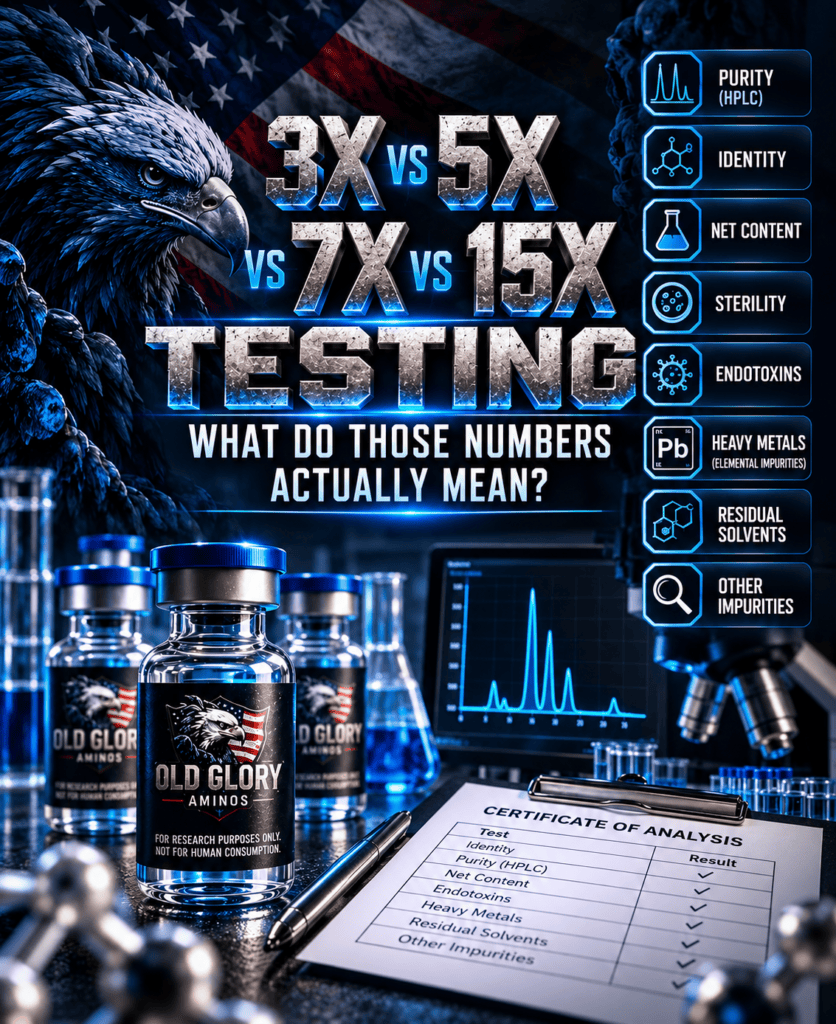
Laboratory testing has increasingly become a major point of comparison when evaluating research compounds. Terms such as “3X tested,” “5X tested,” “7X tested,” and even “15X tested” are now commonly used to describe testing programs—but what those numbers actually represent is not always clear.
At first glance, the comparison seems simple: if one product is 5X tested and another is 15X tested, the 15X-tested product must have undergone three times as much testing and therefore provide greater assurance. In practice, the comparison is not nearly that straightforward.
There is no universal analytical standard that defines what each “X” must represent. Depending on the laboratory, supplier, or testing program, the number may refer to different analytical tests, different characteristics being evaluated, multiple samples from a batch, individual analytes within a larger testing panel, or some combination of these approaches.
More testing can absolutely provide valuable additional information when those tests answer different and relevant analytical questions. But a larger number by itself does not tell researchers what was tested, which methods were used, how samples were selected, or what the results actually demonstrated.
Understanding testing therefore requires looking beyond the number. This guide breaks down what these testing claims can mean, what common laboratory tests actually evaluate, and how to determine whether additional testing provides meaningful analytical information—or simply produces a larger number for marketing purposes.
⚠️ IMPORTANT DISTINCTION
“3X,” “5X,” “7X,” and “15X” are not standardized scientific classifications. The number alone does not establish what was tested, how it was tested, how many samples were analyzed, or the quality of the resulting data.
What Does the “X” in Testing Actually Mean?
The simplest answer is: it depends on who is using the term.
Unlike established analytical terms such as HPLC, mass spectrometry, sterility testing, or elemental analysis, “3X,” “5X,” “7X,” and “15X” do not describe standardized laboratory methods. The “X” is generally being used as a shorthand for the number of tests, measurements, samples, or testing categories included in a particular testing program.
That creates an important problem when comparing testing claims: different organizations may count the “X” differently.
For example, one testing program might describe a product as 7X tested because it evaluates seven categories such as identity, purity, quantity, sterility, endotoxins, heavy metals, and residual solvents. Another program might count several individual measurements within one of those categories separately. A heavy-metals panel evaluating lead, arsenic, cadmium, and mercury, for example, could potentially be described as one heavy-metals test or four separate checks, depending on how the testing program is being counted.
The number can also describe something entirely different: replicate or multi-sample testing. A laboratory may analyze several separate samples from the same batch using the same analytical methods. In that situation, “3X testing” could mean three samples were tested rather than three different types of testing being performed.
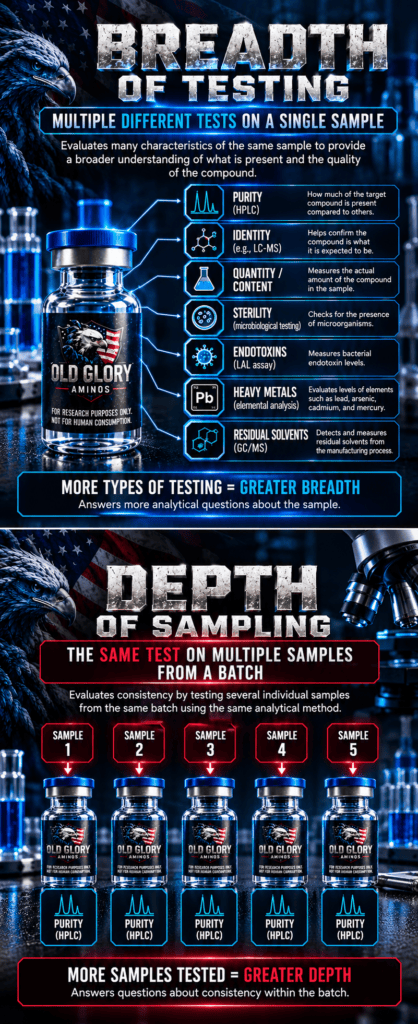
These approaches answer different questions. Testing more characteristics can broaden the types of information available about a sample, while testing more units from the same batch can provide information about consistency or variability within that batch.
Neither approach is automatically superior. The important question is what the number represents and whether the underlying testing provides information relevant to the characteristic being evaluated.
🔬 RESEARCH NOTE
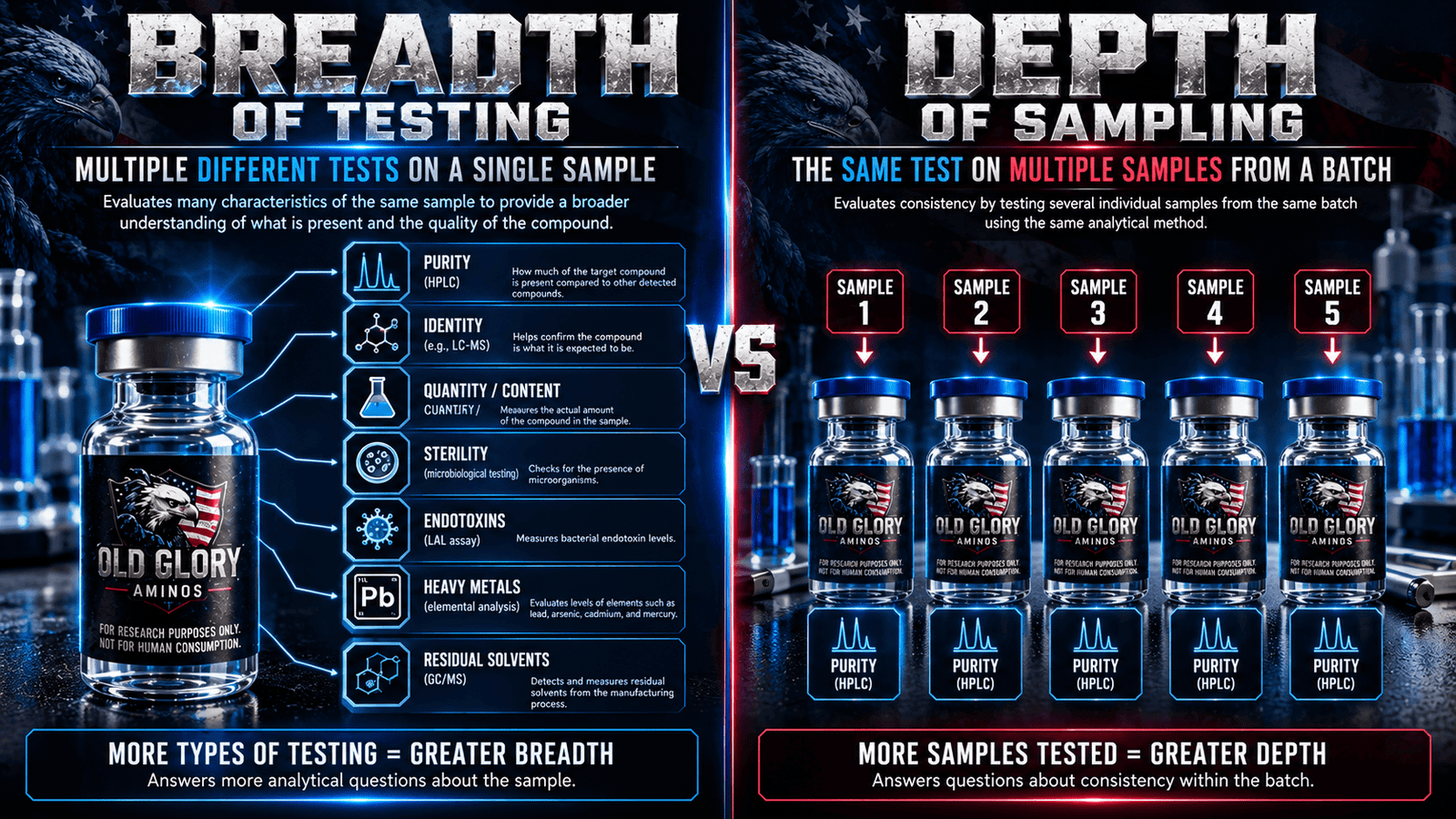
Breadth of testing and depth of sampling are not the same thing.
Breadth asks: How many different characteristics were evaluated?
Depth asks: How many separate samples or units were analyzed?A testing program can have greater breadth, greater sampling depth, or both. The “X” alone does not tell you which one occurred
What Are the Most Common Types of Laboratory Testing?
The exact methods used vary according to the compound, laboratory, research objective, and testing program. However, the following categories are commonly encountered when reviewing analytical documentation for research compounds.
Purity Testing
Question it helps answer: How much of the detected chromatographic response is associated with the primary component compared with other detected components?
High-Performance Liquid Chromatography (HPLC) is commonly used to evaluate chromatographic purity. The sample is separated into components, which appear as peaks on a chromatogram. The relative area of the primary peak can then be compared with the other integrated peaks detected under that method.
A reported result such as 99% HPLC purity should not automatically be interpreted as meaning that 99% of everything physically present in the sample is the target compound. The result reflects what the analytical method and detector were capable of separating, detecting, and integrating under the specified conditions.
Related reading from our library: What Is HPLC? and Understanding Purity Percentages. (See Below)
Identity Testing
Question it helps answer: Is the detected compound actually what it is expected to be?
Purity and identity are different analytical questions. A sample can produce a dominant chromatographic peak without that peak, by itself, conclusively establishing molecular identity.
Techniques such as mass spectrometry (MS) can provide information about the mass-to-charge ratios of detected ions. When liquid chromatography is coupled with mass spectrometry (LC-MS), researchers obtain both chromatographic separation and mass information, providing stronger evidence for identification than chromatographic retention time alone. FDA guidance specifically notes that identification based solely on a single chromatographic retention time is not sufficiently specific.
Quantity or Content Testing
Question it helps answer: How much of the target compound is actually present in the sample?
Quantity or content testing evaluates the measured amount of a target compound rather than simply its relative chromatographic purity.
This distinction matters because purity percentage and total quantity are not interchangeable. A sample may show high chromatographic purity while containing more or less total target material than expected. Quantitative analysis generally relies on an appropriate analytical method, calibration, and reference standards to relate detector response to an actual concentration or amount.
Sterility Testing
Question it helps answer: Are viable microorganisms detectable under the sterility test conditions?
Sterility testing is designed to detect viable microbial contamination using methods specifically intended for that purpose. This is fundamentally different from chemical purity testing.
An HPLC chromatogram cannot establish sterility, and a high HPLC purity percentage should never be interpreted as a sterility result. USP <71>, for example, describes dedicated sterility testing procedures using growth media and incubation conditions rather than chromatographic analysis.
Endotoxin Testing
Question it helps answer: Are bacterial endotoxins present above the level detectable or allowable under the applicable test?
Endotoxins are components associated with the outer membrane of certain Gram-negative bacteria. Their evaluation requires specialized testing separate from HPLC purity analysis.
Importantly, sterility and endotoxin testing are not the same thing. A sterility test evaluates viable microorganisms under its test conditions, while bacterial endotoxin testing evaluates endotoxin contamination using a different analytical approach. USP maintains a separate chapter, <85> Bacterial Endotoxins Test, for this purpose.
Heavy Metals / Elemental Impurities
Question it helps answer: Are particular elemental contaminants present, and at what levels?
Elemental analysis can evaluate substances such as lead, arsenic, cadmium, and mercury, among other elements. Techniques such as ICP-MS are capable of measuring trace elemental concentrations with high sensitivity.
This category also illustrates why comparing “X” numbers can become confusing. One testing program might describe the evaluation of several metals as one elemental-impurities panel, while another might count each measured element separately when describing the total number of checks performed. ICH Q3D treats elemental impurities according to individual elements and their toxicological considerations rather than defining an “X-testing” count.
Residual Solvent Testing
Question it helps answer: Are solvents remaining from manufacturing or processing detectable, and at what levels?
Residual solvents are volatile organic chemicals that may remain following manufacturing or purification processes. Because these compounds have different analytical properties from the target compound itself, they are generally evaluated using methods designed specifically for volatile substances, commonly gas chromatography (GC).
ICH Q3C provides a framework for classifying and controlling residual solvents based on their potential risk.
🔬 RESEARCH NOTE
More tests can provide more information—but only when the tests answer additional meaningful questions.
Purity, identity, quantity, sterility, endotoxins, elemental impurities, and residual solvents evaluate different characteristics of a sample. None of these results automatically substitutes for the others.
Is 15X Testing Better Than 7X or 5X Testing?
Not necessarily—but it can provide more information.
A larger testing number is meaningful only when the additional tests evaluate characteristics that were not already adequately addressed. If a 15X testing program contains additional relevant analytical tests that a 5X program does not perform, then the larger panel can provide a broader analytical picture of the sample.
However, 15X does not automatically mean three times the analytical assurance of 5X, nor does 7X automatically represent a higher scientific standard than 5X. Because the “X” terminology is not standardized, the underlying testing programs must be compared rather than the numbers themselves.
Current testing claims illustrate the problem. One 5X program defines its panel as endotoxin, sterility, heavy metals, quantity, and HPLC purity. Another 5X program describes identity, purity, mass, multi-vial consistency, and endotoxin testing. Those are both called “5X,” but they do not evaluate exactly the same characteristics.
The same variation appears with 7X testing. Current suppliers describe 7X panels using combinations such as mass, purity, identity, sterility, endotoxins, heavy metals, and conformity, while another defines its seven checks as purity, HPLC retention-time identity, net content, heavy metals, sterility, endotoxin, and a fentanyl screen.
A current 15X program goes substantially broader, listing identity, purity, net content, sterility, endotoxins, residual solvents, residual TFA, container-closure integrity, solubility, adulterant screening, unit-to-unit variance—and lead, arsenic, mercury, and cadmium as four separate checks.
This does not make the additional measurements meaningless. Residual-solvent analysis, for example, answers a legitimate analytical question that an HPLC purity result does not. Likewise, testing several units from a lot can provide information about within-lot consistency that testing a single unit cannot provide.
But it does demonstrate why the headline number cannot be used by itself to compare testing programs. A program that counts four individual metals separately may produce a larger “X” than a program that describes the same measurements collectively as an elemental-impurities panel.
The better comparison is therefore not simply “How many X’s?” It is:
What was tested? Which methods were used? How many samples were analyzed? Were the results generated for the specific lot being evaluated? And are the actual laboratory results available for review?
⚠️ IMPORTANT DISTINCTION
More testing and better testing are not synonymous.
Additional testing has analytical value when it provides relevant, reliable information that was not already established by the existing tests. The number of checks is much less informative than the scope, methodology, sampling strategy, laboratory documentation, and actual results behind them. When it comes down to it, it’s up to you to decide what testing is sufficient for your personal research journey.
Can “X Testing” Be a Marketing Gimmick?
Yes and no. The terminology can be used for marketing—but that does not mean the underlying testing is meaningless.
Terms such as “3X tested,” “7X tested,” and “15X tested” are easy to communicate and easy to compare visually, which makes them attractive marketing language. The difficulty is that there is no universal convention requiring every laboratory or supplier to count those numbers the same way.
Current testing programs demonstrate this clearly. Some suppliers describe 7X testing as seven categories that include measurements such as purity, identity, net content or mass, sterility, endotoxins, heavy metals, and conformity. Even among programs using the same “7X” label, the exact categories can differ.
Other programs use a larger number by counting individual measurements separately. One current 15X testing program, for example, counts lead, arsenic, mercury, and cadmium as four individual tests, while also counting broader categories such as purity, identity, sterility, endotoxins, residual solvents, and other analyses.
Neither counting system is inherently wrong. Testing four individual elements produces real analytical information. But the way those measurements are grouped and counted can substantially change the number displayed in a testing claim.
This means two testing programs could potentially evaluate many of the same characteristics while advertising very different “X” numbers. Conversely, two programs advertising the same number may actually perform different analyses. The headline number therefore cannot tell researchers, by itself, which program is more comprehensive.
The distinction between marketing language and analytical evidence is important. “15X tested” is a convenient description of a testing program; it is not itself a laboratory result. The meaningful information lies underneath the claim: the tests performed, analytical methods used, samples evaluated, laboratory documentation, lot identification, and actual results.
A larger testing panel may genuinely provide valuable additional information. But the value comes from what the additional testing demonstrates—not from making the number larger.
Does a Lower “X” Number Mean Inadequate Testing?
No. A lower testing number does not mean that a testing program is inadequate, just as a higher number does not make one superior.
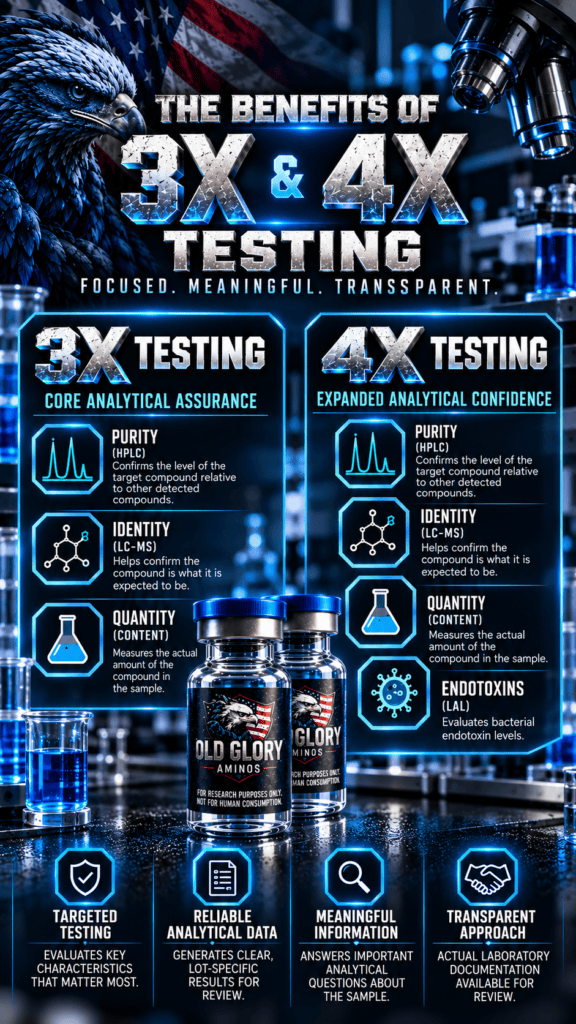
A smaller testing panel still answers several of the most important analytical questions about a sample. For example, a program evaluating identity, purity, and quantity provides three distinct pieces of analytical information. Adding a fourth test can answer another question—but it does not invalidate the information provided by the first three.
Whether additional testing is valuable depends on what is being evaluated and what information is needed. Sterility testing answers a different question from purity testing. Elemental analysis answers a different question from identity testing. Residual-solvent testing answers yet another. Adding one of these analyses broadens the available information; it does not retroactively make a smaller analytical panel scientifically meaningless.
This is also why comparing testing programs solely by their advertised number can create unnecessary concern. A 3X or 4X program with clearly identified methods, traceable lot-specific results, and transparent laboratory documentation may provide more useful information than a larger “X” claim that does not clearly disclose what was tested or how the number was calculated.
The appropriate question is therefore not “Is 15X testing necessary?” or “Is 3X testing enough?” in the abstract. The more useful question is:
What information does this testing program establish—and what questions remain unanswered?
🔬 OLD GLORY AMINOS — TESTING TRANSPARENCY
Old Glory Aminos currently uses 3X and 4X testing programs, depending on the research material and testing performed. And though we plan to move to the next level testing with our future batches, we do not believe an “X” number should be used by itself as a measure of quality.
Our goal is to make the actual laboratory documentation available for review so researchers can see what was tested, which results were reported, and which lot those results apply to.
As analytical testing evolves, additional testing may be incorporated where it provides meaningful information. We would rather explain what our testing demonstrates—and what it does not—than rely on a larger number as a substitute for transparency.
How Should You Evaluate a Testing Claim?
When a research material is advertised as 3X, 5X, 7X, 15X, or any other testing level, the number should be treated as the beginning of the evaluation—not the conclusion.
Instead of focusing primarily on the testing count, look at the documentation behind the claim and determine what was tested, how it was tested, and what the results actually demonstrate.
1. Identify the Tests That Were Actually Performed
Look beyond the headline number and find the individual analyses included in the testing program.
Does the documentation evaluate purity, identity, quantity, sterility, endotoxins, elemental impurities, residual solvents, or something else?
This also reveals how the testing count was calculated. A program may count a heavy-metals panel as one category, while another may count lead, arsenic, cadmium, and mercury individually.
2. Look at the Analytical Method
The name of the test is only part of the story. The analytical method helps explain how the result was obtained and what conclusions can reasonably be drawn from it.
HPLC may be used to evaluate chromatographic purity. Mass spectrometry can provide information relevant to molecular identity. ICP-MS can measure trace elements. Microbiological methods are used for sterility evaluation, while specialized assays are used for bacterial endotoxins.
A testing claim becomes considerably more informative when the underlying methods are clearly identified.
3. Confirm That the Results Match the Lot
Laboratory results are most useful when they can be connected to the specific lot or batch being evaluated.
Look for identifying information such as a lot or batch number on the laboratory documentation and compare it with the material it is intended to represent.
A legitimate laboratory report may provide accurate information about the sample that was submitted for testing, but it does not automatically establish the characteristics of unrelated lots produced at another time.
4. Look at Who Performed the Testing
Laboratory documentation should identify the organization that performed the analysis. Depending on the report, additional information may include the testing date, sample identifier, analytical method, instrumentation, analyst or reviewer information, and other laboratory details.
Independent third-party testing can provide separation between the organization supplying a research material and the laboratory generating the analytical results. However, “third-party tested” should not replace reviewing the actual report. The quality and relevance of the documentation still matter.
5. Examine the Actual Results
Whenever possible, look beyond statements such as “passed,” “verified,” or “tested.”
Analytical reports may contain numerical results, chromatograms, spectra, acceptance criteria, detection limits, sample information, or other supporting data depending on the method performed.
A statement that testing occurred tells researchers relatively little unless they can determine what was measured and what result was obtained.
6. Determine How Many Samples Were Tested
If a testing program emphasizes repeated testing or batch consistency, determine whether multiple independent samples were actually analyzed.
Testing one sample with seven different methods provides breadth of analysis. Testing several units from the same lot can provide depth of sampling. A program may do either—or both.
Again, the testing number alone does not reveal the difference.
7. Ask What the Testing Does Not Establish
One of the most useful ways to evaluate laboratory documentation is to identify the questions it does not answer.
A purity result does not automatically establish identity. Identity testing does not establish sterility. Sterility testing does not establish endotoxin levels. Elemental analysis does not establish residual-solvent levels.
Good analytical documentation does not need to answer every conceivable question about a sample. It should simply be understood within the limits of what was actually tested.
📊 READING THE DATA
When evaluating an “X-tested” claim, look for five things:
WHAT was tested → HOW it was tested → WHO tested it → WHICH LOT was tested → WHAT THE RESULTS SHOWED
If those questions can be answered from the available documentation, the testing claim becomes far more informative than the number of X’s alone.
Key Takeaways
When comparing 3X, 5X, 7X, 15X, or other testing claims, the number alone provides very little information about the quality or scope of the analytical testing. The most important points to remember are:
“X testing” is not a standardized scientific classification. Different laboratories and suppliers may define and count the “X” differently.
A higher testing number does not automatically mean better testing. Additional analyses are most valuable when they answer relevant questions that have not already been addressed.
A lower testing number does not automatically mean inadequate testing. A focused 3X or 4X program can provide meaningful analytical information when appropriate methods are used and the results are clearly documented.
Breadth of testing and depth of sampling are different. Performing several different analyses on one sample answers different questions than performing the same analysis on multiple samples from a lot.
Purity, identity, quantity, sterility, endotoxins, elemental impurities, and residual solvents are different analytical characteristics. A result for one should not automatically be interpreted as evidence for another.
How tests are counted matters. One program may count a multi-element heavy-metals panel as a single testing category, while another may count individual elements separately.
The actual laboratory documentation matters more than the marketing number. Researchers should look for the tests performed, analytical methods, laboratory information, sample or lot identification, and reported results.
No testing program answers every possible question about a sample. The goal is to understand what the available testing demonstrates—and what remains outside its scope.
Ultimately, the most useful question is not “How many X’s?”
It is:
“What was tested, how was it tested, and what do the results actually tell us?”
Continue Your Research...
What Are Amino Acid Compounds?
How to Read a COA
Understanding Purity Percentages
What is HPLC?
References & Further Reading
1. U.S. Food and Drug Administration (FDA).
Q6A Specifications: Test Procedures and Acceptance Criteria for New Drug Substances and New Drug Products: Chemical Substances.
Guidance covering analytical specifications, identity testing, assay, impurities, and appropriate analytical procedures. Particularly useful for understanding why chromatographic retention time alone is not considered sufficiently specific for identification.
Q6A Specifications — FDA
2. United States Pharmacopeia (USP).
General Chapter <71> Sterility Tests.
Compendial reference for microbiological sterility testing, illustrating why sterility is a separate analytical question from chemical purity or identity.
USP <71> Sterility Tests
3. United States Pharmacopeia (USP).
General Chapter <85> Bacterial Endotoxins Test.
Compendial methodology for detecting or quantifying bacterial endotoxins, demonstrating the distinction between endotoxin evaluation and sterility testing.
USP <85> Bacterial Endotoxins Test
4. U.S. Food and Drug Administration / International Council for Harmonisation (ICH).
Q3D(R2) Guideline for Elemental Impurities.
Guidance addressing elemental impurities and their evaluation, including individual elements rather than an “X-testing” classification.
ICH Q3D(R2) — FDA
5. U.S. Food and Drug Administration / International Council for Harmonisation (ICH).
Q3C Impurities: Residual Solvents.
Guidance describing the evaluation and control of residual solvents and their classification according to toxicological risk.
ICH Q3C — FDA
Research Disclaimer
The information provided in this guide is intended solely for educational and research purposes. It is designed to help readers understand common laboratory analytical terminology and should not be interpreted as medical advice or as a statement regarding the safety, efficacy, or intended use of any research material.
3X vs 15X Testing
At a Glance
Reading Time: 7–9 minutes
You’ll Learn
- What 3X, 5X, 7X, and 15X testing actually mean
- Why there is no universal definition for the “X”
- The difference between number of tests and number of samples tested
- What common tests such as purity, identity, net content, sterility, endotoxin, and heavy-metal testing actually evaluate
- Why different laboratories and suppliers may count testing differently
- Whether a higher testing number automatically means better testing
- How to evaluate testing claims by looking at the actual methods, results, laboratory, and lot-specific documentation
- What to look for on a Certificate of Analysis (COA) instead of relying on the marketing number alone
Introduction
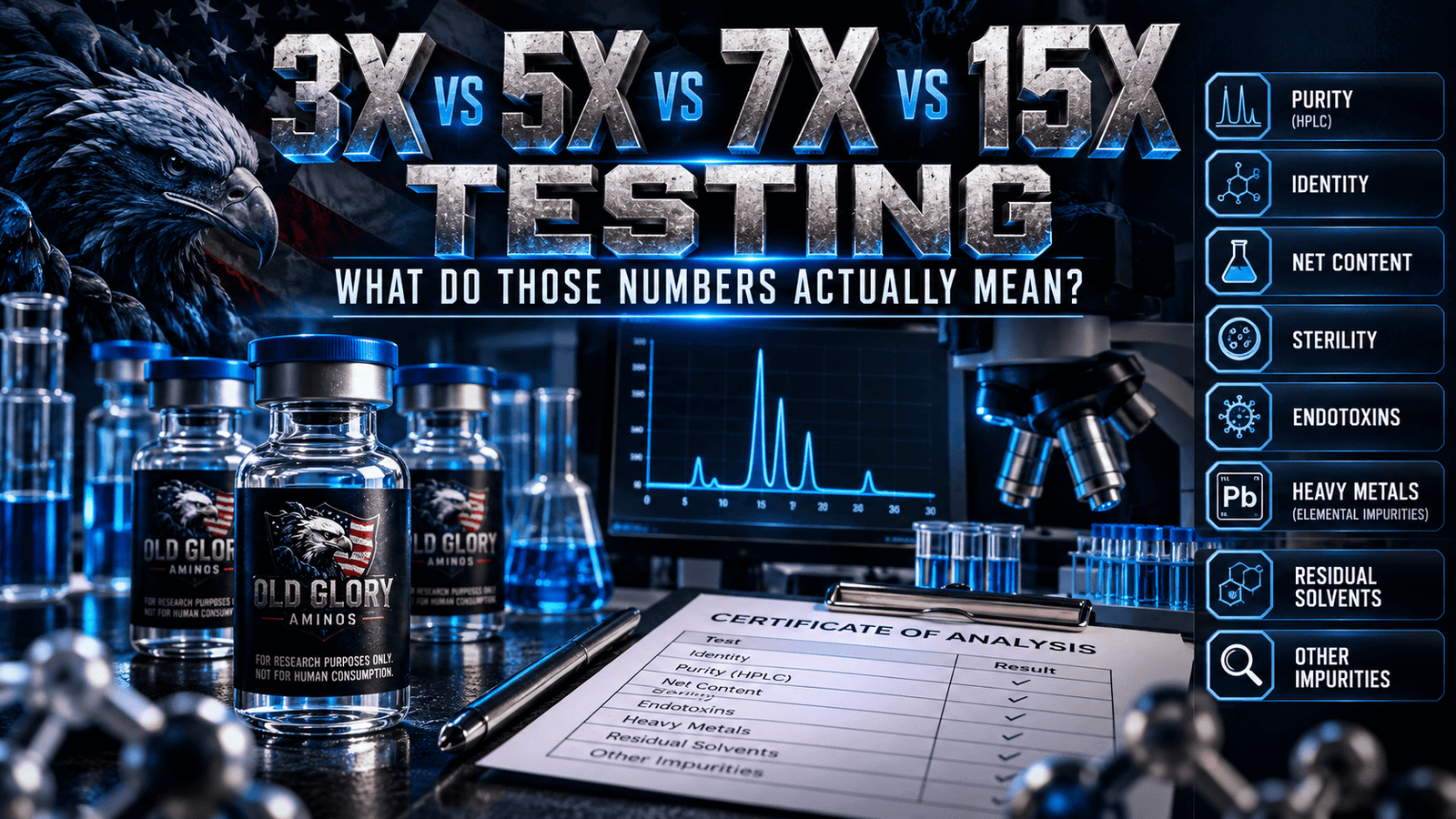
Laboratory testing has increasingly become a major point of comparison when evaluating research compounds. Terms such as “3X tested,” “5X tested,” “7X tested,” and even “15X tested” are now commonly used to describe testing programs—but what those numbers actually represent is not always clear.
At first glance, the comparison seems simple: if one product is 5X tested and another is 15X tested, the 15X-tested product must have undergone three times as much testing and therefore provide greater assurance. In practice, the comparison is not nearly that straightforward.
There is no universal analytical standard that defines what each “X” must represent. Depending on the laboratory, supplier, or testing program, the number may refer to different analytical tests, different characteristics being evaluated, multiple samples from a batch, individual analytes within a larger testing panel, or some combination of these approaches.
More testing can absolutely provide valuable additional information when those tests answer different and relevant analytical questions. But a larger number by itself does not tell researchers what was tested, which methods were used, how samples were selected, or what the results actually demonstrated.
Understanding testing therefore requires looking beyond the number. This guide breaks down what these testing claims can mean, what common laboratory tests actually evaluate, and how to determine whether additional testing provides meaningful analytical information—or simply produces a larger number for marketing purposes.
⚠️ IMPORTANT DISTINCTION
“3X,” “5X,” “7X,” and “15X” are not standardized scientific classifications. The number alone does not establish what was tested, how it was tested, how many samples were analyzed, or the quality of the resulting data.
What Does the “X” in Testing Actually Mean?
The simplest answer is: it depends on who is using the term.
Unlike established analytical terms such as HPLC, mass spectrometry, sterility testing, or elemental analysis, “3X,” “5X,” “7X,” and “15X” do not describe standardized laboratory methods. The “X” is generally being used as a shorthand for the number of tests, measurements, samples, or testing categories included in a particular testing program.
That creates an important problem when comparing testing claims: different organizations may count the “X” differently.
For example, one testing program might describe a product as 7X tested because it evaluates seven categories such as identity, purity, quantity, sterility, endotoxins, heavy metals, and residual solvents. Another program might count several individual measurements within one of those categories separately. A heavy-metals panel evaluating lead, arsenic, cadmium, and mercury, for example, could potentially be described as one heavy-metals test or four separate checks, depending on how the testing program is being counted.
The number can also describe something entirely different: replicate or multi-sample testing. A laboratory may analyze several separate samples from the same batch using the same analytical methods. In that situation, “3X testing” could mean three samples were tested rather than three different types of testing being performed.
These approaches answer different questions. Testing more characteristics can broaden the types of information available about a sample, while testing more units from the same batch can provide information about consistency or variability within that batch.
Neither approach is automatically superior. The important question is what the number represents and whether the underlying testing provides information relevant to the characteristic being evaluated.
🔬 RESEARCH NOTE
Breadth of testing and depth of sampling are not the same thing.
Breadth asks: How many different characteristics were evaluated?
Depth asks: How many separate samples or units were analyzed?A testing program can have greater breadth, greater sampling depth, or both. The “X” alone does not tell you which one occurred
What Are the Most Common Types of Laboratory Testing?
The exact methods used vary according to the compound, laboratory, research objective, and testing program. However, the following categories are commonly encountered when reviewing analytical documentation for research compounds.
Purity Testing
Question it helps answer: How much of the detected chromatographic response is associated with the primary component compared with other detected components?
High-Performance Liquid Chromatography (HPLC) is commonly used to evaluate chromatographic purity. The sample is separated into components, which appear as peaks on a chromatogram. The relative area of the primary peak can then be compared with the other integrated peaks detected under that method.
A reported result such as 99% HPLC purity should not automatically be interpreted as meaning that 99% of everything physically present in the sample is the target compound. The result reflects what the analytical method and detector were capable of separating, detecting, and integrating under the specified conditions.
Related reading from our library: What Is HPLC? and Understanding Purity Percentages. (See Below)
Identity Testing
Question it helps answer: Is the detected compound actually what it is expected to be?
Purity and identity are different analytical questions. A sample can produce a dominant chromatographic peak without that peak, by itself, conclusively establishing molecular identity.
Techniques such as mass spectrometry (MS) can provide information about the mass-to-charge ratios of detected ions. When liquid chromatography is coupled with mass spectrometry (LC-MS), researchers obtain both chromatographic separation and mass information, providing stronger evidence for identification than chromatographic retention time alone. FDA guidance specifically notes that identification based solely on a single chromatographic retention time is not sufficiently specific.
Quantity or Content Testing
Question it helps answer: How much of the target compound is actually present in the sample?
Quantity or content testing evaluates the measured amount of a target compound rather than simply its relative chromatographic purity.
This distinction matters because purity percentage and total quantity are not interchangeable. A sample may show high chromatographic purity while containing more or less total target material than expected. Quantitative analysis generally relies on an appropriate analytical method, calibration, and reference standards to relate detector response to an actual concentration or amount.
Sterility Testing
Question it helps answer: Are viable microorganisms detectable under the sterility test conditions?
Sterility testing is designed to detect viable microbial contamination using methods specifically intended for that purpose. This is fundamentally different from chemical purity testing.
An HPLC chromatogram cannot establish sterility, and a high HPLC purity percentage should never be interpreted as a sterility result. USP <71>, for example, describes dedicated sterility testing procedures using growth media and incubation conditions rather than chromatographic analysis.
Endotoxin Testing
Question it helps answer: Are bacterial endotoxins present above the level detectable or allowable under the applicable test?
Endotoxins are components associated with the outer membrane of certain Gram-negative bacteria. Their evaluation requires specialized testing separate from HPLC purity analysis.
Importantly, sterility and endotoxin testing are not the same thing. A sterility test evaluates viable microorganisms under its test conditions, while bacterial endotoxin testing evaluates endotoxin contamination using a different analytical approach. USP maintains a separate chapter, <85> Bacterial Endotoxins Test, for this purpose.
Heavy Metals / Elemental Impurities
Question it helps answer: Are particular elemental contaminants present, and at what levels?
Elemental analysis can evaluate substances such as lead, arsenic, cadmium, and mercury, among other elements. Techniques such as ICP-MS are capable of measuring trace elemental concentrations with high sensitivity.
This category also illustrates why comparing “X” numbers can become confusing. One testing program might describe the evaluation of several metals as one elemental-impurities panel, while another might count each measured element separately when describing the total number of checks performed. ICH Q3D treats elemental impurities according to individual elements and their toxicological considerations rather than defining an “X-testing” count.
Residual Solvent Testing
Question it helps answer: Are solvents remaining from manufacturing or processing detectable, and at what levels?
Residual solvents are volatile organic chemicals that may remain following manufacturing or purification processes. Because these compounds have different analytical properties from the target compound itself, they are generally evaluated using methods designed specifically for volatile substances, commonly gas chromatography (GC).
ICH Q3C provides a framework for classifying and controlling residual solvents based on their potential risk.
🔬 RESEARCH NOTE
More tests can provide more information—but only when the tests answer additional meaningful questions.
Purity, identity, quantity, sterility, endotoxins, elemental impurities, and residual solvents evaluate different characteristics of a sample. None of these results automatically substitutes for the others.
Is 15X Testing Better Than 7X or 5X Testing?
Not necessarily—but it can provide more information.
A larger testing number is meaningful only when the additional tests evaluate characteristics that were not already adequately addressed. If a 15X testing program contains additional relevant analytical tests that a 5X program does not perform, then the larger panel can provide a broader analytical picture of the sample.
However, 15X does not automatically mean three times the analytical assurance of 5X, nor does 7X automatically represent a higher scientific standard than 5X. Because the “X” terminology is not standardized, the underlying testing programs must be compared rather than the numbers themselves.
Current testing claims illustrate the problem. One 5X program defines its panel as endotoxin, sterility, heavy metals, quantity, and HPLC purity. Another 5X program describes identity, purity, mass, multi-vial consistency, and endotoxin testing. Those are both called “5X,” but they do not evaluate exactly the same characteristics.
The same variation appears with 7X testing. Current suppliers describe 7X panels using combinations such as mass, purity, identity, sterility, endotoxins, heavy metals, and conformity, while another defines its seven checks as purity, HPLC retention-time identity, net content, heavy metals, sterility, endotoxin, and a fentanyl screen.
A current 15X program goes substantially broader, listing identity, purity, net content, sterility, endotoxins, residual solvents, residual TFA, container-closure integrity, solubility, adulterant screening, unit-to-unit variance—and lead, arsenic, mercury, and cadmium as four separate checks.
This does not make the additional measurements meaningless. Residual-solvent analysis, for example, answers a legitimate analytical question that an HPLC purity result does not. Likewise, testing several units from a lot can provide information about within-lot consistency that testing a single unit cannot provide.
But it does demonstrate why the headline number cannot be used by itself to compare testing programs. A program that counts four individual metals separately may produce a larger “X” than a program that describes the same measurements collectively as an elemental-impurities panel.
The better comparison is therefore not simply “How many X’s?” It is:
What was tested? Which methods were used? How many samples were analyzed? Were the results generated for the specific lot being evaluated? And are the actual laboratory results available for review?
⚠️ IMPORTANT DISTINCTION
More testing and better testing are not synonymous.
Additional testing has analytical value when it provides relevant, reliable information that was not already established by the existing tests. The number of checks is much less informative than the scope, methodology, sampling strategy, laboratory documentation, and actual results behind them. When it comes down to it, it’s up to you to decide what testing is sufficient for your personal research journey.
Can “X Testing” Be a Marketing Gimmick?
Yes and no. The terminology can be used for marketing—but that does not mean the underlying testing is meaningless.
Terms such as “3X tested,” “7X tested,” and “15X tested” are easy to communicate and easy to compare visually, which makes them attractive marketing language. The difficulty is that there is no universal convention requiring every laboratory or supplier to count those numbers the same way.
Current testing programs demonstrate this clearly. Some suppliers describe 7X testing as seven categories that include measurements such as purity, identity, net content or mass, sterility, endotoxins, heavy metals, and conformity. Even among programs using the same “7X” label, the exact categories can differ.
Other programs use a larger number by counting individual measurements separately. One current 15X testing program, for example, counts lead, arsenic, mercury, and cadmium as four individual tests, while also counting broader categories such as purity, identity, sterility, endotoxins, residual solvents, and other analyses.
Neither counting system is inherently wrong. Testing four individual elements produces real analytical information. But the way those measurements are grouped and counted can substantially change the number displayed in a testing claim.
This means two testing programs could potentially evaluate many of the same characteristics while advertising very different “X” numbers. Conversely, two programs advertising the same number may actually perform different analyses. The headline number therefore cannot tell researchers, by itself, which program is more comprehensive.
The distinction between marketing language and analytical evidence is important. “15X tested” is a convenient description of a testing program; it is not itself a laboratory result. The meaningful information lies underneath the claim: the tests performed, analytical methods used, samples evaluated, laboratory documentation, lot identification, and actual results.
A larger testing panel may genuinely provide valuable additional information. But the value comes from what the additional testing demonstrates—not from making the number larger.
🔬 OLD GLORY AMINOS — TESTING TRANSPARENCY
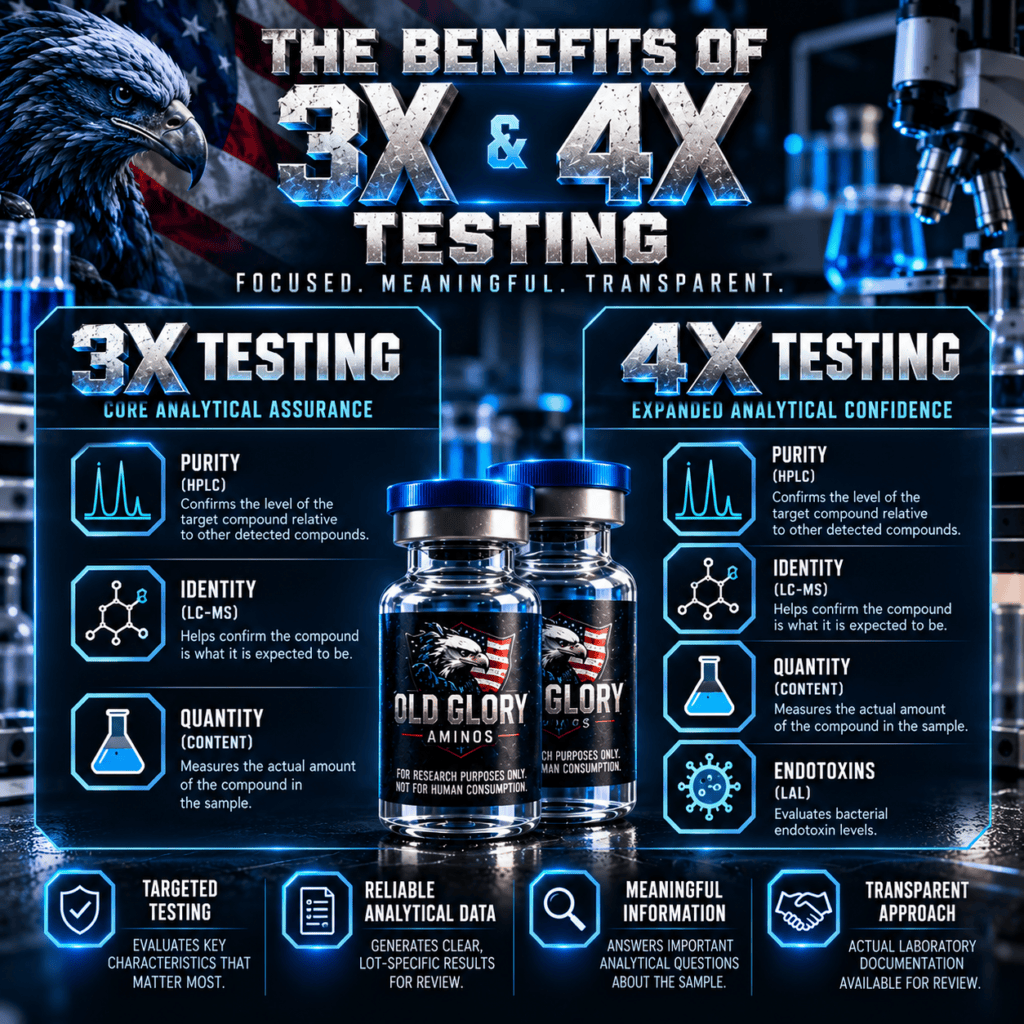
Old Glory Aminos currently uses 3X and 4X testing programs, depending on the research material and testing performed. And though we plan to move to the next level testing with our future batches, we do not believe an “X” number should be used by itself as a measure of quality.
Our goal is to make the actual laboratory documentation available for review so researchers can see what was tested, which results were reported, and which lot those results apply to.
As analytical testing evolves, additional testing may be incorporated where it provides meaningful information. We would rather explain what our testing demonstrates—and what it does not—than rely on a larger number as a substitute for transparency.
Does a Lower “X” Number Mean Inadequate Testing?
No. A lower testing number does not mean that a testing program is inadequate, just as a higher number does not make one superior.
A smaller testing panel still answers several of the most important analytical questions about a sample. For example, a program evaluating identity, purity, and quantity provides three distinct pieces of analytical information. Adding a fourth test can answer another question—but it does not invalidate the information provided by the first three.
Whether additional testing is valuable depends on what is being evaluated and what information is needed. Sterility testing answers a different question from purity testing. Elemental analysis answers a different question from identity testing. Residual-solvent testing answers yet another. Adding one of these analyses broadens the available information; it does not retroactively make a smaller analytical panel scientifically meaningless.
This is also why comparing testing programs solely by their advertised number can create unnecessary concern. A 3X or 4X program with clearly identified methods, traceable lot-specific results, and transparent laboratory documentation may provide more useful information than a larger “X” claim that does not clearly disclose what was tested or how the number was calculated.
The appropriate question is therefore not “Is 15X testing necessary?” or “Is 3X testing enough?” in the abstract. The more useful question is:
What information does this testing program establish—and what questions remain unanswered?
How Should You Evaluate a Testing Claim?
When a research material is advertised as 3X, 5X, 7X, 15X, or any other testing level, the number should be treated as the beginning of the evaluation—not the conclusion.
Instead of focusing primarily on the testing count, look at the documentation behind the claim and determine what was tested, how it was tested, and what the results actually demonstrate.
1. Identify the Tests That Were Actually Performed
Look beyond the headline number and find the individual analyses included in the testing program.
Does the documentation evaluate purity, identity, quantity, sterility, endotoxins, elemental impurities, residual solvents, or something else?
This also reveals how the testing count was calculated. A program may count a heavy-metals panel as one category, while another may count lead, arsenic, cadmium, and mercury individually.
2. Look at the Analytical Method
The name of the test is only part of the story. The analytical method helps explain how the result was obtained and what conclusions can reasonably be drawn from it.
HPLC may be used to evaluate chromatographic purity. Mass spectrometry can provide information relevant to molecular identity. ICP-MS can measure trace elements. Microbiological methods are used for sterility evaluation, while specialized assays are used for bacterial endotoxins.
A testing claim becomes considerably more informative when the underlying methods are clearly identified.
3. Confirm That the Results Match the Lot
Laboratory results are most useful when they can be connected to the specific lot or batch being evaluated.
Look for identifying information such as a lot or batch number on the laboratory documentation and compare it with the material it is intended to represent.
A legitimate laboratory report may provide accurate information about the sample that was submitted for testing, but it does not automatically establish the characteristics of unrelated lots produced at another time.
4. Look at Who Performed the Testing
Laboratory documentation should identify the organization that performed the analysis. Depending on the report, additional information may include the testing date, sample identifier, analytical method, instrumentation, analyst or reviewer information, and other laboratory details.
Independent third-party testing can provide separation between the organization supplying a research material and the laboratory generating the analytical results. However, “third-party tested” should not replace reviewing the actual report. The quality and relevance of the documentation still matter.
5. Examine the Actual Results
Whenever possible, look beyond statements such as “passed,” “verified,” or “tested.”
Analytical reports may contain numerical results, chromatograms, spectra, acceptance criteria, detection limits, sample information, or other supporting data depending on the method performed.
A statement that testing occurred tells researchers relatively little unless they can determine what was measured and what result was obtained.
6. Determine How Many Samples Were Tested
If a testing program emphasizes repeated testing or batch consistency, determine whether multiple independent samples were actually analyzed.
Testing one sample with seven different methods provides breadth of analysis. Testing several units from the same lot can provide depth of sampling. A program may do either—or both.
Again, the testing number alone does not reveal the difference.
7. Ask What the Testing Does Not Establish
One of the most useful ways to evaluate laboratory documentation is to identify the questions it does not answer.
A purity result does not automatically establish identity. Identity testing does not establish sterility. Sterility testing does not establish endotoxin levels. Elemental analysis does not establish residual-solvent levels.
Good analytical documentation does not need to answer every conceivable question about a sample. It should simply be understood within the limits of what was actually tested.
📊 READING THE DATA
When evaluating an “X-tested” claim, look for five things:
WHAT was tested → HOW it was tested → WHO tested it → WHICH LOT was tested → WHAT THE RESULTS SHOWED
If those questions can be answered from the available documentation, the testing claim becomes far more informative than the number of X’s alone.
Key Takeaways
When comparing 3X, 5X, 7X, 15X, or other testing claims, the number alone provides very little information about the quality or scope of the analytical testing. The most important points to remember are:
“X testing” is not a standardized scientific classification. Different laboratories and suppliers may define and count the “X” differently.
A higher testing number does not automatically mean better testing. Additional analyses are most valuable when they answer relevant questions that have not already been addressed.
A lower testing number does not automatically mean inadequate testing. A focused 3X or 4X program can provide meaningful analytical information when appropriate methods are used and the results are clearly documented.
Breadth of testing and depth of sampling are different. Performing several different analyses on one sample answers different questions than performing the same analysis on multiple samples from a lot.
Purity, identity, quantity, sterility, endotoxins, elemental impurities, and residual solvents are different analytical characteristics. A result for one should not automatically be interpreted as evidence for another.
How tests are counted matters. One program may count a multi-element heavy-metals panel as a single testing category, while another may count individual elements separately.
The actual laboratory documentation matters more than the marketing number. Researchers should look for the tests performed, analytical methods, laboratory information, sample or lot identification, and reported results.
No testing program answers every possible question about a sample. The goal is to understand what the available testing demonstrates—and what remains outside its scope.
Ultimately, the most useful question is not “How many X’s?”
It is:
“What was tested, how was it tested, and what do the results actually tell us?”
Continue Your Research....
What Are Amino Acid Compounds?
How to Read a COA
How to Read a Scientific Paper
Understanding Purity Percentages
What is HPLC?
References & Further Reading
1. U.S. Food and Drug Administration (FDA).
Q6A Specifications: Test Procedures and Acceptance Criteria for New Drug Substances and New Drug Products: Chemical Substances.
Guidance covering analytical specifications, identity testing, assay, impurities, and appropriate analytical procedures. Particularly useful for understanding why chromatographic retention time alone is not considered sufficiently specific for identification.
Q6A Specifications — FDA
2. United States Pharmacopeia (USP).
General Chapter <71> Sterility Tests.
Compendial reference for microbiological sterility testing, illustrating why sterility is a separate analytical question from chemical purity or identity.
USP <71> Sterility Tests
3. United States Pharmacopeia (USP).
General Chapter <85> Bacterial Endotoxins Test.
Compendial methodology for detecting or quantifying bacterial endotoxins, demonstrating the distinction between endotoxin evaluation and sterility testing.
USP <85> Bacterial Endotoxins Test
4. U.S. Food and Drug Administration / International Council for Harmonisation (ICH).
Q3D(R2) Guideline for Elemental Impurities.
Guidance addressing elemental impurities and their evaluation, including individual elements rather than an “X-testing” classification.
ICH Q3D(R2) — FDA
5. U.S. Food and Drug Administration / International Council for Harmonisation (ICH).
Q3C Impurities: Residual Solvents.
Guidance describing the evaluation and control of residual solvents and their classification according to toxicological risk.
ICH Q3C — FDA
Research Disclaimer
The information provided in this guide is intended solely for educational and research purposes. It is designed to help readers understand common laboratory analytical terminology and should not be interpreted as medical advice or as a statement regarding the safety, efficacy, or intended use of any research material.