

Sterility vs Endotoxin Testing
AT A GLANCE
Reading Time: 5 minutes
You’ll Learn
You’ll Learn
- What sterility testing evaluates and what a sterility result actually means
- What bacterial endotoxin testing measures and why endotoxins are different from living bacteria
- Why “sterile” and “endotoxin-free” are not interchangeable terms
- Why HPLC purity does not establish sterility or endotoxin levels
- How to interpret sterility and endotoxin results when they appear on a COA
Introduction
What’s the Difference?
When evaluating laboratory testing, sterility and bacterial endotoxin results are sometimes treated as though they measure the same thing. They don’t.
Sterility testing is designed to detect viable microorganisms capable of growing under the specified test conditions. Bacterial endotoxin testing looks instead for endotoxins associated with Gram-negative bacteria—contaminants that may remain even when the bacteria themselves are no longer viable.
That means a sample can meet sterility test requirements and still contain detectable endotoxin. Likewise, an acceptable endotoxin result does not establish sterility.
These tests answer different contamination questions, and understanding that distinction makes their results far more useful when evaluating a Certificate of Analysis.
Sterility Testing: Looking for Microbial Contamination
Sterility testing evaluates whether viable contaminating microorganisms can be detected in a sample under defined test conditions. In compendial testing, the sample is exposed to growth media designed to support microorganisms and observed for evidence of microbial growth.
The goal is straightforward: determine whether organisms capable of reproducing under those conditions are detected during the test period.
🔬 RESEARCH NOTE
USP <71> Sterility Tests describes compendial methods such as membrane filtration and direct inoculation, along with specified culture media, incubation conditions, and observation periods.
⚠️ IMPORTANT DISTINCTION
A reported sterility test result should not be interpreted as proof that every possible microorganism is absent from every unit. Sterility testing examines specified samples using defined procedures and conditions. A passing result means that microbial growth was not detected under those test conditions.
📊 READING THE DATA
Sterility results may be reported using language such as “No Growth,” “Pass,” or “Meets USP <71>.” In each case, the important question is whether microbial growth was detected during the specified test.
Sterile Does Not Mean Endotoxin-Free
This is the distinction that ties everything together: sterility and endotoxin are not two ways of measuring the same type of contamination.
A sample may show no detectable microbial growth during sterility testing while still containing bacterial endotoxins. That can happen because endotoxins are bacterial components—not living organisms—and may remain after the bacteria that produced them are no longer viable.
The reverse distinction matters too: an acceptable endotoxin result does not demonstrate that viable microorganisms are absent.
⚠️ IMPORTANT DISTINCTION
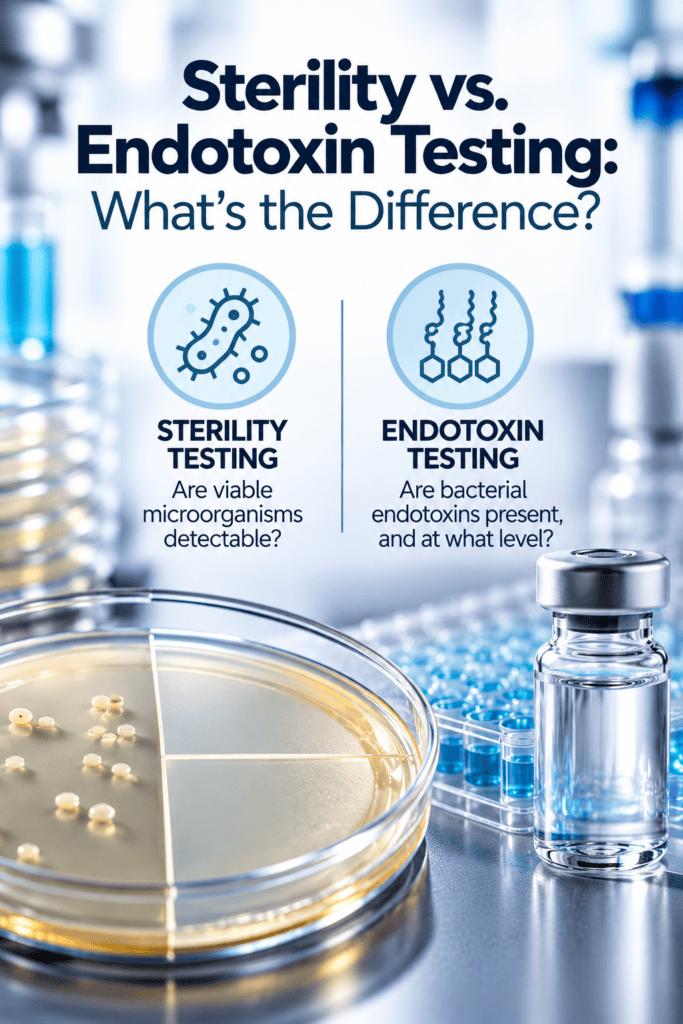
Sterility testing asks: Are viable microorganisms detected under the test conditions?
Endotoxin testing asks: Is bacterial endotoxin detected, and does it meet the specified limit?
Passing one test therefore cannot substitute for passing the other.
Think of them as two different contamination checkpoints: one looks for living microbial contamination, while the other looks for a specific bacterial contaminant that can remain behind.
Why HPLC Purity Doesn’t Answer Either Question
HPLC purity, sterility testing, and bacterial endotoxin testing evaluate different characteristics of a sample.
A high HPLC purity percentage indicates that the primary detected chromatographic component accounts for most of the measured signal under the test conditions. It does not determine whether viable microorganisms or bacterial endotoxins are present.
⚠️ IMPORTANT DISTINCTION
A result such as 99%+ HPLC purity does not mean 99% sterile, 99% endotoxin-free, or 99% “clean.” Those are separate analytical questions requiring different testing methods.
In simple terms:
HPLC → Chromatographic purity
Sterility testing → Viable microbial contamination
Endotoxin testing → Bacterial endotoxin
Each result tells you something useful—but none can stand in for the others.
Want a deeper look at analytical purity?
See our guides: How to Read an HPLC Chromatogram: Peaks, Retention Time & Purity and HPLC vs. Mass Spectrometry: What Does Each Test Actually Tell You?
How to Read Sterility & Endotoxin Results on a COA
When both tests appear on a Certificate of Analysis, evaluate them separately. They provide different information and may be reported in very different ways.
For sterility testing, look for the test method and whether microbial growth was detected during the specified test period. Results may be reported as “No Growth,” “Pass,” or “Meets USP <71>.”
For bacterial endotoxin testing, look for the measured result and the laboratory’s specified acceptance limit. Depending on the method and sample, results may be reported numerically in Endotoxin Units (EU) or as being below a stated limit.
📊 READING THE DATA
A simple way to approach the COA:
Sterility: Was microbial growth detected under the test conditions?
Endotoxin: What endotoxin level was detected, and is it within the specified acceptance criterion?
Together: Do the results support both the reported sterility result and acceptable bacterial endotoxin levels?
🔬 RESEARCH NOTE
A result such as “<0.05 EU/mL” does not necessarily mean zero endotoxin. The “<” means the measured amount was below the laboratory’s stated reporting or measurement threshold for that result.
The big takeaway: don’t use one result to infer the other. Read each according to the test it actually represents.
Key Takeaways
Sterility and endotoxin testing evaluate different types of contamination. Sterility testing looks for detectable viable microorganisms, while bacterial endotoxin testing looks for endotoxins associated with Gram-negative bacteria.
Sterile does not mean endotoxin-free. Endotoxins can remain even when the bacteria that produced them are no longer viable.
An acceptable endotoxin result does not establish sterility. A sample can meet an endotoxin limit while sterility remains a separate question requiring its own test.
HPLC purity tells you neither. Chromatographic purity does not establish sterility or bacterial endotoxin levels.
Each result should be interpreted according to its own test method and acceptance criteria. One test cannot substitute for another simply because they appear together on a COA.
The simplest way to remember it:
Sterility → Are viable microorganisms detected?
Endotoxin → Is bacterial endotoxin detected, and at what level?
HPLC → What does the chromatographic purity profile look like?
Different tests. Different questions. Different pieces of the analytical picture.
Continue Your Research...
What is HPLC?
HPLC vs Mass Spectrometry
How to Read a COA
Understanding Purity Percentages
How to Read an HPLC Chromatogram
References
1. United States Pharmacopeia (USP).
General Chapter <71> Sterility Tests. USP–NF.
Establishes the compendial procedures used for sterility testing, including testing for evidence of microbial growth under specified conditions.
USP — <71> Sterility Tests
2. United States Pharmacopeia (USP).
General Chapter <85> Bacterial Endotoxins Test. USP–NF.
Describes methods for detecting or quantifying bacterial endotoxins present in or on tested samples.
USP — <85> Bacterial Endotoxins Test
3. U.S. Food and Drug Administration (FDA).
Pyrogen and Endotoxins Testing: Questions and Answers — Guidance for Industry, Edition 2. March 2026.
Provides FDA’s current guidance concerning endotoxin testing, acceptance criteria, test methods, and the relationship between bacterial endotoxin and broader pyrogen testing.
FDA — Pyrogen and Endotoxins Testing: Questions and Answers
4. U.S. Food and Drug Administration (FDA).
Q4B Annex 8: Sterility Test General Chapter. December 2009.
Addresses regulatory recognition of harmonized pharmacopoeial sterility-test procedures, including the USP sterility chapter.
FDA — Q4B Annex 8: Sterility Test General Chapter
5. U.S. Food and Drug Administration (FDA).
Container and Closure System Integrity Testing in Lieu of Sterility Testing as a Component of the Stability Protocol for Sterile Products.
Especially useful for understanding the limitations of sterility testing: FDA notes that the test detects viable microorganisms only when they are present in the tested sample and capable of growing in the specified culture media.
FDA — Sterility Testing and Container Closure Integrity
Research Disclaimer
The information provided in this guide is intended solely for educational and research purposes. It is designed to help readers understand common laboratory analytical terminology and should not be interpreted as medical advice or as a statement regarding the safety, efficacy, or intended use of any research material.
Sterility vs Endotoxin Testing
At a Glance
Reading Time: 5-6 minutes
You’ll Learn
- What sterility testing evaluates and what a sterility result actually means
- What bacterial endotoxin testing measures and why endotoxins are different from living bacteria
- Why “sterile” and “endotoxin-free” are not interchangeable terms
- Why HPLC purity does not establish sterility or endotoxin levels
- How to interpret sterility and endotoxin results when they appear on a COA
Introduction
What’s the Difference?
When evaluating laboratory testing, sterility and bacterial endotoxin results are sometimes treated as though they measure the same thing. They don’t.
Sterility testing is designed to detect viable microorganisms capable of growing under the specified test conditions. Bacterial endotoxin testing looks instead for endotoxins associated with Gram-negative bacteria—contaminants that may remain even when the bacteria themselves are no longer viable.
That means a sample can meet sterility test requirements and still contain detectable endotoxin. Likewise, an acceptable endotoxin result does not establish sterility.
These tests answer different contamination questions, and understanding that distinction makes their results far more useful when evaluating a Certificate of Analysis.
Sterility Testing: Looking for Microbial Contamination
Sterility testing evaluates whether viable contaminating microorganisms can be detected in a sample under defined test conditions. In compendial testing, the sample is exposed to growth media designed to support microorganisms and observed for evidence of microbial growth.
The goal is straightforward: determine whether organisms capable of reproducing under those conditions are detected during the test period.
🔬 RESEARCH NOTE
USP <71> Sterility Tests describes compendial methods such as membrane filtration and direct inoculation, along with specified culture media, incubation conditions, and observation periods.
⚠️ IMPORTANT DISTINCTION
A reported sterility test result should not be interpreted as proof that every possible microorganism is absent from every unit. Sterility testing examines specified samples using defined procedures and conditions. A passing result means that microbial growth was not detected under those test conditions.
📊 READING THE DATA
Sterility results may be reported using language such as “No Growth,” “Pass,” or “Meets USP <71>.” In each case, the important question is whether microbial growth was detected during the specified test.
Endotoxin Testing: Looking for Bacterial Endotoxins
Bacterial endotoxin testing looks for endotoxins rather than living microorganisms. Endotoxins are components of the outer membrane of Gram-negative bacteria and can be released when bacterial cells break apart.
Unlike sterility testing, the goal is not to determine whether microorganisms can grow. Instead, the test measures whether bacterial endotoxin is present and, when quantified, how much is detected.
🔬 RESEARCH NOTE
USP <85> Bacterial Endotoxins Test describes compendial methods for detecting or quantifying endotoxins from Gram-negative bacteria. Results are commonly expressed in Endotoxin Units (EU), such as EU/mL.
📊 READING THE DATA
An endotoxin result may appear as a numerical value, a result below a specified detection or quantitation threshold, or simply “Pass” relative to an established limit. Unlike a sterility result, it is evaluating endotoxin—not microbial growth.

Sterile Does Not Mean Endotoxin-Free
This is the distinction that ties everything together: sterility and endotoxin are not two ways of measuring the same type of contamination.
A sample may show no detectable microbial growth during sterility testing while still containing bacterial endotoxins. That can happen because endotoxins are bacterial components—not living organisms—and may remain after the bacteria that produced them are no longer viable.
The reverse distinction matters too: an acceptable endotoxin result does not demonstrate that viable microorganisms are absent.
⚠️ IMPORTANT DISTINCTION
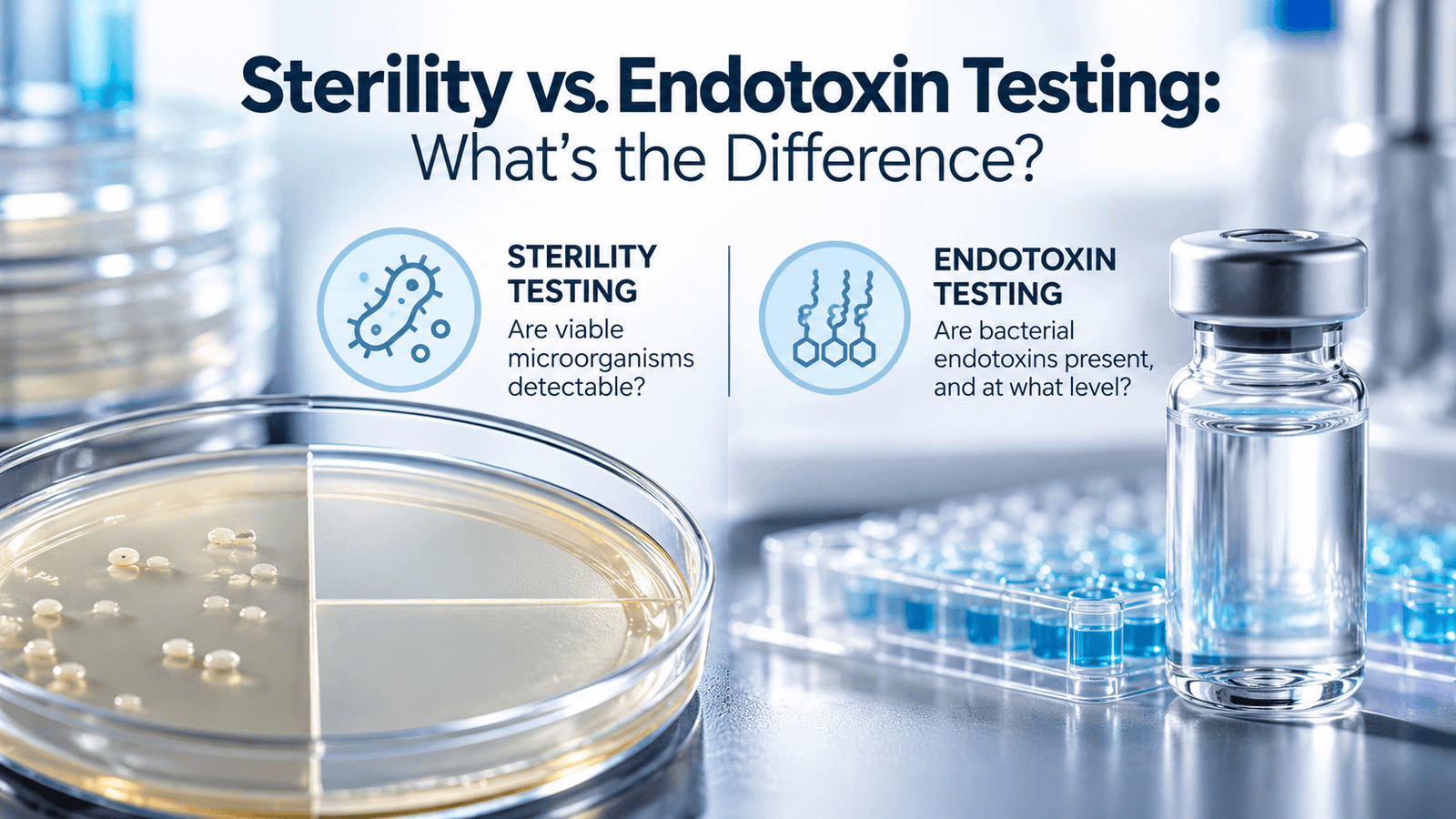
Sterility testing asks: Are viable microorganisms detected under the test conditions?
Endotoxin testing asks: Is bacterial endotoxin detected, and does it meet the specified limit?
Passing one test therefore cannot substitute for passing the other.
Think of them as two different contamination checkpoints: one looks for living microbial contamination, while the other looks for a specific bacterial contaminant that can remain behind.
Why HPLC Purity Doesn’t Answer Either Question
HPLC purity, sterility testing, and bacterial endotoxin testing evaluate different characteristics of a sample.
A high HPLC purity percentage indicates that the primary detected chromatographic component accounts for most of the measured signal under the test conditions. It does not determine whether viable microorganisms or bacterial endotoxins are present.
⚠️ IMPORTANT DISTINCTION
A result such as 99%+ HPLC purity does not mean 99% sterile, 99% endotoxin-free, or 99% “clean.” Those are separate analytical questions requiring different testing methods.
In simple terms:
HPLC → Chromatographic purity
Sterility testing → Viable microbial contamination
Endotoxin testing → Bacterial endotoxin
Each result tells you something useful—but none can stand in for the others.
Want a deeper look at analytical purity?
See our guides: How to Read an HPLC Chromatogram: Peaks, Retention Time & Purity and HPLC vs. Mass Spectrometry: What Does Each Test Actually Tell You?
How to Read Sterility & Endotoxin Results on a COA
When both tests appear on a Certificate of Analysis, evaluate them separately. They provide different information and may be reported in very different ways.
For sterility testing, look for the test method and whether microbial growth was detected during the specified test period. Results may be reported as “No Growth,” “Pass,” or “Meets USP <71>.”
For bacterial endotoxin testing, look for the measured result and the laboratory’s specified acceptance limit. Depending on the method and sample, results may be reported numerically in Endotoxin Units (EU) or as being below a stated limit.
📊 READING THE DATA
A simple way to approach the COA:
Sterility: Was microbial growth detected under the test conditions?
Endotoxin: What endotoxin level was detected, and is it within the specified acceptance criterion?
Together: Do the results support both the reported sterility result and acceptable bacterial endotoxin levels?
🔬 RESEARCH NOTE
A result such as “<0.05 EU/mL” does not necessarily mean zero endotoxin. The “<” means the measured amount was below the laboratory’s stated reporting or measurement threshold for that result.
The big takeaway: don’t use one result to infer the other. Read each according to the test it actually represents.
Key Takeaways
Sterility and endotoxin testing evaluate different types of contamination. Sterility testing looks for detectable viable microorganisms, while bacterial endotoxin testing looks for endotoxins associated with Gram-negative bacteria.
Sterile does not mean endotoxin-free. Endotoxins can remain even when the bacteria that produced them are no longer viable.
An acceptable endotoxin result does not establish sterility. A sample can meet an endotoxin limit while sterility remains a separate question requiring its own test.
HPLC purity tells you neither. Chromatographic purity does not establish sterility or bacterial endotoxin levels.
Each result should be interpreted according to its own test method and acceptance criteria. One test cannot substitute for another simply because they appear together on a COA.
The simplest way to remember it:
Sterility → Are viable microorganisms detected?
Endotoxin → Is bacterial endotoxin detected, and at what level?
HPLC → What does the chromatographic purity profile look like?
Different tests. Different questions. Different pieces of the analytical picture.
Continue Your Research....
How to Read a COA
3X vs 15X Testing
Understanding Purity Percentages
How to Read an HPLC Chromatogram
HPLC vs Mass Spectrometry
References
1. United States Pharmacopeia (USP).
General Chapter <71> Sterility Tests. USP–NF.
Establishes the compendial procedures used for sterility testing, including testing for evidence of microbial growth under specified conditions.
USP — <71> Sterility Tests
2. United States Pharmacopeia (USP).
General Chapter <85> Bacterial Endotoxins Test. USP–NF.
Describes methods for detecting or quantifying bacterial endotoxins present in or on tested samples.
USP — <85> Bacterial Endotoxins Test
3. U.S. Food and Drug Administration (FDA).
Pyrogen and Endotoxins Testing: Questions and Answers — Guidance for Industry, Edition 2. March 2026.
Provides FDA’s current guidance concerning endotoxin testing, acceptance criteria, test methods, and the relationship between bacterial endotoxin and broader pyrogen testing.
FDA — Pyrogen and Endotoxins Testing: Questions and Answers
4. U.S. Food and Drug Administration (FDA).
Q4B Annex 8: Sterility Test General Chapter. December 2009.
Addresses regulatory recognition of harmonized pharmacopoeial sterility-test procedures, including the USP sterility chapter.
FDA — Q4B Annex 8: Sterility Test General Chapter
5. U.S. Food and Drug Administration (FDA).
Container and Closure System Integrity Testing in Lieu of Sterility Testing as a Component of the Stability Protocol for Sterile Products.
Especially useful for understanding the limitations of sterility testing: FDA notes that the test detects viable microorganisms only when they are present in the tested sample and capable of growing in the specified culture media.
FDA — Sterility Testing and Container Closure Integrity
Research Disclaimer
The information provided in this guide is intended solely for educational and research purposes. It is designed to help readers understand common laboratory analytical terminology and should not be interpreted as medical advice or as a statement regarding the safety, efficacy, or intended use of any research material.