

What is HPLC?
AT A GLANCE
reading time 5-6 minutes
You’ll Learn
- What High-Performance Liquid Chromatography (HPLC) is
- Why laboratories use HPLC during analytical testing
- How HPLC separates compounds for analysis
- What chromatograms show
- Why HPLC is considered one of the industry’s most trusted analytical methods
Introduction
High-Performance Liquid Chromatography (HPLC) is one of the most widely used analytical techniques for separating and evaluating compounds within a liquid sample. Rather than examining a sample as a single substance, HPLC separates its components as they travel through a specialized column, allowing a detector to measure them individually.
In laboratory analysis, HPLC can provide valuable information about what components are detected, when they emerge from the column, and their relative or measured amounts, depending on the analytical method being used. The resulting data are displayed as a chromatogram—the familiar graph of peaks often included with laboratory testing results and Certificates of Analysis.
HPLC is frequently used when evaluating purity, but understanding what an HPLC result actually tells you is just as important as the number printed on a report. A high reported purity percentage does not, by itself, answer every question about a sample’s identity, quantity, sterility, contaminants, or overall quality.
This guide explains how HPLC works, what its peaks and percentages mean, what the technique can—and cannot—tell researchers, and how HPLC fits into the larger picture of analytical testing.
What Does HPLC Stand For?
HPLC stands for High-Performance Liquid Chromatography.
It is an analytical technique used to separate the individual components of a mixture so they can be detected and evaluated separately.
Different compounds interact with the stationary phase differently. This difference in movement allows compounds that began together in the same sample to become separated before reaching the detector.
The detector records the compounds as they leave the column, producing the series of peaks seen on an HPLC chromatogram. Researchers can then use information such as retention time, detector response, and peak area to help evaluate the sample.
How Does HPLC Work?
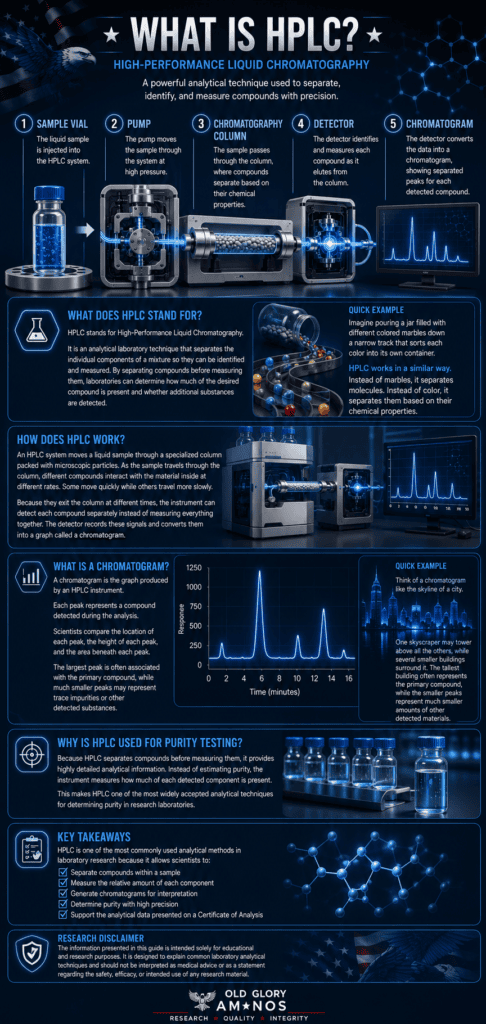
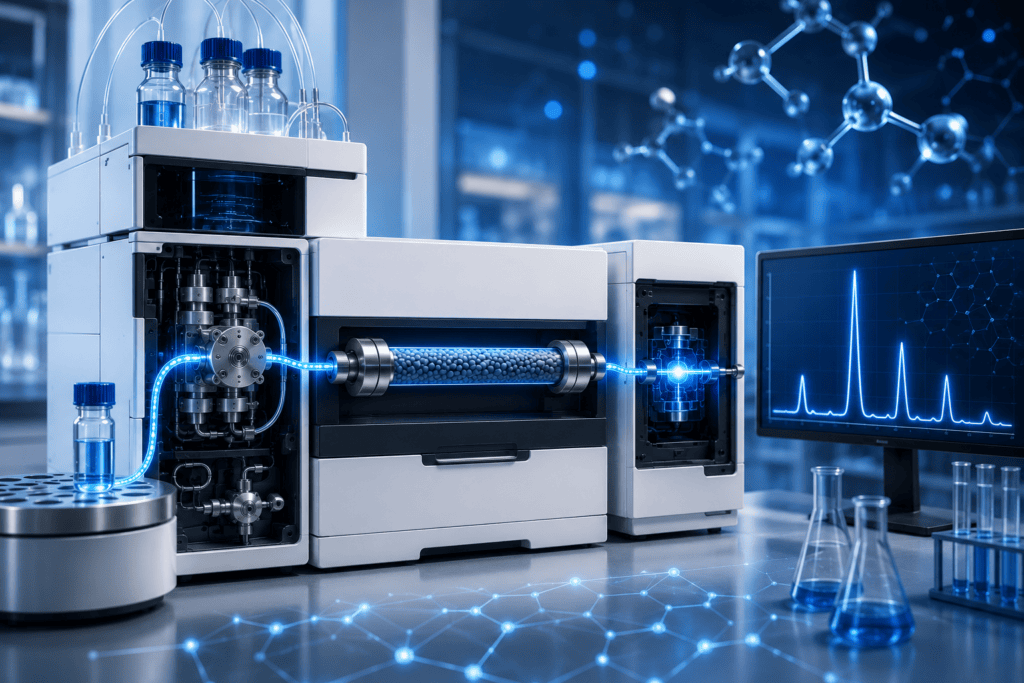
An HPLC analysis begins when a small amount of prepared sample is introduced into a flowing liquid called the mobile phase. A high-pressure pump moves the mobile phase and sample through a specialized column containing the stationary phase.
As the sample travels through the column, its individual components interact differently with the stationary phase and the mobile phase. Some compounds move through the column relatively quickly, while others are retained longer. These differences cause the components of the sample to separate from one another.
As each separated component exits the column, it passes through a detector, which records a signal. The amount of time a compound takes to travel through the system is called its retention time.
The detector’s signals are plotted over time to create a graph called a chromatogram. Instead of seeing the sample as one combined substance, researchers can examine the separated peaks and evaluate the components detected during the analysis.
🔬 RESEARCH NOTE
Retention time can help researchers compare an unknown sample with a known reference standard, but retention time alone does not conclusively establish a compound’s identity. Analytical conditions and additional testing may be needed for confident identification.
What Does HPLC Measure?
HPLC measures the response produced as separated components of a sample pass through a detector. From this data, researchers can evaluate several characteristics of the sample, depending on the analytical method and detector being used.
One important measurement is retention time—the amount of time it takes a component to travel through the chromatographic system and reach the detector. When testing conditions are carefully controlled, retention time can be compared with that of a known reference standard and used as one piece of information when evaluating a compound’s identity.
HPLC also measures detector response, which appears as peaks on the chromatogram. The area of a peak reflects the detector’s response to that component. With an appropriately validated method and calibration using known standards, peak area can be used to determine the concentration or amount of a target compound in a sample.
HPLC can also be used to evaluate relative purity by comparing the detector response associated with the primary component to other detected peaks. However, the meaning of a reported purity percentage depends on the analytical method, detector, integration parameters, and which substances the method is capable of detecting.
This is why an HPLC result should be interpreted as analytical information produced under specific testing conditions, rather than as a complete description of everything present—or absent—in a sample.
⚠️ IMPORTANT DISTINCTION
HPLC purity, identity, and quantity are related—but they are not the same measurement. A reported purity percentage should not automatically be interpreted as confirmation of identity, quantity, sterility, or the absence of every possible contaminant.
What Does HPLC Purity Percentage Mean?
When an HPLC report lists a purity percentage, it commonly refers to the relative area of the target peak compared with the total area of the integrated peaks detected in the chromatogram.
For example, if the target compound accounts for 99% of the total integrated peak area, the result may be reported as approximately 99% HPLC purity. Smaller integrated peaks may represent impurities, degradation products, related substances, or other compounds that produce a response under the analytical conditions.
However, 99% HPLC purity does not necessarily mean that 99% of everything physically present in the sample is the target compound. Area-percent calculations assume that the detected components produce comparable detector responses unless appropriate response or correction factors are used. Some substances may respond differently to the detector, may not be detected effectively by the method, or may fall below the method’s reporting or integration thresholds.
The reported percentage therefore needs to be understood in the context of the analytical method, detector, integration parameters, reference standards, and substances the method was designed to detect.
HPLC purity is extremely useful analytical information—but it answers a specific question. It should not automatically be interpreted as confirmation of a sample’s identity, total quantity, sterility, endotoxin level, heavy-metal content, or the absence of every possible contaminant.
⚠️ IMPORTANT DISTINCTION
99% HPLC purity does not mean “99% of everything in the vial is the desired compound.” It generally describes the relative chromatographic response of the target peak compared with the other integrated peaks detected under that specific HPLC method.
What is a Chromatogram?
The final output of an HPLC analysis is called a chromatogram—a graph showing the detector’s response as the separated components of a sample exit the HPLC column over time.
Each detected component generally appears as a peak on the chromatogram. The horizontal axis represents retention time, while the vertical axis represents the strength of the detector’s response.
Researchers examine several characteristics of these peaks. Retention time indicates when a component reached the detector, while peak area represents the detector’s total response to that component as it passed through. Under an appropriate analytical method, these measurements can be compared with reference standards or with other detected peaks to help evaluate the sample.
The largest peak is often associated with the primary component being analyzed, while smaller peaks may represent related substances, degradation products, impurities, or other detectable compounds. However, peak size alone does not establish a compound’s identity, and not every substance present in a sample will necessarily be visible under every HPLC method.
Reading a chromatogram therefore involves more than simply looking for one large peak. The analytical method, detector, retention times, peak integration, reference standards, and testing conditions all contribute to how the results should be interpreted.
Why is HPLC Used for Purity Testing?
HPLC is widely used for purity analysis because it can separate components within a mixture and measure their detector responses individually. Rather than evaluating a sample only as a whole, chromatographic separation can reveal additional detectable components that may otherwise be difficult to distinguish.
Under a properly developed analytical method, researchers can compare the response associated with the primary component against other integrated peaks in the chromatogram. This makes HPLC particularly useful for evaluating relative purity, related substances, degradation products, and certain impurities that the method is designed and capable of detecting.
HPLC also offers a high degree of precision and reproducibility when analytical conditions are carefully controlled. Factors such as the column, mobile phase, flow rate, temperature, detector settings, sample preparation, and integration parameters can be standardized so results can be meaningfully compared between analyses.
However, HPLC purity testing has limits. A chromatogram only reflects compounds that can be separated and detected under the particular method being used. HPLC purity should therefore be viewed as one part of a broader analytical picture—not as proof that every possible impurity or contaminant has been tested for or excluded.
🔬 RESEARCH NOTE
Different laboratory tests answer different questions. HPLC may provide valuable information about chromatographic purity, while other analytical methods may be needed to evaluate identity, quantity, sterility, endotoxins, elemental impurities, residual solvents, or other characteristics of a sample.
Can HPLC Identify a Compound?
HPLC can provide valuable information that contributes to compound identification, but an HPLC chromatogram should not automatically be treated as definitive proof of identity.
One important clue is retention time. Under controlled analytical conditions, researchers can compare the retention time of a sample peak with the retention time of a known reference standard. A close match provides evidence that the expected compound may be present.
However, different compounds can sometimes produce similar retention behavior under the same chromatographic conditions. For this reason, retention time alone is generally not considered sufficiently specific for conclusive identification. The FDA, for example, states that identification based solely on a single chromatographic retention time is not regarded as specific.
Additional analytical information can provide stronger evidence of identity. Techniques such as LC-MS (Liquid Chromatography–Mass Spectrometry) combine chromatographic separation with mass information, while other analytical approaches may provide additional structural or chemical confirmation.
The important distinction is that purity and identity answer different questions: purity evaluates how much of the detected chromatographic response is associated with the primary component, while identity asks whether that component is actually the compound researchers expect it to be.
What can HPLC Not Tell You?
HPLC is a powerful analytical technique, but no single laboratory method can answer every question about a sample.
An HPLC chromatogram only reflects substances that can be separated and detected under the particular analytical conditions being used. The column chemistry, mobile phase, detector, wavelength or detection settings, sample preparation, reference standards, integration parameters, and other method conditions all influence the information produced.
Depending on the method, HPLC may provide information about chromatographic purity, retention behavior, impurities, and quantity or concentration. However, an HPLC purity result alone does not necessarily establish:
- definitive compound identity
- the total amount of material in a container
- sterility
- endotoxin levels
- heavy-metal or elemental impurity levels
- residual solvent levels
- the absence of every possible contaminant
Evaluating those characteristics may require additional analytical methods specifically designed for those questions.
This is why laboratory results are best understood by asking not simply “Was it tested?” but “What was tested, which analytical method was used, and what can that method actually demonstrate?”
HPLC vs Other Laboratory Tests
HPLC is one tool within a much larger analytical toolbox. Different laboratory methods are designed to evaluate different characteristics of a sample, and one method should not automatically be assumed to answer questions that require another.
For example, chromatographic methods may be used to evaluate purity, related substances, degradation products, or quantity, while mass spectrometry can provide additional information useful for evaluating molecular identity. Other specialized methods are used when researchers need information about characteristics such as sterility, endotoxins, elemental impurities, or residual solvents.
In some analyses, multiple technologies are even combined. LC-MS, for example, couples liquid chromatography with mass spectrometry so researchers obtain both chromatographic separation and mass information about detected compounds.
This distinction becomes especially important when comparing claims such as “3X tested,” “5X tested,” “7X tested,” or “15X tested.” The number of tests alone does not explain what was evaluated. Understanding the individual analytical methods—and the question each method answers—provides much more useful information than the number by itself.
Key Takeaways
HPLC is one of the most commonly used analytical methods in laboratory research because it allows scientists to:
- Separate compounds within a sample
- Measure the relative amount of each component
- Generate chromatograms for interpretation
- Determine purity with high precision
- Support the analytical data presented on a Certificate of Analysis
Continue Your Research...
What Are Amino Acid Compounds?
How to Read a COA
Understanding Purity Percentages
3X vs 15X Testing
References & Further Reading
United States Pharmacopeia (USP). General Chapter <621> Chromatography.
Overview of chromatographic separation principles, mobile and stationary phases, and the use of chromatography for qualitative and quantitative analysis.
USP General Chapter <621> Chromatography
U.S. Food and Drug Administration (FDA). Q6A Specifications: Test Procedures and Acceptance Criteria for New Drug Substances and New Drug Products: Chemical Substances.
Useful guidance on analytical identification, including the important limitation that identification based solely on a single chromatographic retention time is not considered sufficiently specific. The guidance also discusses combined approaches such as HPLC/MS.
FDA Q6A Guidance
Shimadzu Corporation. What Is HPLC (High Performance Liquid Chromatography)?
Technical introduction to HPLC separation, mobile and stationary phases, chromatograms, retention time, peak height and peak area, and qualitative and quantitative analysis.
Shimadzu — What Is HPLC?
Shimadzu Scientific Instruments. High Performance Liquid Chromatography (HPLC) Basics.
Educational reference covering HPLC system components, differential migration through the column, detection, chromatograms and the relationship between chromatographic peaks and analytical measurements.
Shimadzu — HPLC Basics
Agilent Technologies. OpenLab CDS Data Analysis — Area% and Height%.
Explains how chromatographic Area% is calculated and an especially important limitation: Area% approximates relative amounts when the detected components respond equally to the detector; response factors are not applied in the basic Area% calculation.
Agilent — Area% and Height%
Agilent Technologies. OpenLab CDS Data Analysis — Results and Chromatographic Terminology.
Technical reference for retention time, peak area, Area%, peak height and related chromatographic measurements.
Agilent OpenLab Data Analysis Glossary
Research Disclaimer
The information provided in this guide is intended solely for educational and research purposes. It is designed to help readers understand common laboratory analytical terminology and should not be interpreted as medical advice or as a statement regarding the safety, efficacy, or intended use of any research material.
What is HPLC?
At a Glance
Reading Time: 5-6 minutes
You’ll Learn
- What High-Performance Liquid Chromatography (HPLC) is
- Why laboratories use HPLC during analytical testing
- How HPLC separates compounds for analysis
- What chromatograms show
- Why HPLC is considered one of the industry’s most trusted analytical methods
Introduction
High-Performance Liquid Chromatography (HPLC) is one of the most widely used analytical techniques for separating and evaluating compounds within a liquid sample. Rather than examining a sample as a single substance, HPLC separates its components as they travel through a specialized column, allowing a detector to measure them individually.
In laboratory analysis, HPLC can provide valuable information about what components are detected, when they emerge from the column, and their relative or measured amounts, depending on the analytical method being used. The resulting data are displayed as a chromatogram—the familiar graph of peaks often included with laboratory testing results and Certificates of Analysis.
HPLC is frequently used when evaluating purity, but understanding what an HPLC result actually tells you is just as important as the number printed on a report. A high reported purity percentage does not, by itself, answer every question about a sample’s identity, quantity, sterility, contaminants, or overall quality.
This guide explains how HPLC works, what its peaks and percentages mean, what the technique can—and cannot—tell researchers, and how HPLC fits into the larger picture of analytical testing.
What Does HPLC Stand For?
HPLC stands for High-Performance Liquid Chromatography.
It is an analytical technique used to separate the individual components of a mixture so they can be detected and evaluated separately.
Different compounds interact with the stationary phase differently. This difference in movement allows compounds that began together in the same sample to become separated before reaching the detector.
The detector records the compounds as they leave the column, producing the series of peaks seen on an HPLC chromatogram. Researchers can then use information such as retention time, detector response, and peak area to help evaluate the sample.
How Does HPLC Work?
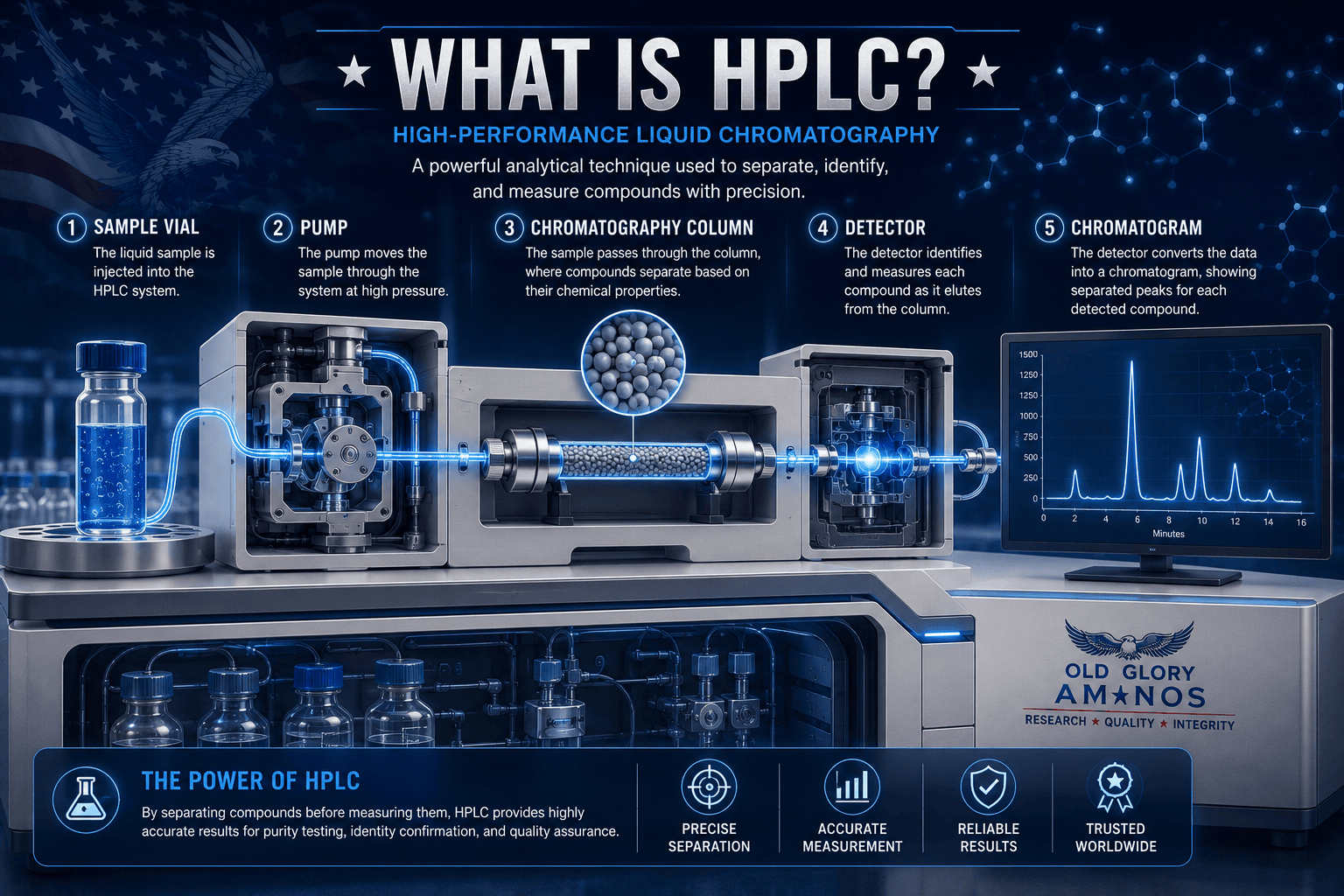
An HPLC analysis begins when a small amount of prepared sample is introduced into a flowing liquid called the mobile phase. A high-pressure pump moves the mobile phase and sample through a specialized column containing the stationary phase.
As the sample travels through the column, its individual components interact differently with the stationary phase and the mobile phase. Some compounds move through the column relatively quickly, while others are retained longer. These differences cause the components of the sample to separate from one another.
As each separated component exits the column, it passes through a detector, which records a signal. The amount of time a compound takes to travel through the system is called its retention time.
The detector’s signals are plotted over time to create a graph called a chromatogram. Instead of seeing the sample as one combined substance, researchers can examine the separated peaks and evaluate the components detected during the analysis.
🔬 RESEARCH NOTE
Retention time can help researchers compare an unknown sample with a known reference standard, but retention time alone does not conclusively establish a compound’s identity. Analytical conditions and additional testing may be needed for confident identification.
What Does HPLC Measure?
HPLC measures the response produced as separated components of a sample pass through a detector. From this data, researchers can evaluate several characteristics of the sample, depending on the analytical method and detector being used.
One important measurement is retention time—the amount of time it takes a component to travel through the chromatographic system and reach the detector. When testing conditions are carefully controlled, retention time can be compared with that of a known reference standard and used as one piece of information when evaluating a compound’s identity.
HPLC also measures detector response, which appears as peaks on the chromatogram. The area of a peak reflects the detector’s response to that component. With an appropriately validated method and calibration using known standards, peak area can be used to determine the concentration or amount of a target compound in a sample.
HPLC can also be used to evaluate relative purity by comparing the detector response associated with the primary component to other detected peaks. However, the meaning of a reported purity percentage depends on the analytical method, detector, integration parameters, and which substances the method is capable of detecting.
This is why an HPLC result should be interpreted as analytical information produced under specific testing conditions, rather than as a complete description of everything present—or absent—in a sample.
⚠️ IMPORTANT DISTINCTION
HPLC purity, identity, and quantity are related—but they are not the same measurement. A reported purity percentage should not automatically be interpreted as confirmation of identity, quantity, sterility, or the absence of every possible contaminant.
What Does HPLC Purity Percentage Mean?
When an HPLC report lists a purity percentage, it commonly refers to the relative area of the target peak compared with the total area of the integrated peaks detected in the chromatogram.
For example, if the target compound accounts for 99% of the total integrated peak area, the result may be reported as approximately 99% HPLC purity. Smaller integrated peaks may represent impurities, degradation products, related substances, or other compounds that produce a response under the analytical conditions.
However, 99% HPLC purity does not necessarily mean that 99% of everything physically present in the sample is the target compound. Area-percent calculations assume that the detected components produce comparable detector responses unless appropriate response or correction factors are used. Some substances may respond differently to the detector, may not be detected effectively by the method, or may fall below the method’s reporting or integration thresholds.
The reported percentage therefore needs to be understood in the context of the analytical method, detector, integration parameters, reference standards, and substances the method was designed to detect.
HPLC purity is extremely useful analytical information—but it answers a specific question. It should not automatically be interpreted as confirmation of a sample’s identity, total quantity, sterility, endotoxin level, heavy-metal content, or the absence of every possible contaminant.
⚠️ IMPORTANT DISTINCTION
99% HPLC purity does not mean “99% of everything in the vial is the desired compound.” It generally describes the relative chromatographic response of the target peak compared with the other integrated peaks detected under that specific HPLC method.
What is a Chromatogram?
The final output of an HPLC analysis is called a chromatogram—a graph showing the detector’s response as the separated components of a sample exit the HPLC column over time.
Each detected component generally appears as a peak on the chromatogram. The horizontal axis represents retention time, while the vertical axis represents the strength of the detector’s response.
Researchers examine several characteristics of these peaks. Retention time indicates when a component reached the detector, while peak area represents the detector’s total response to that component as it passed through. Under an appropriate analytical method, these measurements can be compared with reference standards or with other detected peaks to help evaluate the sample.
The largest peak is often associated with the primary component being analyzed, while smaller peaks may represent related substances, degradation products, impurities, or other detectable compounds. However, peak size alone does not establish a compound’s identity, and not every substance present in a sample will necessarily be visible under every HPLC method.
Reading a chromatogram therefore involves more than simply looking for one large peak. The analytical method, detector, retention times, peak integration, reference standards, and testing conditions all contribute to how the results should be interpreted.
Why is HPLC Used for Purity Testing?
HPLC is widely used for purity analysis because it can separate components within a mixture and measure their detector responses individually. Rather than evaluating a sample only as a whole, chromatographic separation can reveal additional detectable components that may otherwise be difficult to distinguish.
Under a properly developed analytical method, researchers can compare the response associated with the primary component against other integrated peaks in the chromatogram. This makes HPLC particularly useful for evaluating relative purity, related substances, degradation products, and certain impurities that the method is designed and capable of detecting.
HPLC also offers a high degree of precision and reproducibility when analytical conditions are carefully controlled. Factors such as the column, mobile phase, flow rate, temperature, detector settings, sample preparation, and integration parameters can be standardized so results can be meaningfully compared between analyses.
However, HPLC purity testing has limits. A chromatogram only reflects compounds that can be separated and detected under the particular method being used. HPLC purity should therefore be viewed as one part of a broader analytical picture—not as proof that every possible impurity or contaminant has been tested for or excluded.
🔬 RESEARCH NOTE
Different laboratory tests answer different questions. HPLC may provide valuable information about chromatographic purity, while other analytical methods may be needed to evaluate identity, quantity, sterility, endotoxins, elemental impurities, residual solvents, or other characteristics of a sample.
Can HPLC Identify a Compound?
HPLC can provide valuable information that contributes to compound identification, but an HPLC chromatogram should not automatically be treated as definitive proof of identity.
One important clue is retention time. Under controlled analytical conditions, researchers can compare the retention time of a sample peak with the retention time of a known reference standard. A close match provides evidence that the expected compound may be present.
However, different compounds can sometimes produce similar retention behavior under the same chromatographic conditions. For this reason, retention time alone is generally not considered sufficiently specific for conclusive identification. The FDA, for example, states that identification based solely on a single chromatographic retention time is not regarded as specific.
Additional analytical information can provide stronger evidence of identity. Techniques such as LC-MS (Liquid Chromatography–Mass Spectrometry) combine chromatographic separation with mass information, while other analytical approaches may provide additional structural or chemical confirmation.
The important distinction is that purity and identity answer different questions: purity evaluates how much of the detected chromatographic response is associated with the primary component, while identity asks whether that component is actually the compound researchers expect it to be.
What can HPLC Not Tell You?
HPLC is a powerful analytical technique, but no single laboratory method can answer every question about a sample.
An HPLC chromatogram only reflects substances that can be separated and detected under the particular analytical conditions being used. The column chemistry, mobile phase, detector, wavelength or detection settings, sample preparation, reference standards, integration parameters, and other method conditions all influence the information produced.
Depending on the method, HPLC may provide information about chromatographic purity, retention behavior, impurities, and quantity or concentration. However, an HPLC purity result alone does not necessarily establish:
- definitive compound identity
- the total amount of material in a container
- sterility
- endotoxin levels
- heavy-metal or elemental impurity levels
- residual solvent levels
- the absence of every possible contaminant
Evaluating those characteristics may require additional analytical methods specifically designed for those questions.
This is why laboratory results are best understood by asking not simply “Was it tested?” but “What was tested, which analytical method was used, and what can that method actually demonstrate?”
HPLC vs Other Laboratory Tests
HPLC is one tool within a much larger analytical toolbox. Different laboratory methods are designed to evaluate different characteristics of a sample, and one method should not automatically be assumed to answer questions that require another.
For example, chromatographic methods may be used to evaluate purity, related substances, degradation products, or quantity, while mass spectrometry can provide additional information useful for evaluating molecular identity. Other specialized methods are used when researchers need information about characteristics such as sterility, endotoxins, elemental impurities, or residual solvents.
In some analyses, multiple technologies are even combined. LC-MS, for example, couples liquid chromatography with mass spectrometry so researchers obtain both chromatographic separation and mass information about detected compounds.
This distinction becomes especially important when comparing claims such as “3X tested,” “5X tested,” “7X tested,” or “15X tested.” The number of tests alone does not explain what was evaluated. Understanding the individual analytical methods—and the question each method answers—provides much more useful information than the number by itself.
Key Takeaways
HPLC is one of the most widely used analytical techniques for separating and evaluating components within a sample. The most important concepts to remember are:
- HPLC separates compounds before they are detected and evaluated.
- A chromatogram displays detector response over time as a series of peaks.
- Retention time provides useful information about when a component exits the chromatographic system.
- Peak area reflects detector response and can be used for quantitative analysis when an appropriate analytical method and calibration are used.
- An HPLC purity percentage commonly describes the relative chromatographic response associated with the primary peak compared with other integrated peaks—not necessarily the percentage of everything physically present in the sample.
- Purity, identity, and quantity are different analytical questions.
- HPLC results depend on the method, detector, reference standards, sample preparation, and testing conditions used.
- No single HPLC result establishes every characteristic of a sample; additional testing may be needed depending on the research question.
Continue Your Research....
HPLC vs Mass Spectrometry
How to Read a COA
3X vs 15X Testing
Understanding Purity Percentages
How to Read an HPLC Chromatogram
References & Further Reading
United States Pharmacopeia (USP). General Chapter <621> Chromatography.
Overview of chromatographic separation principles, mobile and stationary phases, and the use of chromatography for qualitative and quantitative analysis.
USP General Chapter <621> Chromatography
U.S. Food and Drug Administration (FDA). Q6A Specifications: Test Procedures and Acceptance Criteria for New Drug Substances and New Drug Products: Chemical Substances.
Useful guidance on analytical identification, including the important limitation that identification based solely on a single chromatographic retention time is not considered sufficiently specific. The guidance also discusses combined approaches such as HPLC/MS.
FDA Q6A Guidance
Shimadzu Corporation. What Is HPLC (High Performance Liquid Chromatography)?
Technical introduction to HPLC separation, mobile and stationary phases, chromatograms, retention time, peak height and peak area, and qualitative and quantitative analysis.
Shimadzu — What Is HPLC?
Shimadzu Scientific Instruments. High Performance Liquid Chromatography (HPLC) Basics.
Educational reference covering HPLC system components, differential migration through the column, detection, chromatograms and the relationship between chromatographic peaks and analytical measurements.
Shimadzu — HPLC Basics
Agilent Technologies. OpenLab CDS Data Analysis — Area% and Height%.
Explains how chromatographic Area% is calculated and an especially important limitation: Area% approximates relative amounts when the detected components respond equally to the detector; response factors are not applied in the basic Area% calculation.
Agilent — Area% and Height%
Agilent Technologies. OpenLab CDS Data Analysis — Results and Chromatographic Terminology.
Technical reference for retention time, peak area, Area%, peak height and related chromatographic measurements.
Agilent OpenLab Data Analysis Glossary
Research Disclaimer
The information provided in this guide is intended solely for educational and research purposes. It is designed to help readers understand common laboratory analytical terminology and should not be interpreted as medical advice or as a statement regarding the safety, efficacy, or intended use of any research material.