

Storage and Handling
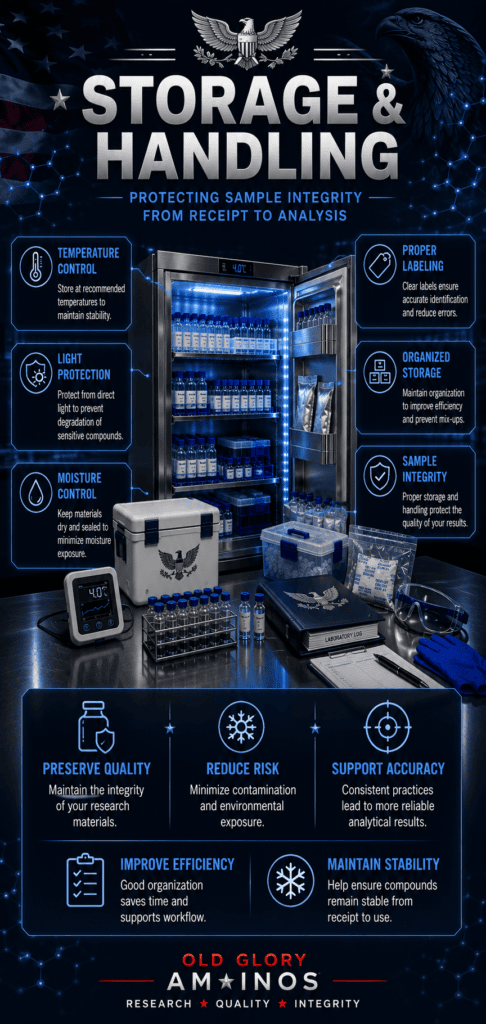
AT A GLANCE
reading time 5-6 minutes
You’ll Learn
- Why storage conditions can affect the stability of research materials
- How temperature, moisture, light, and oxygen exposure can contribute to degradation
- Why lyophilized materials and materials in solution may have different stability considerations
- How repeated temperature changes and freeze–thaw cycles can affect some materials
- Why careful handling helps reduce contamination and unnecessary environmental exposure
- Why storage recommendations should be based on the specific material and formulation, rather than a single rule for every compound
Introduction
Proper storage and handling are important for preserving the integrity of laboratory research materials. Even when a material has been manufactured and analytically characterized, its chemical stability can change over time if it is exposed to unfavorable environmental conditions.
Temperature, moisture, light, and oxygen can contribute to different forms of degradation, and the effects of those conditions can vary depending on the compound, formulation, and whether the material is stored in a dry or dissolved state.
Good storage practices are therefore less about following one universal rule and more about protecting the material from unnecessary environmental stress while following the storage conditions appropriate for that specific material.
🔬 RESEARCH NOTE
Storage recommendations are not interchangeable between research materials. The appropriate temperature, light protection, moisture control, and handling conditions depend on the chemical characteristics and formulation of the material being stored.
Why Storage Matters
Research materials are exposed to environmental conditions from the moment they are produced. Over time, those conditions can influence chemical stability and potentially change the composition of a sample.
Depending on the material, degradation may occur through processes such as hydrolysis, oxidation, or other chemical reactions. Temperature can influence the rate of these reactions, while moisture, light, and oxygen may create additional pathways for degradation.
This does not mean that every compound responds to these conditions in the same way. Some materials are considerably more stable than others, and stability can also change depending on whether the material is lyophilized, dissolved in solution, or formulated with other components.
💡 DID YOU KNOW?
Lyophilization removes water from a material under controlled conditions, which can improve the stability of some compounds by reducing reactions that depend on molecular mobility or water. It does not, however, make a material permanently stable or immune to environmental conditions.
⚠️ IMPORTANT DISTINCTION
“Stable” does not mean “unchanged forever.” Stability describes how well a material maintains defined characteristics under particular conditions and over a particular period of time.
Temperature & Stability
Temperature can have a significant effect on the rate at which chemical changes occur. In general, higher temperatures can accelerate many degradation reactions, which is why temperature control is an important part of long-term material storage.
Lower temperatures may slow these processes for some research materials, but colder is not automatically better in every situation. Appropriate storage temperature depends on the compound, its formulation, and whether it is stored as a dry material or in solution.
Temperature fluctuation can also matter. Repeated movement between warmer and colder environments may expose a sample to changing conditions and, in some cases, contribute to condensation or other physical and chemical stresses.
🔬 RESEARCH NOTE
A specified storage temperature should be treated as a defined condition rather than a general suggestion. When storage information is available for a particular material, those documented conditions should take priority over generalized rules.
⚠️ IMPORTANT DISTINCTION
Refrigeration and freezing can help preserve some materials, but neither guarantees stability indefinitely. Temperature slows certain degradation processes; it does not necessarily stop them completely.
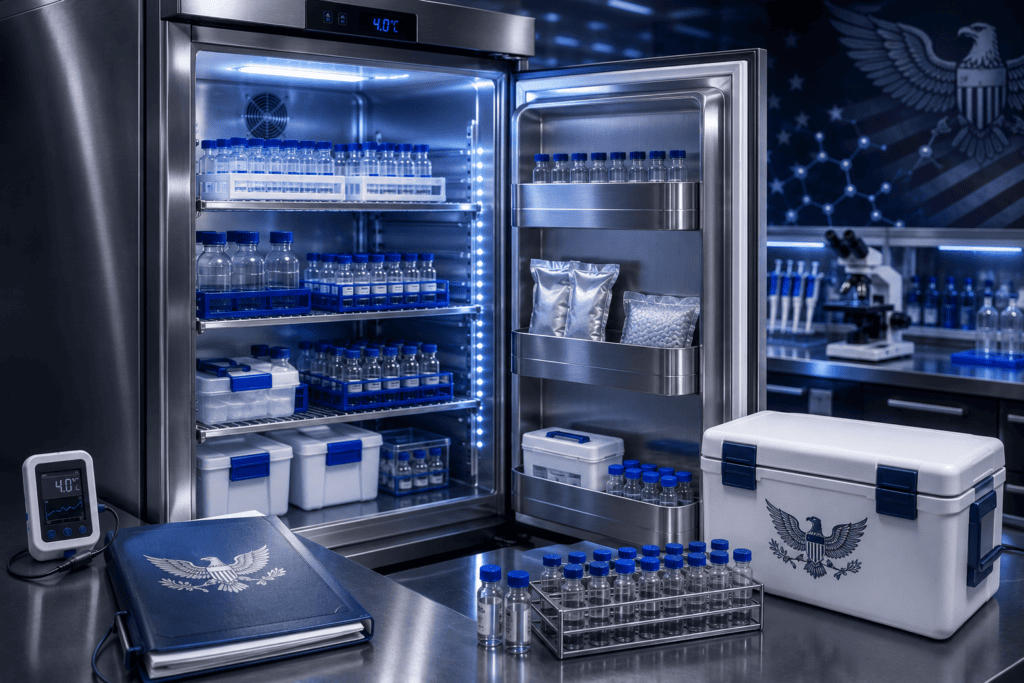
Moisture & Humidity
Moisture can affect the stability of some research materials by increasing molecular mobility or participating directly in chemical reactions. For this reason, limiting unnecessary exposure to humidity can be especially important for materials stored in a dry or lyophilized state.
Lyophilized materials are intentionally prepared with very low water content. If moisture is absorbed during storage or handling, some of the stability advantage provided by the dry state may be reduced.
Condensation is another consideration. When a cold container is opened immediately after removal from refrigerated or frozen storage, moisture from the surrounding air may condense on or inside the container.
🔬 RESEARCH NOTE
The effect of moisture varies by material. Water may contribute to degradation directly through reactions such as hydrolysis or indirectly by increasing molecular mobility within a dried material.
⚠️ IMPORTANT DISTINCTION
A lyophilized material is dry—not moisture-proof. Once exposed to the surrounding environment, its moisture content can potentially change.
Light & Oxygen Exposure
Light and oxygen can contribute to the degradation of certain research materials, although susceptibility varies considerably from one compound to another.
Some compounds may undergo photodegradation when exposed to particular wavelengths of light. Others may be susceptible to oxidation, in which oxygen or reactive oxygen species contribute to chemical changes in the material. The rate and significance of these reactions depend on the compound, formulation, storage environment, and duration of exposure.
For materials known to be sensitive to these conditions, appropriate packaging and storage procedures may be used to limit unnecessary exposure to light or air.
🔬 RESEARCH NOTE
Oxidation does not affect every compound equally. Chemical structure plays an important role in determining whether particular regions of a molecule are susceptible to oxidative degradation.
⚠️ IMPORTANT DISTINCTION
“Protect from light” or “minimize air exposure” should not be treated as universal requirements. These precautions are most meaningful when they are supported by the known stability characteristics or documented storage conditions of the specific material.
Practical Handling & Storage
Good handling practices are designed to limit unnecessary environmental exposure and help maintain the condition of a research material during storage and use.
Keep containers securely closed when not in use, minimize unnecessary exposure to moisture, light, and air when relevant, and avoid repeated temperature changes unless they are part of the documented handling procedure.
Materials stored in solution may have different stability characteristics than the same material in a dry or lyophilized state. Once dissolved, factors such as temperature, pH, concentration, and repeated freeze–thaw cycles may become more important. Storage conditions should therefore be evaluated for the material in the form in which it is actually being stored.
🔬 RESEARCH NOTE
When repeated access to a stored solution is required, laboratory protocols may use smaller aliquots to reduce repeated freeze–thaw cycles or environmental exposure. Whether aliquoting is appropriate depends on the material and experimental procedure.
⚠️ IMPORTANT DISTINCTION
Storage instructions for a dry material should not automatically be assumed to apply after that material has been dissolved. Preparation can change the conditions that influence stability.
Key Takeaways
- Proper storage helps preserve the stability and integrity of research materials over time.
- Temperature, moisture, light, and oxygen can contribute to degradation, but their effects vary by material and formulation.
- Lyophilized materials and materials in solution may have different stability and storage considerations.
- Repeated temperature changes, moisture exposure, and freeze–thaw cycles may affect some materials and should be minimized when appropriate.
- There is no universal storage condition for every research material. Follow the documented requirements for the specific material and the form in which it is being stored.
Continue Your Research...
Best Lab Practices
How to Read a COA
Understanding Purity Percentages
How to Read an HPLC Chromatogram
Research Ethics and Methodology
References & Further Reading
International Council for Harmonisation (ICH). Q1A(R2): Stability Testing of New Drug Substances and Products.
Establishes the general scientific framework for evaluating how temperature, humidity, light, and time influence material stability and emphasizes that storage conditions should be supported by stability data.
FDA — ICH Q1A(R2) Stability TestingInternational Council for Harmonisation (ICH). Q1B: Photostability Testing of New Drug Substances and Products.
Provides the framework for evaluating light-induced changes and photostability, supporting our discussion of why light sensitivity must be assessed for the particular material rather than assumed universally.
ICH — Q1B Photostability TestingLai MC, Topp EM. Solid-State Chemical Stability of Proteins and Peptides. Journal of Pharmaceutical Sciences. 1999;88(5):489–500. doi:10.1021/js980374e.
This one is especially relevant to our article. It discusses degradation pathways including oxidation, deamidation and peptide-bond cleavage, as well as the effects of temperature, moisture content, formulation and physical state on stability of peptides and proteins in the solid state.
PubMed — Lai & ToppManning MC, Chou DK, Murphy BM, Payne RW, Katayama DS. Stability of Protein Pharmaceuticals: An Update. Pharmaceutical Research. 2010;27(4):544–575. doi:10.1007/s11095-009-0045-6.
A comprehensive review of chemical and physical instability, including the important differences between stability in aqueous solutions and dried materials.
PubMed — Manning et al.Jain K, Salamat-Miller N, Taylor K. Freeze–Thaw Characterization Process to Minimize Aggregation and Enable Drug Product Manufacturing of Protein Based Therapeutics. Scientific Reports. 2021;11:11332.
Supports our deliberately qualified discussion of freeze–thaw stress: freezing and thawing can affect some formulations, but the consequences depend on the material and formulation rather than following a universal rule.
Scientific Reports — Jain et al.
Research Disclaimer
The information provided in this guide is intended solely for educational and research purposes. It is designed to help readers understand common laboratory analytical terminology and should not be interpreted as medical advice or as a statement regarding the safety, efficacy, or intended use of any research material.
Storge and Handling
At a Glance
Reading Time: 5-6 minutes
You’ll Learn
- Why storage conditions can affect the stability of research materials
- How temperature, moisture, light, and oxygen exposure can contribute to degradation
- Why lyophilized materials and materials in solution may have different stability considerations
- How repeated temperature changes and freeze–thaw cycles can affect some materials
- Why careful handling helps reduce contamination and unnecessary environmental exposure
- Why storage recommendations should be based on the specific material and formulation, rather than a single rule for every compound
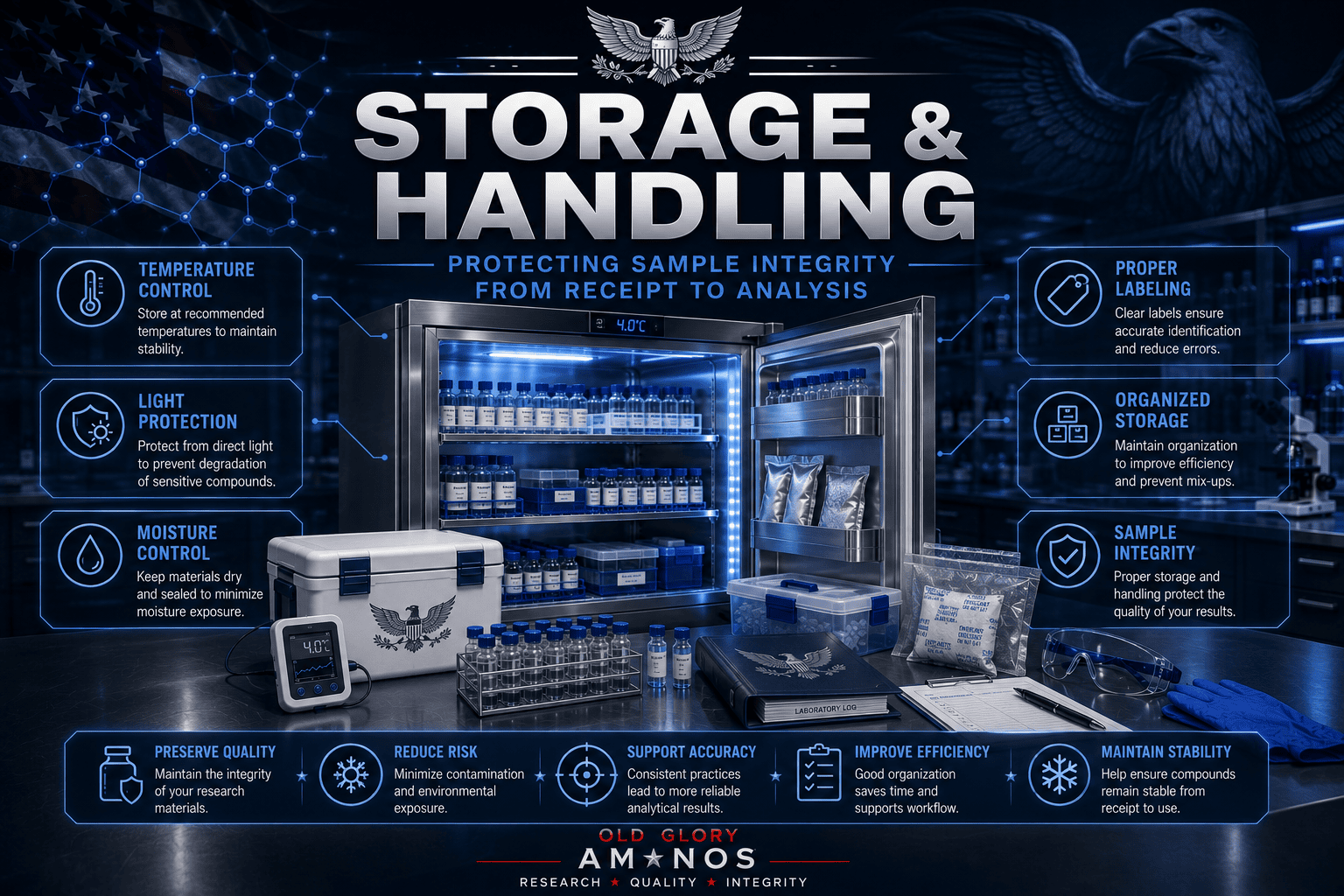
Introduction
Proper storage and handling are important for preserving the integrity of laboratory research materials. Even when a material has been manufactured and analytically characterized, its chemical stability can change over time if it is exposed to unfavorable environmental conditions.
Temperature, moisture, light, and oxygen can contribute to different forms of degradation, and the effects of those conditions can vary depending on the compound, formulation, and whether the material is stored in a dry or dissolved state.
Good storage practices are therefore less about following one universal rule and more about protecting the material from unnecessary environmental stress while following the storage conditions appropriate for that specific material.
🔬 RESEARCH NOTE
Storage recommendations are not interchangeable between research materials. The appropriate temperature, light protection, moisture control, and handling conditions depend on the chemical characteristics and formulation of the material being stored.
Why Storage Matters
Research materials are exposed to environmental conditions from the moment they are produced. Over time, those conditions can influence chemical stability and potentially change the composition of a sample.
Depending on the material, degradation may occur through processes such as hydrolysis, oxidation, or other chemical reactions. Temperature can influence the rate of these reactions, while moisture, light, and oxygen may create additional pathways for degradation.
This does not mean that every compound responds to these conditions in the same way. Some materials are considerably more stable than others, and stability can also change depending on whether the material is lyophilized, dissolved in solution, or formulated with other components.
Lyophilization removes water from a material under controlled conditions, which can improve the stability of some compounds by reducing reactions that depend on molecular mobility or water. It does not, however, make a material permanently stable or immune to environmental conditions.
⚠️ IMPORTANT DISTINCTION
“Stable” does not mean “unchanged forever.” Stability describes how well a material maintains defined characteristics under particular conditions and over a particular period of time.
Temperature & Stability
Temperature can have a significant effect on the rate at which chemical changes occur. In general, higher temperatures can accelerate many degradation reactions, which is why temperature control is an important part of long-term material storage.
Lower temperatures may slow these processes for some research materials, but colder is not automatically better in every situation. Appropriate storage temperature depends on the compound, its formulation, and whether it is stored as a dry material or in solution.
Temperature fluctuation can also matter. Repeated movement between warmer and colder environments may expose a sample to changing conditions and, in some cases, contribute to condensation or other physical and chemical stresses.
🔬 RESEARCH NOTE
A specified storage temperature should be treated as a defined condition rather than a general suggestion. When storage information is available for a particular material, those documented conditions should take priority over generalized rules.
⚠️ IMPORTANT DISTINCTION
Refrigeration and freezing can help preserve some materials, but neither guarantees stability indefinitely. Temperature slows certain degradation processes; it does not necessarily stop them completely.
Moisture & Humidity
Moisture can affect the stability of some research materials by increasing molecular mobility or participating directly in chemical reactions. For this reason, limiting unnecessary exposure to humidity can be especially important for materials stored in a dry or lyophilized state.
Lyophilized materials are intentionally prepared with very low water content. If moisture is absorbed during storage or handling, some of the stability advantage provided by the dry state may be reduced.
Condensation is another consideration. When a cold container is opened immediately after removal from refrigerated or frozen storage, moisture from the surrounding air may condense on or inside the container.
🔬 RESEARCH NOTE
The effect of moisture varies by material. Water may contribute to degradation directly through reactions such as hydrolysis or indirectly by increasing molecular mobility within a dried material.
⚠️ IMPORTANT DISTINCTION
A lyophilized material is dry—not moisture-proof. Once exposed to the surrounding environment, its moisture content can potentially change.
Light & Oxygen Exposure
Light and oxygen can contribute to the degradation of certain research materials, although susceptibility varies considerably from one compound to another.
Some compounds may undergo photodegradation when exposed to particular wavelengths of light. Others may be susceptible to oxidation, in which oxygen or reactive oxygen species contribute to chemical changes in the material. The rate and significance of these reactions depend on the compound, formulation, storage environment, and duration of exposure.
For materials known to be sensitive to these conditions, appropriate packaging and storage procedures may be used to limit unnecessary exposure to light or air.
🔬 RESEARCH NOTE
Oxidation does not affect every compound equally. Chemical structure plays an important role in determining whether particular regions of a molecule are susceptible to oxidative degradation.
⚠️ IMPORTANT DISTINCTION
“Protect from light” or “minimize air exposure” should not be treated as universal requirements. These precautions are most meaningful when they are supported by the known stability characteristics or documented storage conditions of the specific material.
Practical Handling & Storage
Good handling practices are designed to limit unnecessary environmental exposure and help maintain the condition of a research material during storage and use.
Keep containers securely closed when not in use, minimize unnecessary exposure to moisture, light, and air when relevant, and avoid repeated temperature changes unless they are part of the documented handling procedure.
Materials stored in solution may have different stability characteristics than the same material in a dry or lyophilized state. Once dissolved, factors such as temperature, pH, concentration, and repeated freeze–thaw cycles may become more important. Storage conditions should therefore be evaluated for the material in the form in which it is actually being stored.
🔬 RESEARCH NOTE
When repeated access to a stored solution is required, laboratory protocols may use smaller aliquots to reduce repeated freeze–thaw cycles or environmental exposure. Whether aliquoting is appropriate depends on the material and experimental procedure.
⚠️ IMPORTANT DISTINCTION
Storage instructions for a dry material should not automatically be assumed to apply after that material has been dissolved. Preparation can change the conditions that influence stability.
Key Takeaways
- Proper storage helps preserve the stability and integrity of research materials over time.
- Temperature, moisture, light, and oxygen can contribute to degradation, but their effects vary by material and formulation.
- Lyophilized materials and materials in solution may have different stability and storage considerations.
- Repeated temperature changes, moisture exposure, and freeze–thaw cycles may affect some materials and should be minimized when appropriate.
- There is no universal storage condition for every research material. Follow the documented requirements for the specific material and the form in which it is being stored.
Continue Your Research....
How to Read a COA
Understanding Purity Percentages
Best Lab Practices
How to Read an HPLC Chromatogram
Research Ethics and Methodology
References & Further Reading
International Council for Harmonisation (ICH). Q1A(R2): Stability Testing of New Drug Substances and Products.
Establishes the general scientific framework for evaluating how temperature, humidity, light, and time influence material stability and emphasizes that storage conditions should be supported by stability data.
FDA — ICH Q1A(R2) Stability TestingInternational Council for Harmonisation (ICH). Q1B: Photostability Testing of New Drug Substances and Products.
Provides the framework for evaluating light-induced changes and photostability, supporting our discussion of why light sensitivity must be assessed for the particular material rather than assumed universally.
ICH — Q1B Photostability TestingLai MC, Topp EM. Solid-State Chemical Stability of Proteins and Peptides. Journal of Pharmaceutical Sciences. 1999;88(5):489–500. doi:10.1021/js980374e.
This one is especially relevant to our article. It discusses degradation pathways including oxidation, deamidation and peptide-bond cleavage, as well as the effects of temperature, moisture content, formulation and physical state on stability of peptides and proteins in the solid state.
PubMed — Lai & ToppManning MC, Chou DK, Murphy BM, Payne RW, Katayama DS. Stability of Protein Pharmaceuticals: An Update. Pharmaceutical Research. 2010;27(4):544–575. doi:10.1007/s11095-009-0045-6.
A comprehensive review of chemical and physical instability, including the important differences between stability in aqueous solutions and dried materials.
PubMed — Manning et al.Jain K, Salamat-Miller N, Taylor K. Freeze–Thaw Characterization Process to Minimize Aggregation and Enable Drug Product Manufacturing of Protein Based Therapeutics. Scientific Reports. 2021;11:11332.
Supports our deliberately qualified discussion of freeze–thaw stress: freezing and thawing can affect some formulations, but the consequences depend on the material and formulation rather than following a universal rule.
Scientific Reports — Jain et al.
Research Disclaimer
The information provided in this guide is intended solely for educational and research purposes. It is designed to help readers understand common laboratory analytical terminology and should not be interpreted as medical advice or as a statement regarding the safety, efficacy, or intended use of any research material.