

Research Ethics and Methodology
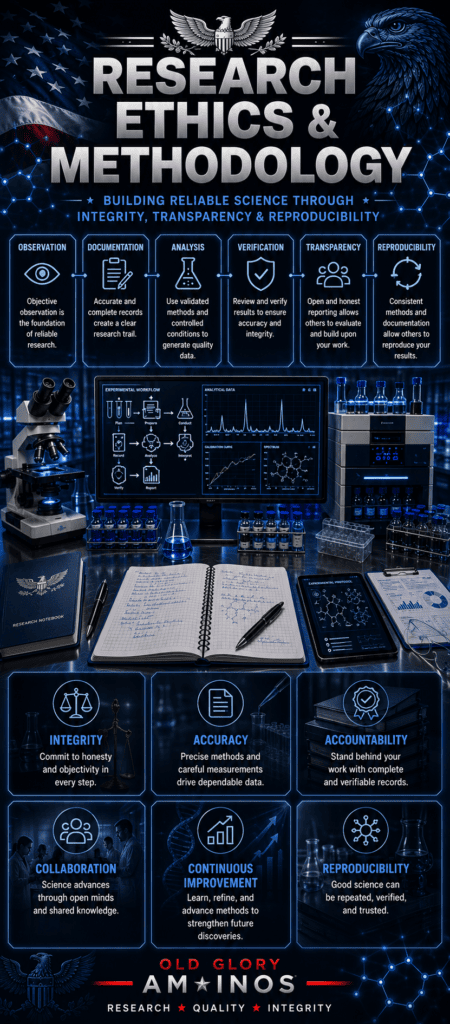
AT A GLANCE
reading time 4-5 minutes
You’ll Learn
- Why ethical research and sound methodology are both essential to trustworthy science
- How clear research questions and appropriate experimental controls strengthen study design
- Why accurate documentation and transparent reporting support reproducibility
- How bias and uncontrolled variables can influence experimental results
- Why unexpected or negative results should be documented rather than ignored
- How responsible interpretation helps prevent conclusions from extending beyond what the data actually support
Introduction
Trustworthy research depends on both ethical conduct and sound methodology. Ethical research requires honesty, transparency, and responsible reporting, while good methodology provides a structured approach for asking questions, collecting data, and evaluating results.
These principles work together. A carefully designed experiment can still produce misleading conclusions if results are selectively reported or interpreted beyond what the data support. Likewise, transparent reporting cannot compensate for an experiment that lacks appropriate controls or contains major uncontrolled variables.
Strong research practices are designed to reduce bias, document uncertainty, and make it possible for others to understand how a conclusion was reached.
⚠️ IMPORTANT DISTINCTION
Research ethics and research methodology are closely connected, but they are not the same thing. Ethics addresses how research is conducted and reported responsibly; methodology addresses how the research question is investigated. Reliable science depends on both.
🔬 RESEARCH NOTE
The goal of a well-designed experiment is not to confirm an expected outcome. It is to create a process capable of producing meaningful evidence—even when the results are unexpected.
Start With a Clear Research Question
Strong methodology begins with a clearly defined research question. Before an experiment is designed, researchers should identify what they are trying to investigate, what variables will be evaluated, and what evidence would meaningfully address the question.
A focused question helps guide decisions about experimental design, measurements, controls, and data collection. It also reduces the temptation to reinterpret the purpose of an experiment after the results are already known.
Whenever possible, the methods and criteria used to evaluate an experiment should be established before the data are interpreted.
🔬 RESEARCH NOTE
Clearly defining the research question in advance helps separate hypothesis-driven investigation from conclusions developed after observing the results. Unexpected findings can still generate valuable new hypotheses—but those new questions may require additional testing.
⚠️ IMPORTANT DISTINCTION
A hypothesis is not a result researchers are expected to prove. It is a testable explanation or prediction that the experiment is designed to evaluate. Evidence may support it, challenge it, or reveal that the original question needs to be reconsidered.
Understand Controls & Variables
Experiments are designed to examine whether changes in one factor are associated with changes in another. To interpret those results meaningfully, researchers need to understand which variables are being changed, which are being measured, and which conditions should remain consistent.
Controls provide a reference point for comparison. Depending on the experiment, they can help determine whether an observed result is associated with the variable being studied rather than another factor in the experimental system.
Keeping other relevant conditions consistent also helps reduce confounding variables—factors that may influence the results and make it difficult to determine what actually caused the observed effect.
📊 READING THE DATA
When evaluating an experiment, ask: What changed? What stayed the same? What was measured? And what was used for comparison? Those four questions can reveal a great deal about the strength of the experimental design.
⚠️ IMPORTANT DISTINCTION
A control does not automatically make an experiment reliable. Controls must be appropriate to the research question and experimental design to provide a meaningful comparison.

Recognize & Reduce Bias
Bias can influence research at many stages—from experimental design and data collection to analysis and interpretation. It does not always involve intentional misconduct; researchers can unintentionally favor information that supports an expected outcome or overlook evidence that challenges it.
Good methodology attempts to reduce these influences by establishing procedures in advance, applying measurement and analysis methods consistently, and evaluating all relevant results rather than only those that support the original hypothesis.
Where appropriate, techniques such as randomization, blinding, standardized procedures, or predefined analysis criteria can further reduce opportunities for bias.
⚠️ IMPORTANT DISTINCTION
Bias does not automatically mean dishonesty. Unintentional bias can affect even carefully conducted research, which is why good methodology is designed to reduce opportunities for personal expectations to influence the outcome.
Document & Report Results Transparently
Transparent research requires an accurate record of what was done, what was observed, and how the results were analyzed. This includes findings that support the original hypothesis as well as those that do not.
Unexpected, negative, or inconclusive results can still provide valuable information. Excluding them simply because they do not match expectations can create a misleading picture of the evidence and make findings more difficult for others to evaluate or reproduce.
Researchers should also document meaningful deviations from the planned methodology. If procedures, analysis methods, or experimental conditions change during the study, those changes should be reported rather than quietly incorporated into the final interpretation.
🔬 RESEARCH NOTE
A result does not become scientifically unimportant simply because it is negative or unexpected. Such findings may reveal limitations, challenge an assumption, or identify questions that require further investigation.
⚠️ IMPORTANT DISTINCTION
Transparent reporting does not require every observation to support a clear conclusion. Uncertainty is itself part of scientific evidence. When the available data do not support a confident conclusion, the responsible interpretation may simply be that more evidence is needed.
Reproducibility & Methodological Transparency
For research findings to be evaluated meaningfully, others need enough information to understand how the experiment was performed and how the results were produced.
Clear methodology describes the important conditions, procedures, measurements, and analysis methods used in the research. This allows other researchers to assess the experimental design, identify potential limitations, and determine whether the work could reasonably be repeated.
Reproducibility does not mean that every repeated experiment will produce identical numbers. Natural variation, measurement uncertainty, and differences in experimental conditions can all influence results. Instead, repeated research should produce findings that are reasonably consistent when comparable methods and conditions are used.
🔬 RESEARCH NOTE
Detailed methodology is valuable even when another researcher never repeats the experiment. It provides the context needed to evaluate how the evidence was generated and how much confidence the conclusions deserve.
⚠️ IMPORTANT DISTINCTION
Reproducibility strengthens confidence in a finding, but a result that has not yet been independently reproduced is not automatically incorrect. Replication adds evidence; it is not a simple pass-or-fail label for scientific validity.
Key Takeaways
- Trustworthy research depends on both ethical conduct and sound methodology.
- Clear research questions, appropriate controls, and consistent procedures help reduce uncontrolled variables and strengthen experimental design.
- Bias can influence research unintentionally, which is why predefined methods and objective evaluation are important.
- Unexpected, negative, and inconclusive results still matter and should be documented rather than excluded because they do not support the original hypothesis.
- Transparent methodology and accurate reporting allow others to understand, evaluate, and potentially reproduce the research.
- Scientific conclusions should reflect what the evidence actually supports, including uncertainty and limitations when they are present.
Continue Your Research...
Best Lab Practices
How to Read a Scientific Paper
Storage and Handling
How to Read a COA
3X vs 15X Testing
References & Further Reading
National Institutes of Health (NIH). Enhancing Reproducibility through Rigor and Transparency.
Excellent umbrella source for rigorous experimental design, methodology, analysis, interpretation, reporting, and reproducibility.
NIH — Enhancing Reproducibility through Rigor and TransparencyNational Institute of Neurological Disorders and Stroke (NINDS). Rigorous Study Design and Transparent Reporting.
This one is particularly strong for our article because it specifically addresses controls, bias, blinding/randomization, inclusion and exclusion criteria, reporting negative/null results, reproducibility, limitations, and alternative interpretations.
NINDS — Rigorous Study Design and Transparent ReportingNational Institutes of Health (NIH). Principles and Guidelines for Reporting Preclinical Research.
Supports our emphasis on sufficiently detailed methodology and transparent reporting so research can be critically evaluated and reproduced.
NIH — Principles and Guidelines for Reporting Preclinical ResearchU.S. Department of Health and Human Services, Office of Research Integrity (ORI). Introduction to the Responsible Conduct of Research.
Useful broader foundation for research integrity, including research misconduct, data management, conflicts of interest, authorship, publication, and peer review.
ORI — Introduction to the Responsible Conduct of ResearchUNESCO. Recommendation on Open Science. 2021.
Provides a broader international framework emphasizing transparency, scrutiny, critique, openness, and reproducibility as principles supporting rigorous scientific work.
UNESCO — Recommendation on Open Science
Research Disclaimer
The information provided in this guide is intended solely for educational and research purposes. It is designed to help readers understand common laboratory analytical terminology and should not be interpreted as medical advice or as a statement regarding the safety, efficacy, or intended use of any research material.
Research Ethics and Methodology
At a Glance
Reading Time: 4-5 minutes
You’ll Learn
- Why ethical research and sound methodology are both essential to trustworthy science
- How clear research questions and appropriate experimental controls strengthen study design
- Why accurate documentation and transparent reporting support reproducibility
- How bias and uncontrolled variables can influence experimental results
- Why unexpected or negative results should be documented rather than ignored
- How responsible interpretation helps prevent conclusions from extending beyond what the data actually support
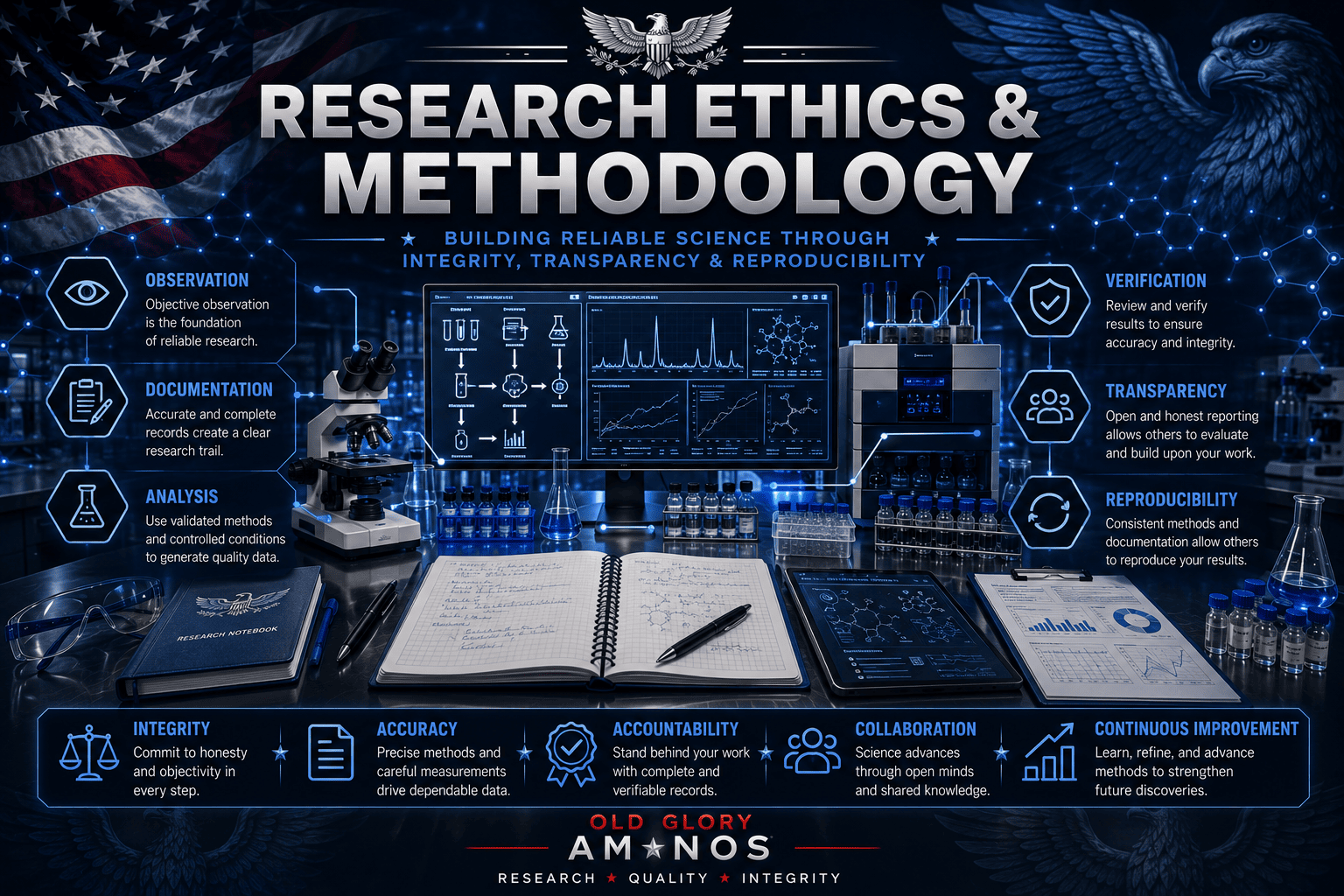
Introduction
Trustworthy research depends on both ethical conduct and sound methodology. Ethical research requires honesty, transparency, and responsible reporting, while good methodology provides a structured approach for asking questions, collecting data, and evaluating results.
These principles work together. A carefully designed experiment can still produce misleading conclusions if results are selectively reported or interpreted beyond what the data support. Likewise, transparent reporting cannot compensate for an experiment that lacks appropriate controls or contains major uncontrolled variables.
Strong research practices are designed to reduce bias, document uncertainty, and make it possible for others to understand how a conclusion was reached.
⚠️ IMPORTANT DISTINCTION
Research ethics and research methodology are closely connected, but they are not the same thing. Ethics addresses how research is conducted and reported responsibly; methodology addresses how the research question is investigated. Reliable science depends on both.
🔬 RESEARCH NOTE
The goal of a well-designed experiment is not to confirm an expected outcome. It is to create a process capable of producing meaningful evidence—even when the results are unexpected.
Start With a Clear Research Question
Strong methodology begins with a clearly defined research question. Before an experiment is designed, researchers should identify what they are trying to investigate, what variables will be evaluated, and what evidence would meaningfully address the question.
A focused question helps guide decisions about experimental design, measurements, controls, and data collection. It also reduces the temptation to reinterpret the purpose of an experiment after the results are already known.
Whenever possible, the methods and criteria used to evaluate an experiment should be established before the data are interpreted.
🔬 RESEARCH NOTE
Clearly defining the research question in advance helps separate hypothesis-driven investigation from conclusions developed after observing the results. Unexpected findings can still generate valuable new hypotheses—but those new questions may require additional testing.
⚠️ IMPORTANT DISTINCTION
A hypothesis is not a result researchers are expected to prove. It is a testable explanation or prediction that the experiment is designed to evaluate. Evidence may support it, challenge it, or reveal that the original question needs to be reconsidered.
Understand Controls & Variables
Experiments are designed to examine whether changes in one factor are associated with changes in another. To interpret those results meaningfully, researchers need to understand which variables are being changed, which are being measured, and which conditions should remain consistent.
Controls provide a reference point for comparison. Depending on the experiment, they can help determine whether an observed result is associated with the variable being studied rather than another factor in the experimental system.
Keeping other relevant conditions consistent also helps reduce confounding variables—factors that may influence the results and make it difficult to determine what actually caused the observed effect.
📊 READING THE DATA
When evaluating an experiment, ask: What changed? What stayed the same? What was measured? And what was used for comparison? Those four questions can reveal a great deal about the strength of the experimental design.
⚠️ IMPORTANT DISTINCTION
A control does not automatically make an experiment reliable. Controls must be appropriate to the research question and experimental design to provide a meaningful comparison.
Recognize & Reduce Bias
Bias can influence research at many stages—from experimental design and data collection to analysis and interpretation. It does not always involve intentional misconduct; researchers can unintentionally favor information that supports an expected outcome or overlook evidence that challenges it.
Good methodology attempts to reduce these influences by establishing procedures in advance, applying measurement and analysis methods consistently, and evaluating all relevant results rather than only those that support the original hypothesis.
Where appropriate, techniques such as randomization, blinding, standardized procedures, or predefined analysis criteria can further reduce opportunities for bias.
⚠️ IMPORTANT DISTINCTION
Bias does not automatically mean dishonesty. Unintentional bias can affect even carefully conducted research, which is why good methodology is designed to reduce opportunities for personal expectations to influence the outcome.
Document & Report Results Transparently
Transparent research requires an accurate record of what was done, what was observed, and how the results were analyzed. This includes findings that support the original hypothesis as well as those that do not.
Unexpected, negative, or inconclusive results can still provide valuable information. Excluding them simply because they do not match expectations can create a misleading picture of the evidence and make findings more difficult for others to evaluate or reproduce.
Researchers should also document meaningful deviations from the planned methodology. If procedures, analysis methods, or experimental conditions change during the study, those changes should be reported rather than quietly incorporated into the final interpretation.
🔬 RESEARCH NOTE
A result does not become scientifically unimportant simply because it is negative or unexpected. Such findings may reveal limitations, challenge an assumption, or identify questions that require further investigation.
⚠️ IMPORTANT DISTINCTION
Transparent reporting does not require every observation to support a clear conclusion. Uncertainty is itself part of scientific evidence. When the available data do not support a confident conclusion, the responsible interpretation may simply be that more evidence is needed.
Reproducibility & Methodological Transparency
For research findings to be evaluated meaningfully, others need enough information to understand how the experiment was performed and how the results were produced.
Clear methodology describes the important conditions, procedures, measurements, and analysis methods used in the research. This allows other researchers to assess the experimental design, identify potential limitations, and determine whether the work could reasonably be repeated.
Reproducibility does not mean that every repeated experiment will produce identical numbers. Natural variation, measurement uncertainty, and differences in experimental conditions can all influence results. Instead, repeated research should produce findings that are reasonably consistent when comparable methods and conditions are used.
🔬 RESEARCH NOTE
Detailed methodology is valuable even when another researcher never repeats the experiment. It provides the context needed to evaluate how the evidence was generated and how much confidence the conclusions deserve.
⚠️ IMPORTANT DISTINCTION
Reproducibility strengthens confidence in a finding, but a result that has not yet been independently reproduced is not automatically incorrect. Replication adds evidence; it is not a simple pass-or-fail label for scientific validity.
Key Takeaways
- Trustworthy research depends on both ethical conduct and sound methodology.
- Clear research questions, appropriate controls, and consistent procedures help reduce uncontrolled variables and strengthen experimental design.
- Bias can influence research unintentionally, which is why predefined methods and objective evaluation are important.
- Unexpected, negative, and inconclusive results still matter and should be documented rather than excluded because they do not support the original hypothesis.
- Transparent methodology and accurate reporting allow others to understand, evaluate, and potentially reproduce the research.
- Scientific conclusions should reflect what the evidence actually supports, including uncertainty and limitations when they are present.
Continue Your Research....
How to Read a COA
3X vs 15X Testing
How to Read a Scientific Paper
Best Lab Practices
Storage and Handling
References & Further Reading
National Institutes of Health (NIH). Enhancing Reproducibility through Rigor and Transparency.
Excellent umbrella source for rigorous experimental design, methodology, analysis, interpretation, reporting, and reproducibility.
NIH — Enhancing Reproducibility through Rigor and TransparencyNational Institute of Neurological Disorders and Stroke (NINDS). Rigorous Study Design and Transparent Reporting.
This one is particularly strong for our article because it specifically addresses controls, bias, blinding/randomization, inclusion and exclusion criteria, reporting negative/null results, reproducibility, limitations, and alternative interpretations.
NINDS — Rigorous Study Design and Transparent ReportingNational Institutes of Health (NIH). Principles and Guidelines for Reporting Preclinical Research.
Supports our emphasis on sufficiently detailed methodology and transparent reporting so research can be critically evaluated and reproduced.
NIH — Principles and Guidelines for Reporting Preclinical ResearchU.S. Department of Health and Human Services, Office of Research Integrity (ORI). Introduction to the Responsible Conduct of Research.
Useful broader foundation for research integrity, including research misconduct, data management, conflicts of interest, authorship, publication, and peer review.
ORI — Introduction to the Responsible Conduct of ResearchUNESCO. Recommendation on Open Science. 2021.
Provides a broader international framework emphasizing transparency, scrutiny, critique, openness, and reproducibility as principles supporting rigorous scientific work.
UNESCO — Recommendation on Open Science
Research Disclaimer
The information provided in this guide is intended solely for educational and research purposes. It is designed to help readers understand common laboratory analytical terminology and should not be interpreted as medical advice or as a statement regarding the safety, efficacy, or intended use of any research material.