

How to Read a Scientific Paper
AT A GLANCE
reading time 4-5 minutes
You’ll Learn
- The major sections found in most scientific papers and what each one tells you
- Why the abstract is a useful starting point—but not the whole story
- What to look for in the study design, methods, and controls
- How to distinguish results from the authors’ interpretation
- Why sample size, statistical context, limitations, and potential conflicts matter
- How to decide whether the conclusions are actually supported by the evidence
Introduction
Scientific papers are one of the primary ways researchers communicate new findings, but they can be difficult to navigate if you are unfamiliar with their structure. Technical terminology, statistical analysis, and dense descriptions of experimental methods can make even a relatively straightforward study feel intimidating.
Fortunately, most scientific papers follow a predictable format. Once you understand the purpose of each section, it becomes much easier to locate important information and evaluate how the study was conducted, what the researchers actually found, and whether the conclusions are supported by the evidence.
Reading a scientific paper also does not necessarily mean reading every word from beginning to end. A more effective approach is to move through the paper strategically—using each section to answer a different question about the research.
Experienced readers often move back and forth between sections rather than reading a paper in order. The abstract may provide the overview, but the methods, results, figures, and discussion provide the context needed to evaluate what that overview actually means.
⚠️ IMPORTANT DISTINCTION
A published paper is evidence—not automatic proof. Publication and peer review add important levels of scientific scrutiny, but readers should still evaluate the study design, methods, results, limitations, and conclusions critically.
Start With the Abstract
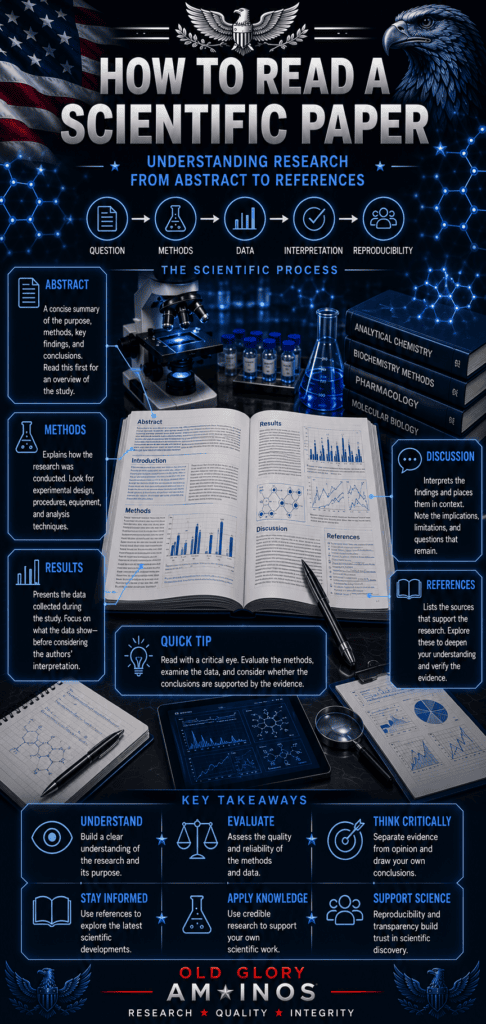
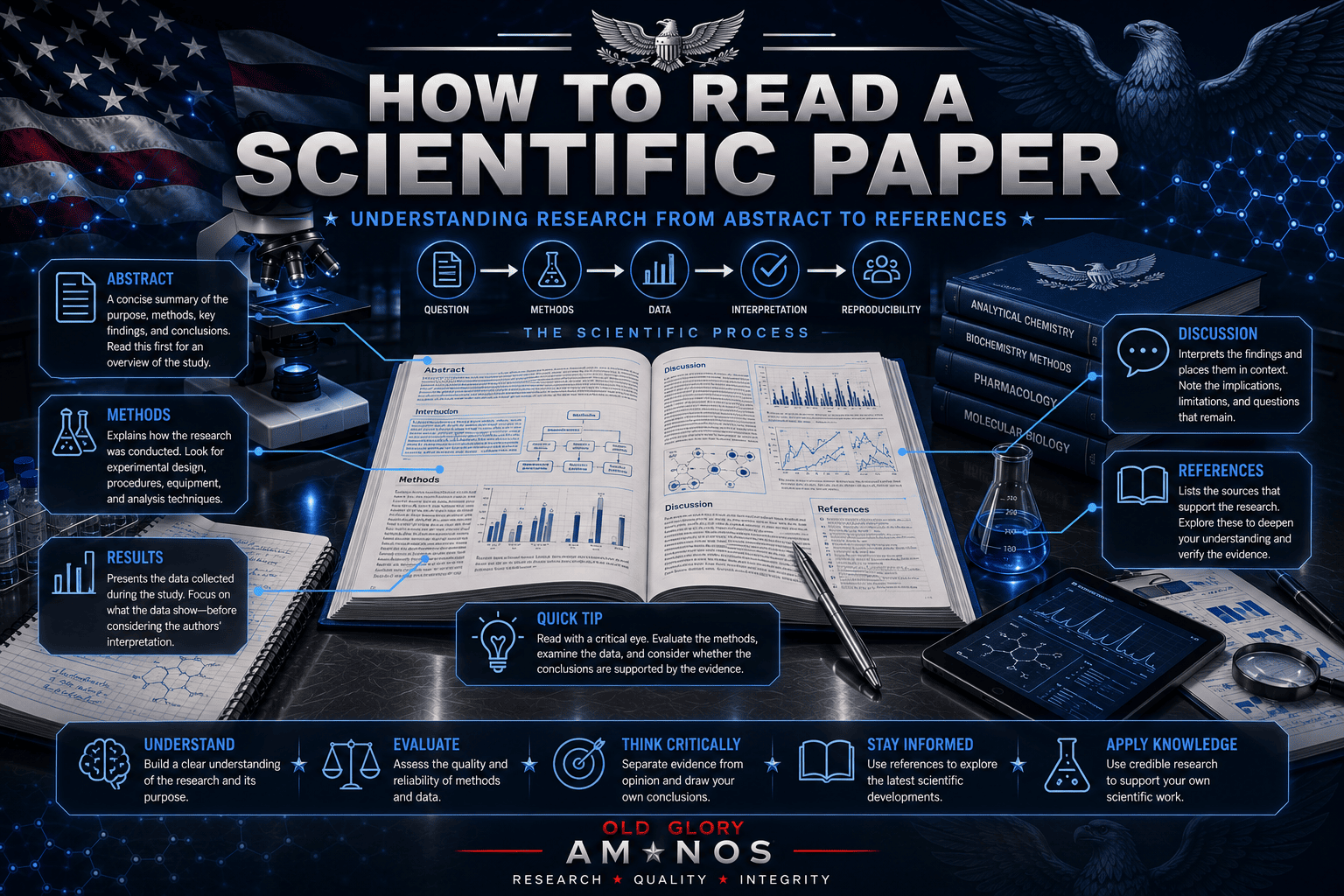
The abstract provides a brief summary of the study and is usually the fastest way to determine what the researchers investigated and whether the paper is relevant to your question.
A well-written abstract typically summarizes the research objective, basic methodology, major findings, and primary conclusion. Reading it first gives you a map of the study before you move into the more detailed sections.
But the abstract is intentionally condensed. Important details about experimental design, sample size, controls, statistical analysis, limitations, and unexpected findings may appear only in the full paper.
📊 READING THE DATA
Use the abstract to answer three initial questions: What did the researchers investigate? What did they find? What conclusion did they draw? Then use the rest of the paper to determine how strongly the evidence supports that conclusion.
⚠️ IMPORTANT DISTINCTION
The abstract is a summary of the research—not a substitute for evaluating it. A conclusion that sounds convincing in the abstract may become more nuanced once you examine the methods, complete results, and study limitations.
Examine the Methods
The Methods section explains how the study was conducted. It describes the experimental design, materials or subjects studied, procedures performed, measurements collected, and analytical or statistical methods used.
This section is essential because the strength of a conclusion depends partly on how the evidence was produced. Look for whether the methods are appropriate for the research question, whether relevant controls or comparison groups were used, and whether the sample size and experimental conditions are clearly described.
You do not need to understand every technical detail to evaluate the basic structure of a study. Focus first on whether the researchers provide enough information to understand what they tested, what they compared, what they measured, and how they analyzed the results.
🔬 RESEARCH NOTE
Sample size matters, but larger does not automatically mean better. The appropriate sample size depends on the type of research, expected variability, study design, and analysis being performed.
⚠️ IMPORTANT DISTINCTION
A sophisticated analytical method cannot compensate for a poorly designed experiment. The method must be appropriate for the question the researchers are trying to answer.

Review the Results
The Results section presents what the researchers observed or measured during the study. Depending on the research, this may include numerical data, statistical analyses, tables, graphs, images, or other experimental findings.
Pay attention to the actual data, not just whether a result is described as significant. Look at the size and direction of the observed effect, variability in the data, comparisons between groups or conditions, and whether the figures and tables support the findings described in the text.
Statistical significance can help researchers evaluate whether an observed result is unlikely to be explained by chance under a particular statistical model, but it does not automatically tell you whether the effect is large, important, or meaningful in practice.
📊 READING THE DATA
Figures and tables often reveal details that a written summary cannot. Look at the scale of the graph, variability or error bars when provided, sample sizes, and the actual differences between groups—not simply the presence of an asterisk or a reported p-value.
⚠️ IMPORTANT DISTINCTION
The Results section tells you what the study found. The authors’ explanation of what those findings may mean belongs primarily in the Discussion. Keeping those two things separate makes it easier to distinguish evidence from interpretation.
Read the Discussion Carefully
The Discussion section explains how the authors interpret their findings and how those findings relate to the original research question and existing scientific knowledge.
This is also where researchers commonly address limitations, unexpected findings, possible explanations, and questions that remain unanswered. Pay particular attention to whether those limitations could affect how broadly the results can be applied.
As you read, compare the authors’ conclusions with the results you just reviewed. Ask whether the interpretation follows reasonably from the evidence or whether the conclusions extend beyond what the study actually demonstrated.
🔬 RESEARCH NOTE
Scientific conclusions often use cautious language such as suggests, indicates, is associated with, or may contribute to. Those qualifiers are meaningful. They communicate the level of certainty supported by the evidence rather than necessarily indicating weakness in the research.
⚠️ IMPORTANT DISTINCTION
Association does not automatically establish causation. Whether a study can support a causal conclusion depends heavily on its design, controls, and the alternative explanations that can reasonably be ruled out.
Check the References
The References section shows which previous studies, reviews, and other sources the authors used to support the background, methods, and interpretation of their research.
You do not need to read every cited source. Instead, use the reference list to investigate important claims, unfamiliar concepts, or studies that appear central to the paper’s conclusions. Following those citations can help you understand how the current study fits into the larger body of research.
References can also provide useful context about whether a finding has been investigated repeatedly or whether the paper relies heavily on a smaller or more limited evidence base.
⚠️ IMPORTANT DISTINCTION
A long reference list does not automatically make a paper stronger. What matters is whether the cited research is relevant, appropriate, and accurately represented by the authors.
Look at the Study as a Whole
After reviewing the individual sections, step back and consider the study as a complete piece of evidence. No single feature—large sample size, statistical significance, sophisticated methods, or publication in a respected journal—can determine the strength of a study by itself.
Consider whether the research question, study design, controls, sample size, measurements, results, and conclusions fit together logically. Also look for acknowledged limitations and whether those limitations meaningfully affect what can be concluded from the research.
Funding sources and conflict-of-interest disclosures are also worth reviewing. A financial or professional relationship does not automatically invalidate research, but knowing about potential conflicts provides important context when evaluating the study.
📊 READING THE DATA
Before accepting the paper’s conclusion, ask one final question: If I looked only at the methods and results, would the evidence support the conclusion being presented?
⚠️ IMPORTANT DISTINCTION
Scientific papers should rarely be evaluated as simply “good” or “bad.” A study may provide useful evidence while still having important limitations. The better question is: What does this study allow us to conclude—and what does it not?
Key Takeaways
- Scientific papers are easier to evaluate when you understand the purpose of the Abstract, Methods, Results, Discussion, and References.
- The abstract provides a useful overview, but it should not replace reading the full study when evaluating the evidence.
- Study design, controls, sample size, measurements, and analytical methods all provide important context for interpreting results.
- Statistical significance does not automatically mean practical or scientific importance, and results should be evaluated in context.
- Separate what the researchers observed from how the authors interpret those findings, and consider limitations or alternative explanations.
- Evaluate the study as a whole and ask whether the conclusions are actually supported by the evidence presented.
How to Read a Scientific Paper
Research Ethics and Methodology
Best Lab Practices
How to Read a COA
Understanding Purity Percentages
How to Read an HPLC Chromatogram
References & Further Reading
Carey, M. A., Steiner, K. L., & Petri, W. A. Jr. Ten Simple Rules for Reading a Scientific Paper. PLOS Computational Biology, 2020.
This is almost tailor-made for our article: it covers moving strategically through a paper, examining figures and tables, distinguishing results from interpretation, assessing limitations, and using references to explore the broader evidence.
Ten Simple Rules for Reading a Scientific PaperNational Center for Complementary and Integrative Health (NCCIH), National Institutes of Health. How To Make Sense of a Scientific Journal Article.
A very accessible NIH resource explaining the abstract and major sections of a scientific paper and how each contributes to understanding the research.
NCCIH — How To Make Sense of a Scientific Journal ArticleBahadoran, Z., Mirmiran, P., Kashfi, K., & Ghasemi, A. How to Write the Methods Section of a Research Manuscript. International Journal of Endocrinology and Metabolism, 2023.
Useful support for our emphasis on the Methods section as the place to evaluate study design, procedures, measurements, statistical analysis, and the validity of the evidence being produced.
How to Write the Methods Section of a Research ManuscriptAltman, N., & Krzywinski, M. Interpreting P Values. Nature Methods, 2017; 14:213–214.
Supports our warning against treating statistical significance as the whole story. A p-value has a specific statistical meaning and should not be interpreted as proof that a hypothesis is true or as a measure of the importance of an observed effect.
Nature Methods — Interpreting P ValuesEQUATOR Network. Reporting Guidelines for Health Research.
A useful broader resource for understanding transparent scientific reporting. EQUATOR maintains reporting guidelines for different study types—including randomized trials, observational studies, systematic reviews, diagnostic studies, animal research, and others—because the information needed to evaluate a paper depends partly on the type of research being reported.
EQUATOR Network Reporting Guideline Library
Research Disclaimer
The information provided in this guide is intended solely for educational and research purposes. It is designed to help readers understand common laboratory analytical terminology and should not be interpreted as medical advice or as a statement regarding the safety, efficacy, or intended use of any research material.
How to Read a Scientific Paper
At a Glance
Reading Time: 4-5 minutes
You’ll Learn
- The major sections found in most scientific papers and what each one tells you
- Why the abstract is a useful starting point—but not the whole story
- What to look for in the study design, methods, and controls
- How to distinguish results from the authors’ interpretation
- Why sample size, statistical context, limitations, and potential conflicts matter
- How to decide whether the conclusions are actually supported by the evidence
You’ll Learn
- The major sections found in most scientific papers
- Which sections to read first
- How to distinguish conclusions from evidence
- Why methods and references matter
- Tips for evaluating research critically
Introduction
Scientific papers are one of the primary ways researchers communicate new findings, but they can be difficult to navigate if you are unfamiliar with their structure. Technical terminology, statistical analysis, and dense descriptions of experimental methods can make even a relatively straightforward study feel intimidating.
Fortunately, most scientific papers follow a predictable format. Once you understand the purpose of each section, it becomes much easier to locate important information and evaluate how the study was conducted, what the researchers actually found, and whether the conclusions are supported by the evidence.
Reading a scientific paper also does not necessarily mean reading every word from beginning to end. A more effective approach is to move through the paper strategically—using each section to answer a different question about the research.
Experienced readers often move back and forth between sections rather than reading a paper in order. The abstract may provide the overview, but the methods, results, figures, and discussion provide the context needed to evaluate what that overview actually means.
⚠️ IMPORTANT DISTINCTION
A published paper is evidence—not automatic proof. Publication and peer review add important levels of scientific scrutiny, but readers should still evaluate the study design, methods, results, limitations, and conclusions critically.
Start With the Abstract
The abstract provides a brief summary of the study and is usually the fastest way to determine what the researchers investigated and whether the paper is relevant to your question.
A well-written abstract typically summarizes the research objective, basic methodology, major findings, and primary conclusion. Reading it first gives you a map of the study before you move into the more detailed sections.
But the abstract is intentionally condensed. Important details about experimental design, sample size, controls, statistical analysis, limitations, and unexpected findings may appear only in the full paper.
📊 READING THE DATA
Use the abstract to answer three initial questions: What did the researchers investigate? What did they find? What conclusion did they draw? Then use the rest of the paper to determine how strongly the evidence supports that conclusion.
⚠️ IMPORTANT DISTINCTION
The abstract is a summary of the research—not a substitute for evaluating it. A conclusion that sounds convincing in the abstract may become more nuanced once you examine the methods, complete results, and study limitations.
Examine the Methods
The Methods section explains how the study was conducted. It describes the experimental design, materials or subjects studied, procedures performed, measurements collected, and analytical or statistical methods used.
This section is essential because the strength of a conclusion depends partly on how the evidence was produced. Look for whether the methods are appropriate for the research question, whether relevant controls or comparison groups were used, and whether the sample size and experimental conditions are clearly described.
You do not need to understand every technical detail to evaluate the basic structure of a study. Focus first on whether the researchers provide enough information to understand what they tested, what they compared, what they measured, and how they analyzed the results.
🔬 RESEARCH NOTE
Sample size matters, but larger does not automatically mean better. The appropriate sample size depends on the type of research, expected variability, study design, and analysis being performed.
⚠️ IMPORTANT DISTINCTION
A sophisticated analytical method cannot compensate for a poorly designed experiment. The method must be appropriate for the question the researchers are trying to answer.
Review the Results
The Results section presents what the researchers observed or measured during the study. Depending on the research, this may include numerical data, statistical analyses, tables, graphs, images, or other experimental findings.
Pay attention to the actual data, not just whether a result is described as significant. Look at the size and direction of the observed effect, variability in the data, comparisons between groups or conditions, and whether the figures and tables support the findings described in the text.
Statistical significance can help researchers evaluate whether an observed result is unlikely to be explained by chance under a particular statistical model, but it does not automatically tell you whether the effect is large, important, or meaningful in practice.
📊 READING THE DATA
Figures and tables often reveal details that a written summary cannot. Look at the scale of the graph, variability or error bars when provided, sample sizes, and the actual differences between groups—not simply the presence of an asterisk or a reported p-value.
⚠️ IMPORTANT DISTINCTION
The Results section tells you what the study found. The authors’ explanation of what those findings may mean belongs primarily in the Discussion. Keeping those two things separate makes it easier to distinguish evidence from interpretation.
Read the Discussion Carefully
The Discussion section explains how the authors interpret their findings and how those findings relate to the original research question and existing scientific knowledge.
This is also where researchers commonly address limitations, unexpected findings, possible explanations, and questions that remain unanswered. Pay particular attention to whether those limitations could affect how broadly the results can be applied.
As you read, compare the authors’ conclusions with the results you just reviewed. Ask whether the interpretation follows reasonably from the evidence or whether the conclusions extend beyond what the study actually demonstrated.
🔬 RESEARCH NOTE
Scientific conclusions often use cautious language such as suggests, indicates, is associated with, or may contribute to. Those qualifiers are meaningful. They communicate the level of certainty supported by the evidence rather than necessarily indicating weakness in the research.
⚠️ IMPORTANT DISTINCTION
Association does not automatically establish causation. Whether a study can support a causal conclusion depends heavily on its design, controls, and the alternative explanations that can reasonably be ruled out.
Check the References
The References section shows which previous studies, reviews, and other sources the authors used to support the background, methods, and interpretation of their research.
You do not need to read every cited source. Instead, use the reference list to investigate important claims, unfamiliar concepts, or studies that appear central to the paper’s conclusions. Following those citations can help you understand how the current study fits into the larger body of research.
References can also provide useful context about whether a finding has been investigated repeatedly or whether the paper relies heavily on a smaller or more limited evidence base.
⚠️ IMPORTANT DISTINCTION
A long reference list does not automatically make a paper stronger. What matters is whether the cited research is relevant, appropriate, and accurately represented by the authors.
Look at the Study as a Whole
After reviewing the individual sections, step back and consider the study as a complete piece of evidence. No single feature—large sample size, statistical significance, sophisticated methods, or publication in a respected journal—can determine the strength of a study by itself.
Consider whether the research question, study design, controls, sample size, measurements, results, and conclusions fit together logically. Also look for acknowledged limitations and whether those limitations meaningfully affect what can be concluded from the research.
Funding sources and conflict-of-interest disclosures are also worth reviewing. A financial or professional relationship does not automatically invalidate research, but knowing about potential conflicts provides important context when evaluating the study.
📊 READING THE DATA
Before accepting the paper’s conclusion, ask one final question: If I looked only at the methods and results, would the evidence support the conclusion being presented?
⚠️ IMPORTANT DISTINCTION
Scientific papers should rarely be evaluated as simply “good” or “bad.” A study may provide useful evidence while still having important limitations. The better question is: What does this study allow us to conclude—and what does it not?
Key Takeaways
- Scientific papers are easier to evaluate when you understand the purpose of the Abstract, Methods, Results, Discussion, and References.
- The abstract provides a useful overview, but it should not replace reading the full study when evaluating the evidence.
- Study design, controls, sample size, measurements, and analytical methods all provide important context for interpreting results.
- Statistical significance does not automatically mean practical or scientific importance, and results should be evaluated in context.
- Separate what the researchers observed from how the authors interpret those findings, and consider limitations or alternative explanations.
- Evaluate the study as a whole and ask whether the conclusions are actually supported by the evidence presented.
Continue Your Research....
How to Read a COA
Understanding Purity Percentages
Research Ethics and Methodology
Best Lab Practices
How to Read an HPLC Chromatogram
References & Further Reading
Carey, M. A., Steiner, K. L., & Petri, W. A. Jr. Ten Simple Rules for Reading a Scientific Paper. PLOS Computational Biology, 2020.
This is almost tailor-made for our article: it covers moving strategically through a paper, examining figures and tables, distinguishing results from interpretation, assessing limitations, and using references to explore the broader evidence.
Ten Simple Rules for Reading a Scientific PaperNational Center for Complementary and Integrative Health (NCCIH), National Institutes of Health. How To Make Sense of a Scientific Journal Article.
A very accessible NIH resource explaining the abstract and major sections of a scientific paper and how each contributes to understanding the research.
NCCIH — How To Make Sense of a Scientific Journal ArticleBahadoran, Z., Mirmiran, P., Kashfi, K., & Ghasemi, A. How to Write the Methods Section of a Research Manuscript. International Journal of Endocrinology and Metabolism, 2023.
Useful support for our emphasis on the Methods section as the place to evaluate study design, procedures, measurements, statistical analysis, and the validity of the evidence being produced.
How to Write the Methods Section of a Research ManuscriptAltman, N., & Krzywinski, M. Interpreting P Values. Nature Methods, 2017; 14:213–214.
Supports our warning against treating statistical significance as the whole story. A p-value has a specific statistical meaning and should not be interpreted as proof that a hypothesis is true or as a measure of the importance of an observed effect.
Nature Methods — Interpreting P ValuesEQUATOR Network. Reporting Guidelines for Health Research.
A useful broader resource for understanding transparent scientific reporting. EQUATOR maintains reporting guidelines for different study types—including randomized trials, observational studies, systematic reviews, diagnostic studies, animal research, and others—because the information needed to evaluate a paper depends partly on the type of research being reported.
EQUATOR Network Reporting Guideline Library
Research Disclaimer
The information provided in this guide is intended solely for educational and research purposes. It is designed to help readers understand common laboratory analytical terminology and should not be interpreted as medical advice or as a statement regarding the safety, efficacy, or intended use of any research material.