

What Are Amino Acid Compounds?
AT A GLANCE
reading time 4-5 minutes
You’ll Learn
- What amino acids are and why they matter in biological systems
- How amino acids join together to form peptides and proteins
- The basic difference between amino acids, peptides, and proteins
- Why the boundaries between peptides and proteins are not always defined by a simple chain length
- Why Old Glory Aminos uses the broader term “amino acid compounds”
- Why these compounds are studied in scientific research
What Are Amino Acids?
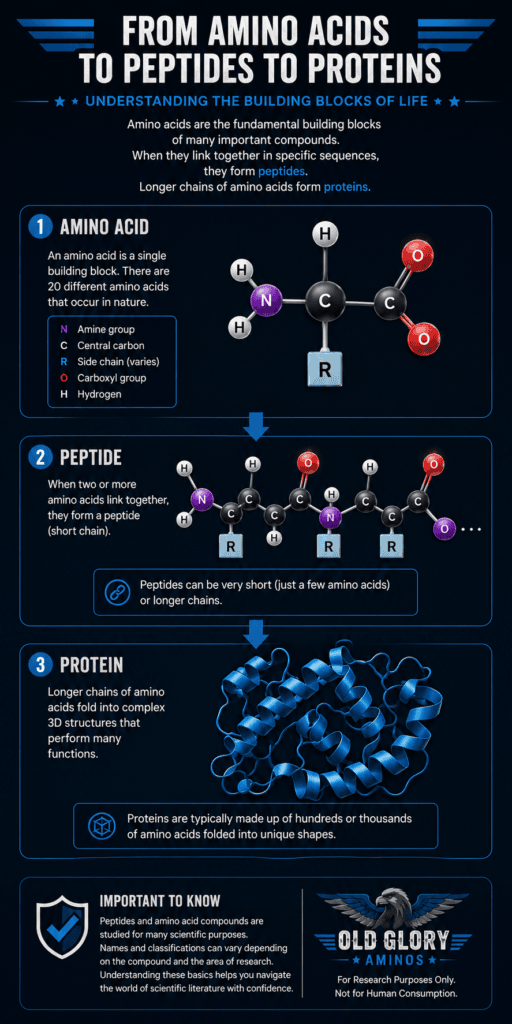
Amino acids are small organic molecules that serve as the building blocks of peptides and proteins. They contain characteristic chemical groups and can connect to one another through bonds known as peptide bonds, creating chains of different lengths and structures.
Think of each amino acid as a single LEGO® brick.
One brick by itself is relatively simple. But connect many bricks in different combinations and arrangements, and they can form structures with dramatically different shapes and functions. Amino acids work in a similar way: their sequence and arrangement help determine the properties of the larger molecules they form.
In biological systems, amino acids are involved in far more than simply building proteins. Individual amino acids and amino-acid-derived molecules can participate in processes such as cellular signaling, metabolism, and molecular synthesis.
🔬 RESEARCH NOTE
Scientists often study not only which amino acids are present, but also their sequence, structure, chemical modifications, and interactions. These characteristics can significantly influence how an amino-acid-based molecule behaves.
What Is a Peptide?
When amino acids connect through peptide bonds, they can form chains called peptides.
Peptides are generally composed of relatively short chains of amino acids, while proteins are typically larger and often fold into more complex three-dimensional structures. However, there is no single universally accepted chain length at which a peptide automatically becomes a protein.
Instead, scientists may consider several characteristics—including chain length, structure, folding, and biological function—when describing an amino acid chain as a peptide or protein.
This means the terms are related, but they are not simply interchangeable.
⚠️ IMPORTANT DISTINCTION
You may see different sources use slightly different definitions for peptide and protein. A specific number of amino acids is sometimes used as a convenient guideline, but the scientific distinction is not determined by chain length alone.
Peptides vs Proteins
| Amino Acids | Peptides | Proteins |
|---|---|---|
| Individual building blocks | Short chains of amino acids | Larger, more complex chains folded into functional structures |
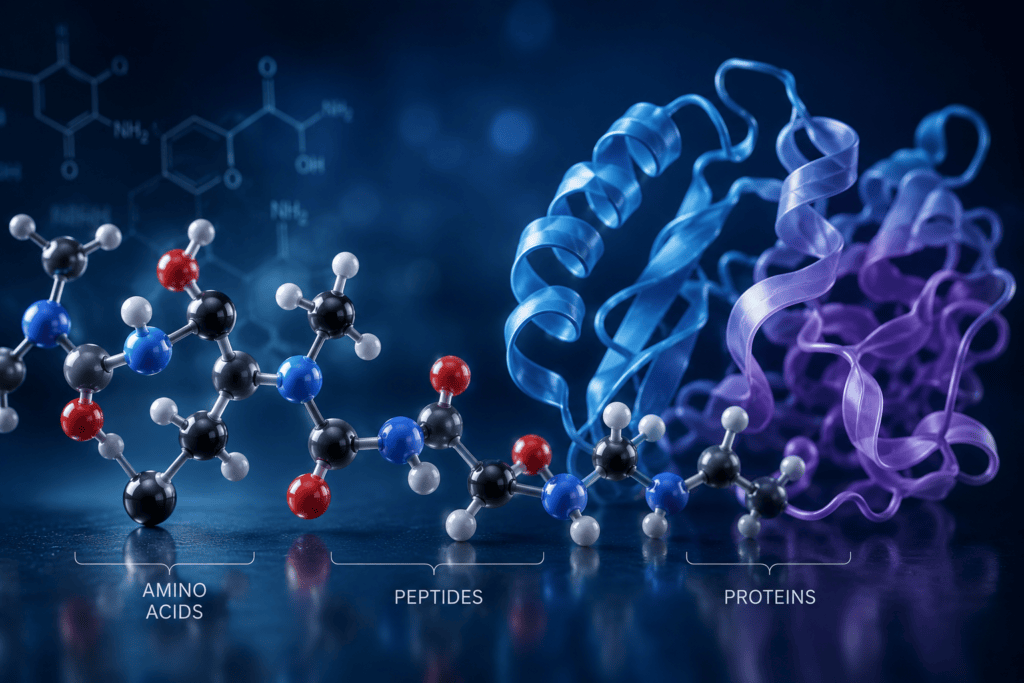
The exact point where a peptide becomes a protein isn’t universally defined, but understanding the progression is more important than memorizing a number.
Why Does Old Glory Aminos Use the Term “Amino Acid Compounds?”
Many materials studied in this field are commonly described as peptides, but not every research compound fits neatly into the same scientific category.
At Old Glory Aminos, we use “amino acid compounds” as a broad educational and organizational term for the range of research materials discussed throughout our site. It is not intended to replace established scientific terminology or suggest that “amino acid compound” is a formal classification.
When discussing a specific material, its established scientific name and classification remain important. Depending on the compound, researchers may encounter terms such as amino acid, peptide, protein, peptide derivative, or other related classifications in scientific literature.
Our goal is simple: provide readers with an approachable way to navigate the broader subject while encouraging them to understand the specific terminology associated with each compound they research.
⚠️ IMPORTANT DISTINCTION
The term “amino acid compound” is used by Old Glory Aminos as broad educational terminology. Scientific classifications are more specific and may differ depending on the molecular structure and characteristics of the individual compound.
Why Are Amino Acid Compounds Studied?
Amino-acid-based compounds are studied for many different scientific reasons. Because differences in sequence, structure, and chemical properties can influence how a molecule behaves, researchers investigate these compounds across a wide range of laboratory settings.
Research may examine:
- Molecular structure — how atoms and amino acids are arranged within a compound
- Stability — how a compound changes under different environmental or storage conditions
- Chemical interactions — how molecules interact with other substances
- Biological mechanisms — how particular compounds interact with biological systems in experimental models
- Analytical properties — how compounds can be identified, separated, measured, and characterized using laboratory methods
The purpose of scientific research is to increase understanding through observation and evidence, not to assume a particular outcome before the research is conducted.
🔬 RESEARCH NOTE
Different research questions require different analytical methods. A test used to investigate identity may not answer questions about purity, stability, or biological activity. Understanding what a particular method actually measures is essential when interpreting research results.
Key Takeaways
Amino acids are the building blocks of peptides and proteins. Their sequence and arrangement help determine the properties of the molecules they form.
Peptides are chains of amino acids connected by peptide bonds. They are generally shorter than proteins, although there is no single universally accepted chain length that separates the two.
Peptides and proteins are related, but the terminology is not determined by size alone. Structure, folding, and biological function may also influence how an amino acid chain is described.
“Amino acid compounds” is a broad educational term used by Old Glory Aminos. Individual research materials may have more specific scientific classifications.
These compounds can be studied from many different perspectives, including molecular structure, stability, chemical interactions, biological mechanisms, and analytical properties.
Scientific conclusions should follow the evidence. Understanding what was tested, how it was tested, and what the results actually demonstrate is essential to responsible research.
What Are Amino Acid Compounds?
What is HPLC?
Understanding Purity Percentages
How to Read a COA
Storage and Handling
How to Read a Scientific Paper
References and Further Reading
International Union of Pure and Applied Chemistry (IUPAC). Compendium of Chemical Terminology (Gold Book): Peptides. Defines peptides based on amino acids joined through covalent amide/peptide bonds.
IUPAC Gold Book — PeptidesIUPAC-IUB Joint Commission on Biochemical Nomenclature. Nomenclature and Symbolism for Amino Acids and Peptides (Recommendations 1983). Pure and Applied Chemistry. 1984;56(5):595–624. Authoritative terminology and nomenclature for amino acids, amino-acid residues, peptides, and peptide sequences.
IUPAC — Nomenclature and Symbolism for Amino Acids and PeptidesInternational Union of Pure and Applied Chemistry (IUPAC). Principles of Chemical Nomenclature — Nomenclature and Symbolism for Amino Acids and Peptides. Discusses peptide bonds, oligopeptides, polypeptides, and the variable terminology used to distinguish polypeptides from proteins.
IUPAC — Principles of Chemical NomenclatureAlberts B, Johnson A, Lewis J, et al. Molecular Biology of the Cell: The Chemical Components of a Cell. NCBI Bookshelf. Explains amino acids as protein subunits, peptide-bond formation, polypeptide chains, and protein structure.
NCBI Bookshelf — The Chemical Components of a CellAlberts B, Johnson A, Lewis J, et al. Molecular Biology of the Cell: The Shape and Structure of Proteins. NCBI Bookshelf. Describes how amino-acid sequence relates to protein structure and how amino acids are linked through peptide bonds.
NCBI Bookshelf — The Shape and Structure of Proteins
Research Disclaimer
The information provided in this guide is intended solely for educational and research purposes. It is designed to help readers understand common laboratory analytical terminology and should not be interpreted as medical advice or as a statement regarding the safety, efficacy, or intended use of any research material.
What Are Amino Acid Compounds?
At a Glance
Reading Time: 3-4 minutes
You’ll Learn
- What amino acids are and why they matter in biological systems
- How amino acids join together to form peptides and proteins
- The basic difference between amino acids, peptides, and proteins
- Why the boundaries between peptides and proteins are not always defined by a simple chain length
- Why Old Glory Aminos uses the broader term “amino acid compounds”
- Why these compounds are studied in scientific research
What Are Amino Acids?
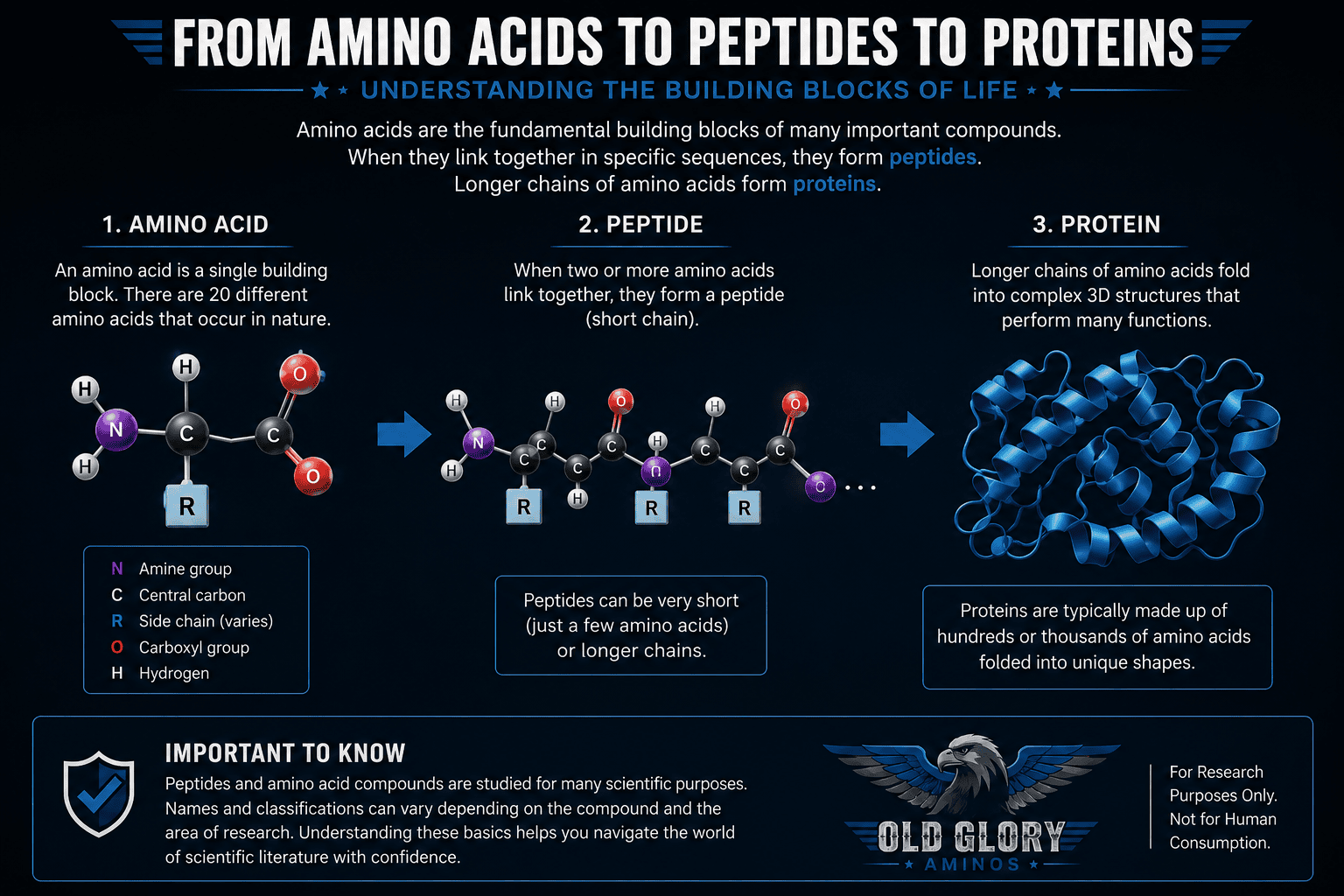
Amino acids are small organic molecules that serve as the building blocks of peptides and proteins. They contain characteristic chemical groups and can connect to one another through bonds known as peptide bonds, creating chains of different lengths and structures.
Think of each amino acid as a single LEGO® brick.
One brick by itself is relatively simple. But connect many bricks in different combinations and arrangements, and they can form structures with dramatically different shapes and functions. Amino acids work in a similar way: their sequence and arrangement help determine the properties of the larger molecules they form.
In biological systems, amino acids are involved in far more than simply building proteins. Individual amino acids and amino-acid-derived molecules can participate in processes such as cellular signaling, metabolism, and molecular synthesis.
🔬 RESEARCH NOTE
Scientists often study not only which amino acids are present, but also their sequence, structure, chemical modifications, and interactions. These characteristics can significantly influence how an amino-acid-based molecule behaves.
What Is a Peptide?
When amino acids connect through peptide bonds, they can form chains called peptides.
Peptides are generally composed of relatively short chains of amino acids, while proteins are typically larger and often fold into more complex three-dimensional structures. However, there is no single universally accepted chain length at which a peptide automatically becomes a protein.
Instead, scientists may consider several characteristics—including chain length, structure, folding, and biological function—when describing an amino acid chain as a peptide or protein.
This means the terms are related, but they are not simply interchangeable.
⚠️ IMPORTANT DISTINCTION
You may see different sources use slightly different definitions for peptide and protein. A specific number of amino acids is sometimes used as a convenient guideline, but the scientific distinction is not determined by chain length alone.
Peptides vs Proteins
| Amino Acids | Peptides | Proteins |
|---|---|---|
| Individual building blocks | Short chains of amino acids | Larger, more complex chains folded into functional structures |
The exact point where a peptide becomes a protein isn’t universally defined, but understanding the progression is more important than memorizing a number.
Why Does Old Glory Aminos Use the Term “Amino Acid Compounds?”
Many materials studied in this field are commonly described as peptides, but not every research compound fits neatly into the same scientific category.
At Old Glory Aminos, we use “amino acid compounds” as a broad educational and organizational term for the range of research materials discussed throughout our site. It is not intended to replace established scientific terminology or suggest that “amino acid compound” is a formal classification.
When discussing a specific material, its established scientific name and classification remain important. Depending on the compound, researchers may encounter terms such as amino acid, peptide, protein, peptide derivative, or other related classifications in scientific literature.
Our goal is simple: provide readers with an approachable way to navigate the broader subject while encouraging them to understand the specific terminology associated with each compound they research.
⚠️ IMPORTANT DISTINCTION
The term “amino acid compound” is used by Old Glory Aminos as broad educational terminology. Scientific classifications are more specific and may differ depending on the molecular structure and characteristics of the individual compound.
Why Are Amino Acid Compounds Studied?
Amino-acid-based compounds are studied for many different scientific reasons. Because differences in sequence, structure, and chemical properties can influence how a molecule behaves, researchers investigate these compounds across a wide range of laboratory settings.
Research may examine:
- Molecular structure — how atoms and amino acids are arranged within a compound
- Stability — how a compound changes under different environmental or storage conditions
- Chemical interactions — how molecules interact with other substances
- Biological mechanisms — how particular compounds interact with biological systems in experimental models
- Analytical properties — how compounds can be identified, separated, measured, and characterized using laboratory methods
The purpose of scientific research is to increase understanding through observation and evidence, not to assume a particular outcome before the research is conducted.
🔬 RESEARCH NOTE
Different research questions require different analytical methods. A test used to investigate identity may not answer questions about purity, stability, or biological activity. Understanding what a particular method actually measures is essential when interpreting research results.
Key Takeaways
Amino acids are the building blocks of peptides and proteins. Their sequence and arrangement help determine the properties of the molecules they form.
Peptides are chains of amino acids connected by peptide bonds. They are generally shorter than proteins, although there is no single universally accepted chain length that separates the two.
Peptides and proteins are related, but the terminology is not determined by size alone. Structure, folding, and biological function may also influence how an amino acid chain is described.
“Amino acid compounds” is a broad educational term used by Old Glory Aminos. Individual research materials may have more specific scientific classifications.
These compounds can be studied from many different perspectives, including molecular structure, stability, chemical interactions, biological mechanisms, and analytical properties.
Scientific conclusions should follow the evidence. Understanding what was tested, how it was tested, and what the results actually demonstrate is essential to responsible research.
Continue Your Research....
How to Read a COA
How to Read a Scientific Paper
Understanding Purity Percentages
What is HPLC?
Storage and Handling
References and Further Reading
International Union of Pure and Applied Chemistry (IUPAC). Compendium of Chemical Terminology (Gold Book): Peptides. Defines peptides based on amino acids joined through covalent amide/peptide bonds.
IUPAC Gold Book — PeptidesIUPAC-IUB Joint Commission on Biochemical Nomenclature. Nomenclature and Symbolism for Amino Acids and Peptides (Recommendations 1983). Pure and Applied Chemistry. 1984;56(5):595–624. Authoritative terminology and nomenclature for amino acids, amino-acid residues, peptides, and peptide sequences.
IUPAC — Nomenclature and Symbolism for Amino Acids and PeptidesInternational Union of Pure and Applied Chemistry (IUPAC). Principles of Chemical Nomenclature — Nomenclature and Symbolism for Amino Acids and Peptides. Discusses peptide bonds, oligopeptides, polypeptides, and the variable terminology used to distinguish polypeptides from proteins.
IUPAC — Principles of Chemical NomenclatureAlberts B, Johnson A, Lewis J, et al. Molecular Biology of the Cell: The Chemical Components of a Cell. NCBI Bookshelf. Explains amino acids as protein subunits, peptide-bond formation, polypeptide chains, and protein structure.
NCBI Bookshelf — The Chemical Components of a CellAlberts B, Johnson A, Lewis J, et al. Molecular Biology of the Cell: The Shape and Structure of Proteins. NCBI Bookshelf. Describes how amino-acid sequence relates to protein structure and how amino acids are linked through peptide bonds.
NCBI Bookshelf — The Shape and Structure of Proteins
Research Disclaimer
The information provided in this guide is intended solely for educational and research purposes. It is designed to help readers understand common laboratory analytical terminology and should not be interpreted as medical advice or as a statement regarding the safety, efficacy, or intended use of any research material.