
Understanding FDA Peptide Regulations: Categories, Compounding & the Debate

AT A GLANCE
Reading Time: 9-11 minutes
You’ll Learn
- The difference between FDA-approved medications, compounded drugs, and research compounds.
- How the FDA’s 503A and 503B compounding frameworks work.
- What Category 1, Category 2, and Category 3 mean—and what they don’t.
- Why a peptide’s regulatory classification may change.
- The FDA’s stated safety concerns and the arguments raised by compounding stakeholders.
- How to distinguish regulatory decisions from scientific evidence.
Introduction
Why Are Peptide Regulations So Complicated?
Two peptides may be studied for similar biological purposes, yet face very different regulatory circumstances.
One might be an ingredient in an FDA-approved medication. Another might be undergoing clinical trials. A third might appear on an FDA compounding-related list despite having published laboratory research behind it.
Why the differences?
Because FDA approval, eligibility for pharmaceutical compounding, and permission to conduct scientific research are separate regulatory questions.
Compounding involves preparing medications for particular medical needs under specific legal conditions. It is not the same as manufacturing an FDA-approved drug, and it is not the same as producing a substance solely for laboratory research.
Confusion often arises when FDA compounding classifications are described as if they were universal judgments about a compound’s scientific value or safety.
In reality, those classifications serve particular regulatory purposes.
Understanding these distinctions is essential before examining the ongoing debate over peptide restrictions, patient access, and the evidence regulators rely upon.
🔬 RESEARCH NOTE
A peptide’s inclusion on—or removal from—an FDA compounding-related list does not automatically mean the compound has been approved, banned for all purposes, or proven safe or unsafe.
Its actual regulatory status depends on the applicable law, the specific substance, and the circumstances in which it is manufactured or used.
FDA-Approved Drugs vs. Compounded Medications vs. Research Compounds
Not all peptides fall under the same regulatory framework. Understanding three key distinctions helps explain why their legal status can differ.
FDA-Approved Drugs
FDA-approved drugs have undergone regulatory review demonstrating that their benefits outweigh their known risks for specific medical uses.
Approval applies to a particular drug product and its approved uses—not automatically to every product containing the same compound.
Compounded Medications
Compounded medications are prepared by combining, mixing, or altering ingredients to meet particular medical needs.
Unlike FDA-approved drugs, compounded medications do not undergo individual FDA review for safety, effectiveness, or quality before marketing.
They must meet applicable legal requirements, including those governing eligible ingredients and compounding practices.
Research Compounds
Research compounds are substances investigated to understand their biological properties and potential applications.
Some have extensive published research; others remain in early development. Neither circumstance automatically establishes FDA approval or eligibility for pharmaceutical compounding.
A “Research Use Only” label also does not, by itself, exempt a product from drug regulations.
⚠️ IMPORTANT DISTINCTION
FDA approval, pharmaceutical compounding eligibility, and scientific research are separate regulatory matters. Restrictions affecting one activity do not necessarily prohibit every other lawful use of a substance.
Understanding 503A and 503B: Two Different Compounding Frameworks
Federal law establishes two primary pathways for human drug compounding: Section 503A and Section 503B of the Federal Food, Drug, and Cosmetic Act.
Both allow qualifying compounded medications to receive exemptions from certain federal drug requirements, but they serve different purposes and operate under different conditions.
Section 503A: Traditional Pharmacy Compounding
Section 503A generally applies to licensed pharmacists working in state-licensed pharmacies or federal facilities, and to licensed physicians who compound medications.
This framework primarily addresses medications prepared for individual patients based on valid prescriptions.
Under certain conditions, limited compounding may occur before a prescription is received, based on an established history of patient-specific prescriptions.
503A compounding remains subject to applicable state oversight and federal requirements.
Section 503B: Outsourcing Facilities
Section 503B applies to facilities registered with the FDA as outsourcing facilities.
Unlike traditional 503A compounding, qualifying 503B facilities may compound medications without first receiving individual patient prescriptions.
These facilities are subject to additional federal requirements, including current good manufacturing practice (CGMP) standards, FDA inspections, and adverse-event reporting obligations.
How Do They Compare?
Feature / Section 503A / Section 503B:
Primary setting / Traditional pharmacy or physician compounding / FDA registered outsourcing facility
Patient specific prescription / generally required / not required
FDA registration as outsourcing / not required / required
Federal CGMP requirements / qualifying drugs are exempt / apply
FDA approval of individual compounded drugs / not required under qualifying exemption / not required under qualifying exemption
Why This Matters for Peptides
Neither framework gives pharmacies unrestricted permission to compound any substance.
When a compounder uses a bulk drug substance—an active ingredient used to prepare a medication—specific legal eligibility requirements apply.
These requirements differ between 503A and 503B. A substance’s eligibility under one framework does not automatically establish eligibility under the other.
This distinction is particularly important when interpreting FDA announcements about peptide compounding.
⚠️ IMPORTANT DISTINCTION
503A and 503B are legal compounding frameworks, not classifications of peptide safety or effectiveness.
Neither framework makes an individual compounded medication FDA-approved.

What Do FDA Categories 1, 2, and 3 Actually Mean?
The FDA developed three interim categories to organize certain bulk drug substances nominated for pharmaceutical compounding under Section 503A.
These categories describe regulatory status—not FDA approval or a universal ranking of safety and effectiveness.
Category 1: Under Evaluation
Substances nominated with sufficient information for FDA evaluation.
Qualifying compounders may receive temporary enforcement discretion under specific conditions while the FDA considers these substances.
Category 1 does not mean FDA-approved or proven safe.
Category 2: Significant Safety Concerns
Substances for which the FDA has identified potential significant safety risks associated with compounding.
These substances do not qualify for the Category 1 interim enforcement policy.
Category 2 does not mean every possible research use has been prohibited.
Category 3: Insufficient Information
Substances whose nominations lacked sufficient supporting information for FDA evaluation.
Additional documentation may be submitted through a new nomination.
Category 3 does not necessarily indicate a finding of danger or ineffectiveness.
Can These Classifications Change?
Yes. Categories may change following nomination withdrawals, additional review, or regulatory decisions.
In January 2025, the FDA revised its interim policy so that newly nominated substances w
Why Do Peptides Move On or Off FDA Compounding Lists?
FDA compounding lists can change as new evidence emerges, nominations are withdrawn, or regulatory reviews are completed.
However, a change in classification does not necessarily represent a new finding about a substance’s safety.
Why Do Changes Happen?
1. Safety Concerns
The FDA may identify potential risks involving impurities, immune reactions, manufacturing quality, or other safety considerations.
2. Withdrawn Nominations
A substance may be removed from an interim category because its nomination was withdrawn.
For example, BPC-157 was removed from Category 2 following withdrawal of its nominations. This did not mean the FDA had approved the peptide or reversed its previously identified safety concerns.
3. Regulatory Decisions
Following scientific review and consideration of clinical needs, the FDA may decide whether a substance qualifies for inclusion on an official compounding list.
Why Context Matters
A withdrawn nomination, a safety concern, and a final regulatory decision are three different events.
Rather than asking only whether a peptide was removed from a list, researchers should ask:
Why was it removed, and what did that decision actually change?
🔬 RESEARCH NOTE
FDA compo
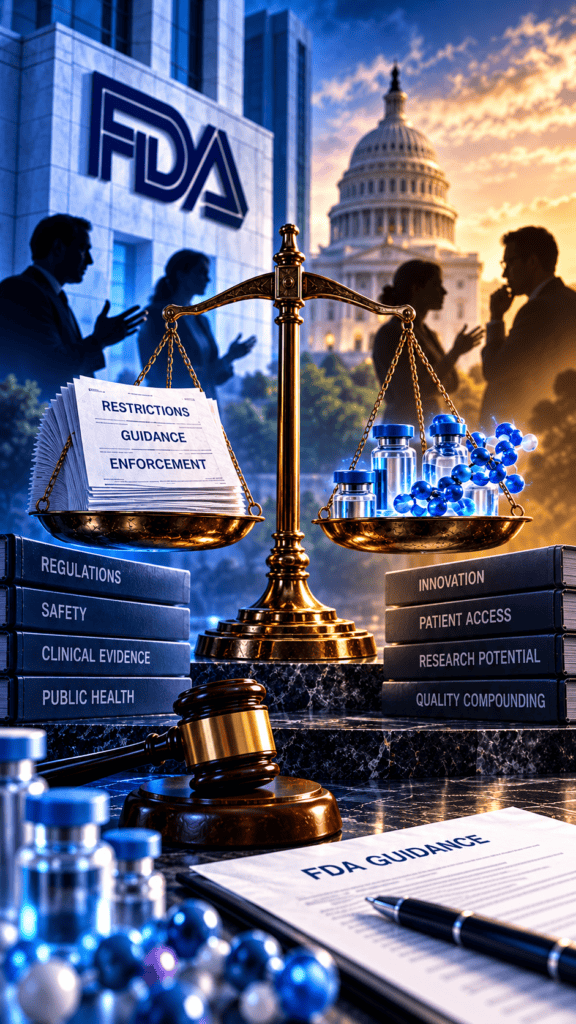
The Debate: Patient Safety, Scientific Evidence & Access
Peptide compounding regulations have generated debate among regulators, healthcare professionals, researchers, and advocates for patient access.
Although these groups may disagree about particular restrictions, the central question is often the same:
How should regulators balance patient safety with access to treatments that have not completed the FDA approval process?
The FDA’s Position: Protecting Patients
The FDA emphasizes that compounded medications do not undergo the same premarket review as FDA-approved drugs.
Its concerns include:
Safety: Limited human studies may leave important risks unknown.
Quality: Impurities, contamination, or inconsistent manufacturing can create additional hazards.
Immune reactions: Certain peptides may trigger unwanted immune responses.
Effectiveness: Promising laboratory findings do not necessarily establish clinical benefits.
These concerns are not purely theoretical. Serious injuries and deaths have occurred following failures in pharmaceutical compounding.
From the FDA’s perspective, restrictions are intended to reduce preventable harm while preserving access to legally compounded medications when patients have legitimate medical needs.
The Other Perspective: Access and Scientific Progress
Some clinicians, researchers, and compounding advocates question whether certain restrictions are appropriately tailored to the available evidence.
Their arguments include:
Limited evidence is not the same as demonstrated harm. An absence of large clinical trials creates uncertainty, but does not automatically prove a substance is dangerous.
Compounding can address unmet needs. Some patients require formulations that commercially available medications cannot provide.
Restrictions may affect access. Removing a substance from an eligible compounding pathway can limit options for patients and practitioners.
Scientific understanding evolves. Supporters of further investigation argue that emerging evidence should be evaluated as it becomes available.
These arguments raise legitimate questions about regulatory flexibility, but they do not establish that a particular unapproved peptide is safe or effective.
Where the Debate Becomes Complicated
A substance may have encouraging laboratory results, limited human research, and unresolved manufacturing or safety concerns—all at the same time.
This creates difficult questions.
How much evidence should be required before a substance can be compounded? When does uncertainty justify restrictions? And how should regulators respond when new research becomes available?
⚠️ IMPORTANT DISTINCTION
There is a difference between no evidence of harm, insufficient evidence to evaluate harm, and evidence demonstrating harm.
These are not interchangeable conclusions.
Finding Common Ground
Patient safety and scientific progress do not have to be opposing goals.
Rigorous research, transparent regulatory decisions, reliable manufacturing standards, and continued evaluation of emerging evidence can support both.
The most productive debate is not simply whether the FDA is right or wrong. It is whether individual regulatory decisions are supported by appropriate evidence, clearly explained, and responsive to new information.
Key Takeaways
FDA approval and compounding eligibility are different. A peptide may be studied scientifically without being approved for medical use or eligible for pharmaceutical compounding.
503A and 503B establish different compounding requirements. Both allow qualifying compounding activities under specific federal conditions.
Categories 1, 2, and 3 are regulatory classifications, not safety ratings. They describe the FDA’s interim approach to certain nominated bulk drug substances.
Regulatory changes require context. Removal from a compounding list does not automatically establish that a peptide is safe, approved, or prohibited for all purposes.
Safety and access are central to the debate. Regulators emphasize patient protection, while some healthcare professionals and advocates question whether particular restrictions appropriately reflect available evidence.
Scientific evidence and regulatory policies can evolve. Understanding a peptide’s status requires examining current FDA decisions, supporting research, and remaining uncertainties.
The Bottom Line
Peptide regulation is more complex than simply labeling substances approved or banned.
Understanding what the evidence demonstrates, what remains uncertain, and why regulatory decisions are made allows for a more informed scientific discussion.
Continue Your Research...
How to Read a COA
Understanding Purity Percentages
How to Read a Scientific Paper
Research Ethics and Methodology
How Does a Compound Become FDA Approved?
References
1. U.S. Food and Drug Administration (FDA). Compounding and the FDA: Questions and Answers.
Explains the purpose of pharmaceutical compounding, its regulatory limitations, and how compounded drugs differ from FDA-approved medications.
https://www.fda.gov/drugs/human-drug-compounding/compounding-and-fda-questions-and-answers
2. U.S. Food and Drug Administration (FDA). Human Drug Compounding Laws.
Outlines Sections 503A and 503B of the Federal Food, Drug, and Cosmetic Act and their respective requirements.
https://www.fda.gov/drugs/human-drug-compounding/compounding-laws-and-policies
3. U.S. Food and Drug Administration (FDA). Bulk Drug Substances Used in Compounding Under Section 503A.
Explains the 503A bulk substances framework, interim categories, and regulatory considerations.
https://www.fda.gov/drugs/human-drug-compounding/bulk-drug-substances-used-compounding-under-section-503a-fdc-act
4. U.S. Food and Drug Administration (FDA). Bulk Drug Substances Used in Compounding Under Section 503B.
Describes ingredient eligibility, clinical-need considerations, and interim policies for outsourcing facilities.
https://www.fda.gov/drugs/human-drug-compounding/bulk-drug-substances-used-compounding-under-section-503b-fdc-act
5. U.S. Food and Drug Administration (FDA). Interim Policy on Compounding Using Bulk Drug Substances Under Section 503A. January 2025.
Provides the updated federal guidance governing interim enforcement discretion and the treatment of newly nominated substances.
https://www.fda.gov/regulatory-information/search-fda-guidance-documents/interim-policy-compounding-using-bulk-drug-substances-under-section-503a-federal-food-drug-and
6. U.S. Food and Drug Administration (FDA). *Certain Bulk Drug Substances for Use in Compounding That May
Research Disclaimer
The information provided in this guide is intended solely for educational and research purposes. It is designed to help readers understand common laboratory analytical terminology and should not be interpreted as medical advice or as a statement regarding the safety, efficacy, or intended use of any research material.
Understanding FDA Peptide Regulations: Categories, Compounding & the Debate
At a Glance
Reading Time: 9-11 minutes
You’ll Learn
- The difference between FDA-approved medications, compounded drugs, and research compounds.
- How the FDA’s 503A and 503B compounding frameworks work.
- What Category 1, Category 2, and Category 3 mean—and what they don’t.
- Why a peptide’s regulatory classification may change.
- The FDA’s stated safety concerns and the arguments raised by compounding stakeholders.
- How to distinguish regulatory decisions from scientific evidence.
You’ll Learn
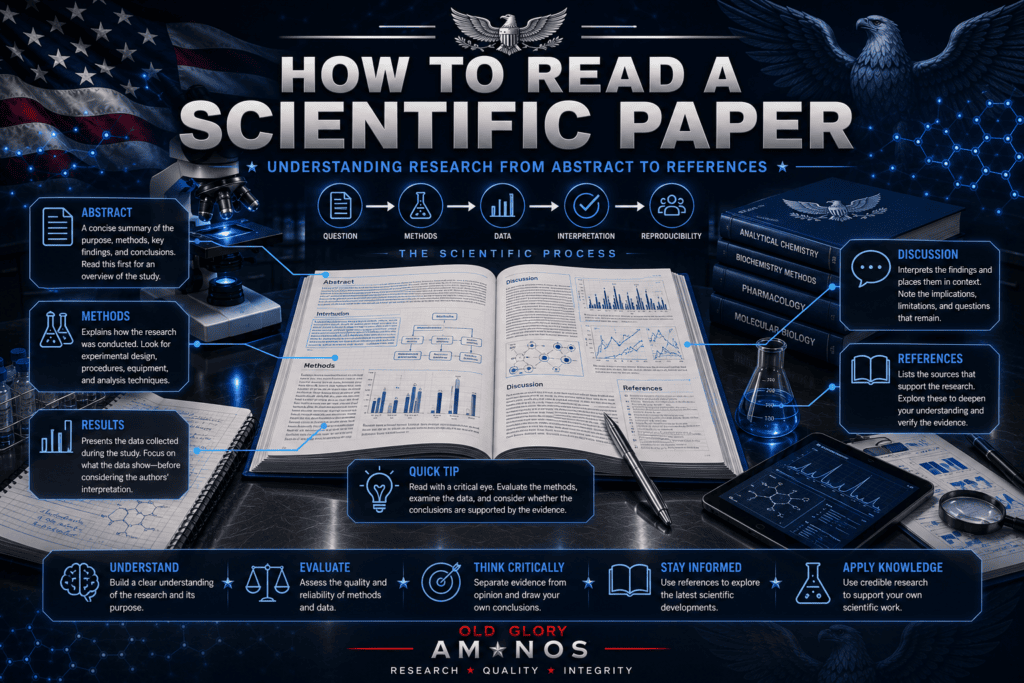
- The major sections found in most scientific papers
- Which sections to read first
- How to distinguish conclusions from evidence
- Why methods and references matter
- Tips for evaluating research critically
Introduction
Why Are Peptide Regulations So Complicated?
Two peptides may be studied for similar biological purposes, yet face very different regulatory circumstances.
One might be an ingredient in an FDA-approved medication. Another might be undergoing clinical trials. A third might appear on an FDA compounding-related list despite having published laboratory research behind it.
Why the differences?
Because FDA approval, eligibility for pharmaceutical compounding, and permission to conduct scientific research are separate regulatory questions.
Compounding involves preparing medications for particular medical needs under specific legal conditions. It is not the same as manufacturing an FDA-approved drug, and it is not the same as producing a substance solely for laboratory research.
Confusion often arises when FDA compounding classifications are described as if they were universal judgments about a compound’s scientific value or safety.
In reality, those classifications serve particular regulatory purposes.
Understanding these distinctions is essential before examining the ongoing debate over peptide restrictions, patient access, and the evidence regulators rely upon.
🔬 RESEARCH NOTE
A peptide’s inclusion on—or removal from—an FDA compounding-related list does not automatically mean the compound has been approved, banned for all purposes, or proven safe or unsafe.
Its actual regulatory status depends on the applicable law, the specific substance, and the circumstances in which it is manufactured or used.
FDA-Approved Drugs vs. Compounded Medications vs. Research Compounds
Not all peptides fall under the same regulatory framework. Understanding three key distinctions helps explain why their legal status can differ.
FDA-Approved Drugs
FDA-approved drugs have undergone regulatory review demonstrating that their benefits outweigh their known risks for specific medical uses.
Approval applies to a particular drug product and its approved uses—not automatically to every product containing the same compound.
Compounded Medications
Compounded medications are prepared by combining, mixing, or altering ingredients to meet particular medical needs.
Unlike FDA-approved drugs, compounded medications do not undergo individual FDA review for safety, effectiveness, or quality before marketing.
They must meet applicable legal requirements, including those governing eligible ingredients and compounding practices.
Research Compounds
Research compounds are substances investigated to understand their biological properties and potential applications.
Some have extensive published research; others remain in early development. Neither circumstance automatically establishes FDA approval or eligibility for pharmaceutical compounding.
A “Research Use Only” label also does not, by itself, exempt a product from drug regulations.
⚠️ IMPORTANT DISTINCTION
FDA approval, pharmaceutical compounding eligibility, and scientific research are separate regulatory matters. Restrictions affecting one activity do not necessarily prohibit every other lawful use of a substance.
Understanding 503A and 503B: Two Different Compounding Frameworks
Federal law establishes two primary pathways for human drug compounding: Section 503A and Section 503B of the Federal Food, Drug, and Cosmetic Act.
Both allow qualifying compounded medications to receive exemptions from certain federal drug requirements, but they serve different purposes and operate under different conditions.
Section 503A: Traditional Pharmacy Compounding
Section 503A generally applies to licensed pharmacists working in state-licensed pharmacies or federal facilities, and to licensed physicians who compound medications.
This framework primarily addresses medications prepared for individual patients based on valid prescriptions.
Under certain conditions, limited compounding may occur before a prescription is received, based on an established history of patient-specific prescriptions.
503A compounding remains subject to applicable state oversight and federal requirements.
Section 503B: Outsourcing Facilities
Section 503B applies to facilities registered with the FDA as outsourcing facilities.
Unlike traditional 503A compounding, qualifying 503B facilities may compound medications without first receiving individual patient prescriptions.
These facilities are subject to additional federal requirements, including current good manufacturing practice (CGMP) standards, FDA inspections, and adverse-event reporting obligations.
How Do They Compare?
| Feature | Section 503A | Section 503B |
|---|---|---|
| Primary setting | Traditional pharmacy or physician compounding | FDA-registered outsourcing facility |
| Patient-specific prescription | Generally required | Not required |
| FDA registration as outsourcing facility | Not required | Required |
| Federal CGMP requirements | Qualifying drugs are exempt | Apply |
| FDA approval of individual compounded drugs | Not required under qualifying exemption | Not required under qualifying exemption |
Why This Matters for Peptides
Neither framework gives pharmacies unrestricted permission to compound any substance.
When a compounder uses a bulk drug substance—an active ingredient used to prepare a medication—specific legal eligibility requirements apply.
These requirements differ between 503A and 503B. A substance’s eligibility under one framework does not automatically establish eligibility under the other.
This distinction is particularly important when interpreting FDA announcements about peptide compounding.
⚠️ IMPORTANT DISTINCTION
503A and 503B are legal compounding frameworks, not classifications of peptide safety or effectiveness.
Neither framework makes an individual compounded medication FDA-approved.
What Do FDA Categories 1, 2, and 3 Actually Mean?
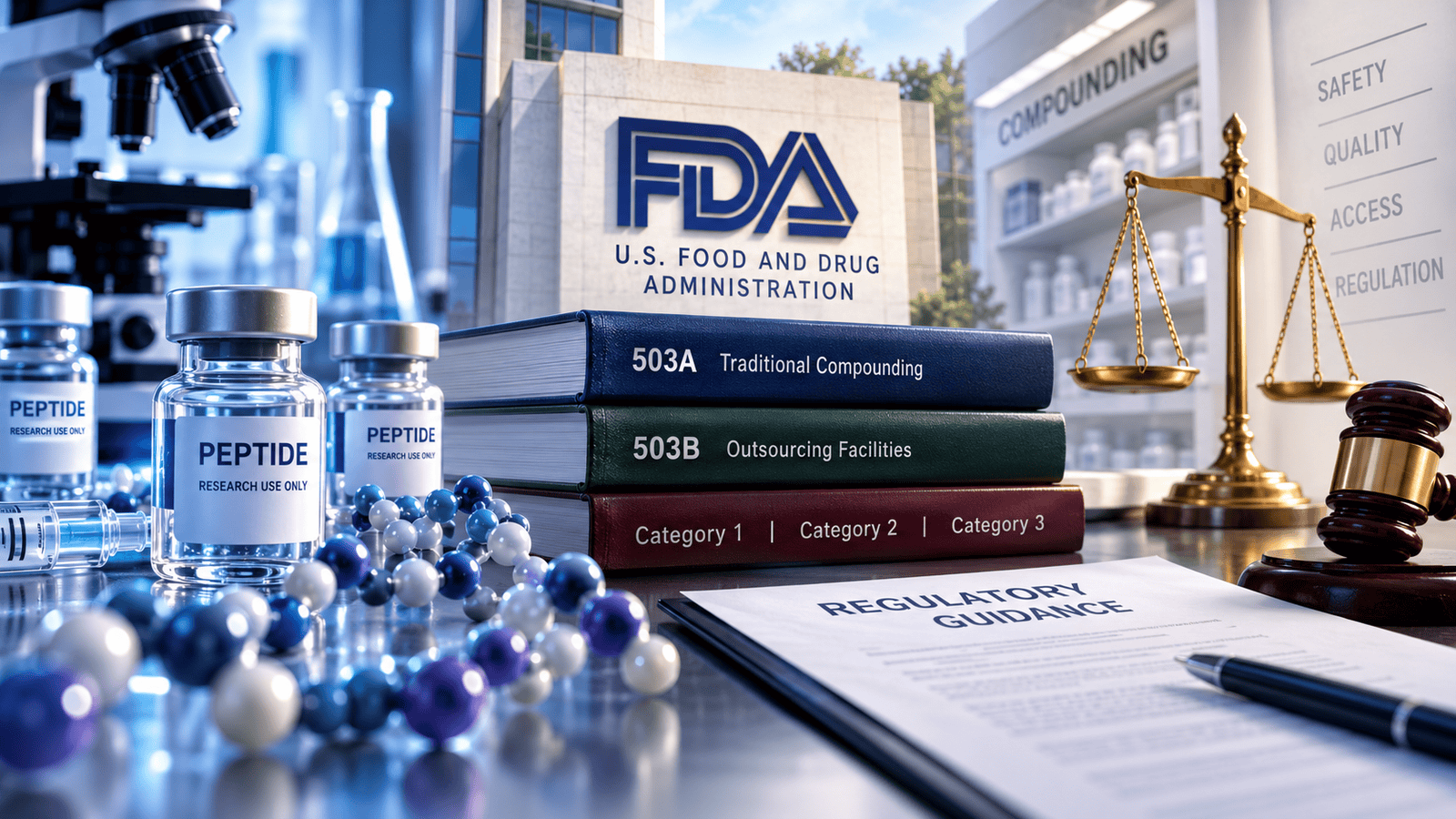
The FDA developed three interim categories to organize certain bulk drug substances nominated for pharmaceutical compounding under Section 503A.
These categories describe regulatory status—not FDA approval or a universal ranking of safety and effectiveness.
Category 1: Under Evaluation
Substances nominated with sufficient information for FDA evaluation.
Qualifying compounders may receive temporary enforcement discretion under specific conditions while the FDA considers these substances.
Category 1 does not mean FDA-approved or proven safe.
Category 2: Significant Safety Concerns
Substances for which the FDA has identified potential significant safety risks associated with compounding.
These substances do not qualify for the Category 1 interim enforcement policy.
Category 2 does not mean every possible research use has been prohibited.
Category 3: Insufficient Information
Substances whose nominations lacked sufficient supporting information for FDA evaluation.
Additional documentation may be submitted through a new nomination.
Category 3 does not necessarily indicate a finding of danger or ineffectiveness.
Can These Classifications Change?
Yes. Categories may change following nomination withdrawals, additional review, or regulatory decisions.
In January 2025, the FDA revised its interim policy so that newly nominated substances w
Why Do Peptides Move On or Off FDA Compounding Lists?
FDA compounding lists can change as new evidence emerges, nominations are withdrawn, or regulatory reviews are completed.
However, a change in classification does not necessarily represent a new finding about a substance’s safety.
Why Do Changes Happen?
1. Safety Concerns
The FDA may identify potential risks involving impurities, immune reactions, manufacturing quality, or other safety considerations.
2. Withdrawn Nominations
A substance may be removed from an interim category because its nomination was withdrawn.
For example, BPC-157 was removed from Category 2 following withdrawal of its nominations. This did not mean the FDA had approved the peptide or reversed its previously identified safety concerns.
3. Regulatory Decisions
Following scientific review and consideration of clinical needs, the FDA may decide whether a substance qualifies for inclusion on an official compounding list.
Why Context Matters
A withdrawn nomination, a safety concern, and a final regulatory decision are three different events.
Rather than asking only whether a peptide was removed from a list, researchers should ask:
Why was it removed, and what did that decision actually change?
🔬 RESEARCH NOTE
FDA compo

The Debate: Patient Safety, Scientific Evidence & Access
Peptide compounding regulations have generated debate among regulators, healthcare professionals, researchers, and advocates for patient access.
Although these groups may disagree about particular restrictions, the central question is often the same:
How should regulators balance patient safety with access to treatments that have not completed the FDA approval process?
The FDA’s Position: Protecting Patients
The FDA emphasizes that compounded medications do not undergo the same premarket review as FDA-approved drugs.
Its concerns include:
Safety: Limited human studies may leave important risks unknown.
Quality: Impurities, contamination, or inconsistent manufacturing can create additional hazards.
Immune reactions: Certain peptides may trigger unwanted immune responses.
Effectiveness: Promising laboratory findings do not necessarily establish clinical benefits.
These concerns are not purely theoretical. Serious injuries and deaths have occurred following failures in pharmaceutical compounding.
From the FDA’s perspective, restrictions are intended to reduce preventable harm while preserving access to legally compounded medications when patients have legitimate medical needs.
The Other Perspective: Access and Scientific Progress
Some clinicians, researchers, and compounding advocates question whether certain restrictions are appropriately tailored to the available evidence.
Their arguments include:
Limited evidence is not the same as demonstrated harm. An absence of large clinical trials creates uncertainty, but does not automatically prove a substance is dangerous.
Compounding can address unmet needs. Some patients require formulations that commercially available medications cannot provide.
Restrictions may affect access. Removing a substance from an eligible compounding pathway can limit options for patients and practitioners.
Scientific understanding evolves. Supporters of further investigation argue that emerging evidence should be evaluated as it becomes available.
These arguments raise legitimate questions about regulatory flexibility, but they do not establish that a particular unapproved peptide is safe or effective.
Where the Debate Becomes Complicated
A substance may have encouraging laboratory results, limited human research, and unresolved manufacturing or safety concerns—all at the same time.
This creates difficult questions.
How much evidence should be required before a substance can be compounded? When does uncertainty justify restrictions? And how should regulators respond when new research becomes available?
⚠️ IMPORTANT DISTINCTION
There is a difference between no evidence of harm, insufficient evidence to evaluate harm, and evidence demonstrating harm.
These are not interchangeable conclusions.
Finding Common Ground
Patient safety and scientific progress do not have to be opposing goals.
Rigorous research, transparent regulatory decisions, reliable manufacturing standards, and continued evaluation of emerging evidence can support both.
The most productive debate is not simply whether the FDA is right or wrong. It is whether individual regulatory decisions are supported by appropriate evidence, clearly explained, and responsive to new information.
Key Takeaways
FDA approval and compounding eligibility are different. A peptide may be studied scientifically without being approved for medical use or eligible for pharmaceutical compounding.
503A and 503B establish different compounding requirements. Both allow qualifying compounding activities under specific federal conditions.
Categories 1, 2, and 3 are regulatory classifications, not safety ratings. They describe the FDA’s interim approach to certain nominated bulk drug substances.
Regulatory changes require context. Removal from a compounding list does not automatically establish that a peptide is safe, approved, or prohibited for all purposes.
Safety and access are central to the debate. Regulators emphasize patient protection, while some healthcare professionals and advocates question whether particular restrictions appropriately reflect available evidence.
Scientific evidence and regulatory policies can evolve. Understanding a peptide’s status requires examining current FDA decisions, supporting research, and remaining uncertainties.
The Bottom Line
Peptide regulation is more complex than simply labeling substances approved or banned.
Understanding what the evidence demonstrates, what remains uncertain, and why regulatory decisions are made allows for a more informed scientific discussion.
Continue Your Research....
How to Read a COA
Understanding Purity Percentages
Research Ethics and Methodology
How to Read a Scientific Paper
How Does a Compound Become FDA Approved?
References
1. U.S. Food and Drug Administration (FDA). Compounding and the FDA: Questions and Answers.
Explains the purpose of pharmaceutical compounding, its regulatory limitations, and how compounded drugs differ from FDA-approved medications.
https://www.fda.gov/drugs/human-drug-compounding/compounding-and-fda-questions-and-answers
2. U.S. Food and Drug Administration (FDA). Human Drug Compounding Laws.
Outlines Sections 503A and 503B of the Federal Food, Drug, and Cosmetic Act and their respective requirements.
https://www.fda.gov/drugs/human-drug-compounding/compounding-laws-and-policies
3. U.S. Food and Drug Administration (FDA). Bulk Drug Substances Used in Compounding Under Section 503A.
Explains the 503A bulk substances framework, interim categories, and regulatory considerations.
https://www.fda.gov/drugs/human-drug-compounding/bulk-drug-substances-used-compounding-under-section-503a-fdc-act
4. U.S. Food and Drug Administration (FDA). Bulk Drug Substances Used in Compounding Under Section 503B.
Describes ingredient eligibility, clinical-need considerations, and interim policies for outsourcing facilities.
https://www.fda.gov/drugs/human-drug-compounding/bulk-drug-substances-used-compounding-under-section-503b-fdc-act
5. U.S. Food and Drug Administration (FDA). Interim Policy on Compounding Using Bulk Drug Substances Under Section 503A. January 2025.
Provides the updated federal guidance governing interim enforcement discretion and the treatment of newly nominated substances.
https://www.fda.gov/regulatory-information/search-fda-guidance-documents/interim-policy-compounding-using-bulk-drug-substances-under-section-503a-federal-food-drug-and
6. U.S. Food and Drug Administration (FDA). *Certain Bulk Drug Substances for Use in Compounding That May
Research Disclaimer
The information provided in this guide is intended solely for educational and research purposes. It is designed to help readers understand common laboratory analytical terminology and should not be interpreted as medical advice or as a statement regarding the safety, efficacy, or intended use of any research material.